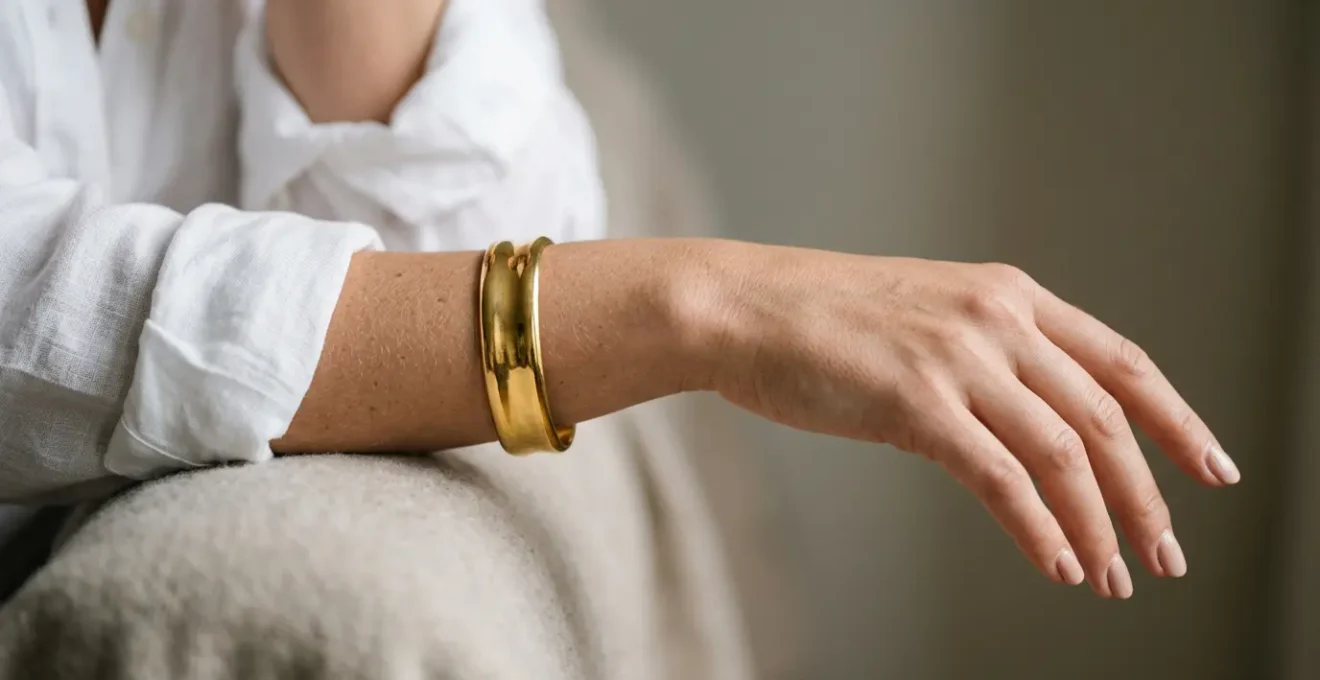
A single gold cuff is the most effective tool for curating a minimalist look, acting as a visual anchor that provides structure and eliminates the need for other accessories.
- It creates an intentional focal point, adding authority and polish to even the simplest outfits.
- Choosing the right material (solid gold) and finish (hammered) makes it a durable, cost-effective investment that improves with age.
Recommendation: Measure your wrist for a precise, non-spinning fit and wear it as your sole statement piece to maximize impact and minimize clutter.
The core promise of a capsule wardrobe is simplicity—a curated collection of items that work harmoniously to reduce decision fatigue. Yet, for many minimalists, the realm of accessories becomes a new source of clutter. The conventional wisdom is to build a “jewelry capsule” with delicate chains, simple studs, a classic watch, and perhaps a ring or two. While logical, this approach can inadvertently recreate the very problem it aims to solve: too many choices, too many small pieces competing for attention, and a lack of a clear statement.
This collection-based mindset often overlooks a more powerful, singular strategy. What if the key to an effortlessly polished look wasn’t an assortment of discreet items, but one definitive piece that could anchor an entire wardrobe? What if the solution wasn’t about building a collection, but about identifying the one accessory with enough presence and structure to stand alone? This is where the gold cuff transcends its role as mere ornamentation and becomes a strategic tool.
The right gold cuff is not just another bracelet; it’s an architectural anchor. It provides visual weight, conveys intention, and offers a point of focus that elevates everything from a simple t-shirt to a silk blouse. It’s a piece of visual punctuation in the sentence of your outfit. This guide will deconstruct the philosophy of the single cuff, exploring how to choose the perfect one, style it with precision, and leverage it as the cornerstone of a truly minimalist, high-impact aesthetic.
To help you master this singular approach, this article breaks down the essential considerations, from the technicalities of fit to the philosophy of styling. Explore the sections below to understand how one piece can redefine your entire look.
Summary: Why a Gold Cuff Is the Ultimate Capsule Wardrobe Accessory
- How to Measure Your Wrist so the Cuff Doesn’t Spin Around?
- Cuff Over Sleeve: How to Keep It in Place on a Silk Shirt?
- Hammered vs. Polished: Which Finish Hides Scratches Better?
- Watch and Cuff: How to Stack Without Scratching the Watch Case?
- Solid Gold vs. Vermeil: Is the Price Difference Justified for a Cuff?
- Gold vs. Silver: The Test That Reveals Your True Metal Match in 5 Minutes
- Why Clean Nails Matter More Than Shoes in a Minimalist Look?
- How to Style Oversized Jewelry Without Looking Cluttered at Work?
How to Measure Your Wrist so the Cuff Doesn’t Spin Around?
The power of a statement cuff is immediately nullified if it’s constantly spinning, clanking, or sliding down your forearm. A perfect fit is the non-negotiable foundation of this minimalist strategy. An ill-fitting cuff looks accidental, not intentional. The goal is a secure placement that feels like a part of you, sitting gracefully just above the wrist bone without constriction. This requires a precise measurement that accounts for not just the circumference, but the unique shape of your wrist.
Many people have an oval-shaped wrist profile rather than a perfectly round one. Understanding this is key to selecting a cuff that conforms to your anatomy and resists rotation. An oval cuff on an oval wrist will lock into place naturally. To achieve this, follow a methodical measurement process:
- Use a flexible measuring tape or a strip of paper. Wrap it around the widest part of your wrist, which is typically just below the prominent wrist bone.
- The tape should be snug but not tight. You should be able to comfortably slip one finger between the tape and your skin.
- Mark the measurement. For a cuff that will have some movement, choose a size equal to this circumference. For a snugger fit that stays put, select a cuff that is up to a half-inch smaller than your wrist measurement, as it will have an opening.
- Pay attention to the cuff’s width. A wider cuff (over one inch) occupies more space and may require you to size up slightly for comfort, even if you desire a snug fit.
This simple process ensures your chosen piece acts as a confident anchor, not a distracting nuisance. The visual below highlights how the wrist’s natural anatomy influences the fit.
As this detail shows, the subtle contours of the wrist are what a well-fitted cuff should follow. By taking a precise measurement, you are ensuring the cuff works with your body’s natural form, creating a seamless and sophisticated look that feels custom-made. It is the first step toward making the cuff a true extension of your personal style.
Cuff Over Sleeve: How to Keep It in Place on a Silk Shirt?
Wearing a cuff over a sleeve, particularly on a fluid fabric like silk or fine cashmere, is a sophisticated power move. It projects confidence and a high-fashion sensibility. However, it presents a significant practical challenge: how to prevent the cuff from sliding down the slippery material. The secret lies not in force, but in technique and a strategic understanding of fabric and jewelry mechanics. A cuff that stays perfectly placed over a sleeve demonstrates a mastery of style.
Forget simply clamping the cuff tighter, which can damage both the cuff and the fabric. Professional stylists and jewelers use specific methods to ensure a secure fit without compromising the integrity of the piece. One of the most effective techniques involves both how you put the cuff on and where you position it.
Case Study: The Professional “Roll-On” and “Anchor” Method
Jewelry experts advocate for the ‘roll-on’ technique to preserve the cuff’s shape and ensure a snug fit. To do this, you turn your hand so the thumb is pointing up, exposing the thinnest part of your wrist. You then place the cuff’s opening on this narrow point, about an inch back from the wrist joint, and gently rotate the cuff into place over the radius bone. This method prevents the metal fatigue that comes from repeatedly prying the cuff open. When applying this over a sleeve, the key is to position the cuff just above a natural fabric anchor point, such as the edge of a shirt’s placket or an elasticated sleeve end. These features provide a subtle ridge that stops the cuff from sliding down, allowing it to sit securely and intentionally.
By leveraging these subtle structural elements of your garment, you create a stable platform for the cuff. This transforms the look from a precarious balancing act into a deliberate and stable styling choice. The cuff and the garment work together, creating a cohesive and polished silhouette that looks and feels secure throughout the day.
Hammered vs. Polished: Which Finish Hides Scratches Better?
When selecting a single gold cuff to serve as the architectural anchor of your wardrobe, its ability to withstand daily life is paramount. This isn’t a delicate piece to be reserved for special occasions; it’s a workhorse. The finish of the gold—whether mirror-polished or textured—plays a crucial role in its long-term beauty and maintenance. While a high-polish finish offers an initial burst of flawless glamour, it’s also a pristine canvas for every inevitable scratch and scuff.
A polished finish reflects light beautifully but is notoriously unforgiving. Every minor impact from a desk, a countertop, or even other jewelry will be visible as a micro-scratch, slowly dulling its perfect surface. For a perfectionist, this can lead to constant worry and frequent trips to the jeweler for re-polishing, which contradicts the minimalist ethos of ease and low maintenance.
Conversely, a hammered or satin finish is designed for life. These textured surfaces are inherently forgiving because they already consist of multiple facets and intentional imperfections. A new scratch simply blends into the existing pattern, becoming part of the cuff’s evolving character rather than a flaw. A hammered finish, in particular, celebrates the interaction of light and shadow, and its appearance remains consistent and beautiful even with years of wear. It embraces patina, telling the story of its journey with you. For a signature piece meant for constant wear, a textured finish is the smarter, more practical, and ultimately more minimalist choice.
Watch and Cuff: How to Stack Without Scratching the Watch Case?
For the minimalist who already has a signature watch, the idea of adding a cuff can seem daunting. The primary concern is practical: how to combine two substantial metal pieces on one wrist without causing scratches and damage, particularly to the softer gold of a watch case or the cuff itself. While wearing them on opposite wrists is the safest option, stacking them can create a powerful, unified statement if done with care and strategic knowledge. The key is to create separation or leverage the hierarchy of material hardness.
Metal-on-metal contact is the enemy of a pristine finish. A stainless steel watch case is significantly harder than an 18k gold cuff and will inevitably scratch it over time. Conversely, a steel cuff could damage a gold watch. To prevent this, you must either create a physical barrier or ensure the pieces don’t interact. This requires a more thoughtful approach than simply sliding a bracelet next to your watch.
Applying a few simple rules can protect your investment pieces while allowing you to achieve a sophisticated stacked look. It’s about curating the space on your wrist with the same intention you apply to the rest of your wardrobe. The following checklist provides a clear framework for safe and stylish stacking.
Your 5-Point Checklist for Safe Stacking
- The ‘Opposite Wrists Power Move’: The simplest and safest method. Wear your watch on one wrist and the cuff on the other. This creates visual balance and completely eliminates the risk of contact.
- The ‘Buffer Zone’: If stacking on the same wrist, place a thin bracelet made of a soft material like woven leather or fabric between the metal watch and the metal cuff. This acts as a physical shock absorber.
- Material Hardness Hierarchy: Understand that harder metals scratch softer ones. An 18k gold cuff (softer) is less likely to damage a hard stainless steel watch. Never stack a steel cuff next to a solid gold watch.
- Mohs Scale Awareness: Remember the science. Gold has a Mohs hardness of 2.5-3, while stainless steel is around 5.5. Always pair accordingly to protect the softer, more valuable metal from damage.
- Positional Separation: If stacking without a buffer, ensure the cuff sits higher on your forearm, away from the watch case. This physical distance minimizes contact and clanking during daily movements.
By internalizing these techniques, you can confidently integrate a cuff into your look without sacrificing the condition of your beloved watch. It transforms stacking from a risk into a calculated and elegant style choice.
Solid Gold vs. Vermeil: Is the Price Difference Justified for a Cuff?
The choice between solid gold and gold vermeil is one of the most critical decisions when investing in a signature cuff. On the surface, vermeil—a thick layer of gold over a sterling silver base—offers an attractive, budget-friendly entry point. However, for a piece intended to be an architectural anchor worn daily for years, the initial savings can be a false economy. The justification for solid gold lies not in its price tag, but in its permanence and long-term value, a concept central to the minimalist’s cost-per-wear philosophy.
A solid gold cuff is an heirloom. It does not tarnish or fade, and its color is consistent throughout the entire piece. Scratches can be polished out indefinitely, and it develops a beautiful patina over time that tells a personal story. It is a one-time purchase that lasts a lifetime and beyond. Gold vermeil, by contrast, has a finite lifespan. The gold plating, even when thick, will inevitably wear away at high-contact points, exposing the sterling silver base. This wear can begin within 2-3 years of daily use, leading to a bicolored appearance and the need for costly re-plating or replacement. The following table breaks down this crucial distinction, as detailed in a recent comparative analysis of gold jewelry types.
| Factor | Solid Gold | Gold Vermeil |
|---|---|---|
| Composition | Same gold alloy throughout (typically 14K or 18K) | Sterling silver base with 2.5+ microns of gold plating |
| Durability for Daily Wear | Does not tarnish or fade with repeated wear; lasts a lifetime | Gold layer wears away at contact points (desk, skin) over 2-3 years |
| Maintenance | Simple care; can be re-polished indefinitely to restore shine | Requires delicate care; plating can expose base silver when worn through |
| Heirloom Potential | Multi-generational investment; holds intrinsic metal value | Not suitable as heirloom; finite lifespan due to plating wear |
| Initial Cost | Higher upfront investment | More affordable entry point; budget-friendly option |
| Cost-Per-Wear (10 years) | Lower long-term cost when worn daily for a decade | Higher overall cost if replacement needed every 2-3 years |
| Skin Reactions | No risk of exposed base metal causing reactions | Worn plating can reveal sterling silver, potential for tarnish or sensitivity |
While the upfront cost of solid gold is higher, its cost-per-wear over a decade is significantly lower than replacing a vermeil piece multiple times. It embodies the “buy once, cry once” principle.
This visual contrast between a pristine new surface and one with a rich, lived-in patina perfectly illustrates the beauty of solid gold’s journey. The wear is not a flaw; it’s a feature. For a true capsule wardrobe cornerstone, the permanence and graceful aging of solid gold make the investment not just justified, but essential.
Gold vs. Silver: The Test That Reveals Your True Metal Match in 5 Minutes
Before committing to a significant piece like a gold cuff, it’s essential to confirm that gold is indeed your most flattering metal. While personal preference is important, the “right” metal is often the one that harmonizes with your skin’s natural undertones, making your complexion look brighter and more vibrant. Silver and gold interact with light and skin differently, and choosing the one that complements you best is a hallmark of sophisticated, intentional style. Luckily, you don’t need a professional consultation to figure this out; a simple five-minute self-test is all it takes.
The most reliable method is the “vein test.” Look at the veins on the inside of your wrist in natural daylight.
- If your veins appear predominantly green or olive, you likely have warm undertones. Gold jewelry will be especially flattering, bringing out the warmth in your skin.
- If your veins look blue or purple, you have cool undertones. Silver, platinum, and white gold will likely be your best match, as they complement the cool tones.
- If you can’t clearly distinguish between blue or green, you may have neutral undertones, meaning you can wear both gold and silver with ease.
This quick diagnostic ensures your investment piece will enhance your natural radiance. While silver has its own minimalist appeal, the current mood in fashion strongly favors the warmth and subtle luxury of gold. In fact, a 2024 industry trend analysis reveals that Millennial and Gen Z consumers are driving demand for minimalist gold jewelry, valuing its versatility and understated polish over more ostentatious displays.
Choosing gold, therefore, is not only a choice that may align with your skin tone but also one that places your style firmly in the contemporary minimalist conversation. It’s a choice that feels both classic and current, making it the ideal metal for a defining accessory.
Why Clean Nails Matter More Than Shoes in a Minimalist Look?
In a minimalist aesthetic, every detail is magnified. When you strip away excess, the elements that remain carry more weight. While well-chosen shoes are undoubtedly important, a statement gold cuff performs a unique function: it acts as a powerful directional tool, drawing the eye with intention to one specific area of the body—the hands. Consequently, the state of your hands and nails is elevated from a minor grooming detail to a critical component of your overall presentation. An expensive cuff on a hand with unkempt nails creates a jarring dissonance that undermines the entire look.
Think of the cuff as a frame and your hand as the artwork. A beautiful frame cannot save a neglected painting. The polished gold serves to highlight, and what it highlights is the care and attention you give to yourself. Clean, shaped, and healthy-looking nails—whether bare, buffed, or painted with a neutral polish—signal intentionality and self-respect. They complete the story that the cuff begins: a story of polish, control, and an appreciation for quiet luxury.
This idea is a cornerstone of advanced minimalist styling, where accessories are used to guide the viewer’s gaze. As one expert from Filigree Jewelers notes in a guide to building a capsule jewelry wardrobe:
A statement cuff is a directional arrow pointing directly to the hands. It intentionally draws the eye, so well-maintained nails become part of the accessory.
– Capsule Jewelry Wardrobe Expert, Filigree Jewelers Blog
This insight is profound. The cuff and your nails are not two separate items; they form a single, cohesive statement. In a minimalist context where you wear very little jewelry, this single focal point becomes incredibly powerful. Investing a few minutes in nail care delivers a higher return on style investment than almost any other detail, ensuring your architectural anchor has a worthy foundation.
Key Takeaways
- The single gold cuff serves as an “architectural anchor,” providing structure and a focal point that eliminates the need for other accessories.
- A precise fit based on your wrist’s unique shape and a textured finish like hammered gold are crucial for comfortable, low-maintenance daily wear.
- Investing in solid gold over vermeil is a more sustainable and cost-effective choice in the long run, aligning with a minimalist “cost-per-wear” philosophy.
How to Style Oversized Jewelry Without Looking Cluttered at Work?
The term “oversized jewelry” can be intimidating in a professional context, often conjuring images of distracting, clunky accessories ill-suited for the office. However, this is where a fundamental re-framing is necessary. A single, substantial gold cuff is not “oversized jewelry” in the cluttered sense; it is the strategic antidote to clutter. It operates on the “one-piece rule,” providing a singular point of focus that reads as confident and intentional, not busy. Its growing presence on runways confirms its status as a key piece for a modern wardrobe.
The power of the cuff in a work setting is its ability to communicate authority and polish with unparalleled efficiency. It grounds an outfit, adding structure to simple knits or providing a flash of brilliance against a dark blazer. According to NET-A-PORTER’s fine jewelry buyer, cuffs are a key piece for modern capsule collections, with designers favoring big, bold statement pieces for their ability to define a look. The key is to leverage this boldness without creating a distraction.
Case Study: The ‘One-Piece Rule’ and the ‘Sleeve Peek’
The philosophy of a capsule jewelry wardrobe, as championed by experts at Filigree Jewelers, positions a substantial cuff as a ‘visual anchor.’ Instead of adding to a cluttered look, it consolidates focus into a single, powerful statement. This one-piece approach is inherently minimalist. In conservative office environments, the ‘sleeve peek’ strategy is particularly effective. By allowing just an inch or so of the gold cuff to show from beneath a blazer or shirt sleeve, you create a subtle flash of personal style and confidence. It’s not an overt display but a curated glimpse that speaks volumes, conveying authority without demanding attention.
By embracing the cuff as your sole accessory, you are not wearing “oversized” jewelry. You are making a single, decisive style choice that eliminates visual noise. This singular focus is the essence of a powerful minimalist aesthetic at work, proving that one well-chosen piece has more impact than a handful of smaller, less significant ones.
Embracing the single gold cuff is more than a style choice; it’s a commitment to a philosophy of intention and efficiency. By selecting one powerful, permanent piece to anchor your look, you free yourself from the daily calculus of accessorizing and step into a more confident, streamlined, and polished version of your personal style. Start by finding the one that speaks to you.