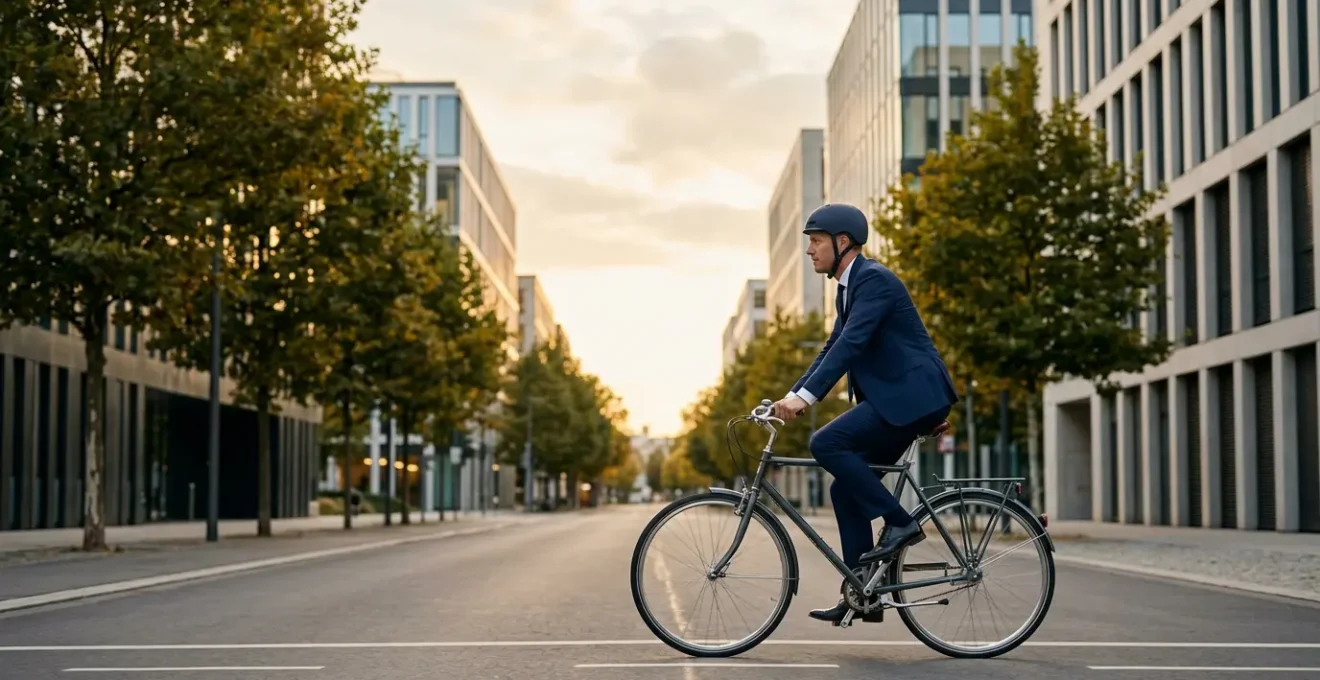
The common belief is that cycling in a suit requires compromising either your style or your comfort. The reality is that by investing in a curated system of high-performance materials and gear, you eliminate the need for compromise entirely.
- Material intelligence—understanding fabric breathability, moisture-wicking properties, and durability—is more important than brand names for staying fresh and sharp.
- Modern functional fashion integrates « stealth tech » like subtle reflective elements and advanced textiles, allowing you to maintain a professional aesthetic without sacrificing safety or performance.
Recommendation: Shift your mindset from « protecting » a standard suit to building a versatile, functional wardrobe where each piece is engineered for the dual demands of the commute and the office.
The urban professional’s dilemma is a modern classic: how to embrace the health, environmental, and mental benefits of a bike commute without arriving at the office looking like you’ve just completed a stage of the Tour de France. The usual advice—roll up your trousers, pack a change of clothes, cycle at a glacial pace—treats the problem defensively. It positions your professional attire as a fragile liability to be protected from the rigors of the journey. This approach is fundamentally flawed because it forces a choice between practicality and elegance.
What if the solution wasn’t about compromise, but about curation? What if, instead of viewing your suit as the problem, we viewed it as the starting point for a smarter, more integrated wardrobe? This guide rejects the notion that you must sacrifice style for function. Instead, it offers a new perspective: by understanding the principles of material science, ergonomic design, and « functional elegance, » you can build a commute-ready ecosystem that not only preserves your professional image but actively enhances it. It’s about selecting pieces that are inherently designed for this dual life, turning your daily journey into a seamless, stylish, and invigorating part of your day.
This article will deconstruct the key challenges of the suited cyclist and provide expert, actionable solutions. We will explore everything from the right fabrics to resist wrinkles and odor to the gear that carries your life without compromising your posture or your aesthetic, proving that you can, and should, have it all.
Summary: A Suited Cyclist’s Manual to Functional Elegance
- Gore-Tex in the City: Is It Overkill for a Rainy Commute?
- Sneakers with Suits: Which Brand Is Acceptable in a Law Firm?
- Backpack vs. Messenger Bag: Which One Causes Less Back Pain?
- The « Gym-to-Desk » Kit: How to Pack Minimal Gear for Lunch Workouts?
- Visibility vs. Style: How to Be Seen at Night Without Wearing a Vest?
- Silk vs. Polyester: Which Material Actually Breeds Bacteria in Summer?
- Subway or Walk: How 30 Minutes of Commuting Burns More than the Gym?
- Why Investing in Cashmere and Silk Saves You Money After 3 Years?
Gore-Tex in the City: Is It Overkill for a Rainy Commute?
When faced with a downpour, the instinct is to reach for the most powerful waterproofing technology available, often leading to a bulky, expedition-grade Gore-Tex jacket. For the urban professional, this can be a stylistic and functional misstep. The core challenge of a city commute isn’t just staying dry from the outside, but also managing heat and moisture from the inside. A high-end mountaineering jacket is designed for extreme conditions, and its formidable membrane might not offer the breathability needed for even a low-intensity ride, leaving you damp with your own sweat.
The key is not the brand name, but the principle of material intelligence. For short, low-intensity commutes, a jacket’s breathability rating can be lower. In fact, a rating under 10,000g/m² is acceptable if the garment has other ways to ventilate. This is where functional design surpasses raw specs. As one technical analysis notes, « For a short, low-intensity commute, mechanical venting (pit zips, back vents) and fabric drape are more critical for comfort than a membrane’s g/m²/24hr rating. »
Therefore, instead of a stiff, heavy-duty shell, look for a lightweight, packable jacket with a focus on mechanical ventilation. Features like zippered underarm « pit zips, » a vented back panel, and two-way zippers allow you to manually regulate airflow and release heat buildup far more effectively than relying on a membrane alone. This approach delivers a jacket that is stylistically appropriate for the city, comfortable for the ride, and perfectly aligned with the principle of functional elegance.
Sneakers with Suits: Which Brand Is Acceptable in a Law Firm?
The « sneakers with a suit » debate has moved from a fashion-forward statement to a widely accepted norm in many professional environments. However, success hinges entirely on execution. The question isn’t about which specific brand is « acceptable, » but rather about which *category* of sneaker respects the sartorial context of a suit. Brightly colored, athletic-performance running shoes will always clash with tailored trousers. The answer lies in minimalist leather sneakers.
The key is a shift in focus from branding to material and form. A high-quality minimalist sneaker acts more like a modern, comfortable alternative to a Derby or Loafer than a piece of sportswear. The criteria for selection are strict:
- Material: Pristine, high-grade leather (or a convincing vegan equivalent). Suede can work but requires more maintenance.
- Silhouette: A low-profile, clean, and unadorned shape. No chunky soles, excessive paneling, or aggressive designs.
- Color: Solid, neutral colors. White, black, grey, navy, or brown are the safest and most versatile options.
- Condition: Impeccable. Any scuffs, dirt, or signs of wear immediately disqualify them from a professional setting.
This image perfectly captures the essence of the right choice: the clean lines, the quality of the material, and the seamless integration with the suiting fabric.
As a Highsnobiety fashion editorial on the topic states, « The key is not the brand, but the material (pristine leather) and condition. » While brands like Common Projects, Koio, or Axel Arigato are known for perfecting this aesthetic, it is the adherence to these principles of minimalism and quality that grants entry into the law firm, not the logo on the heel. This choice embodies functional elegance, providing all-day comfort for a commute and walking without sacrificing a shred of professional polish.
Backpack vs. Messenger Bag: Which One Causes Less Back Pain?
For the cycling professional, the choice of bag is not a trivial accessory decision; it is an ergonomic one with long-term consequences. The messenger bag, with its romantic connotations of urban couriers, is often the stylistic choice. However, from a biomechanical perspective, it is a clear loser. The fundamental issue is its asymmetrical load-bearing design, which places the entire weight of your laptop, documents, and gear onto one shoulder.
This uneven distribution forces your body to constantly compensate, leading to muscle fatigue, postural imbalances, and potential pain in the shoulders, neck, and lower back. This isn’t just anecdotal. Scientific research confirms the negative impact. For instance, a university study using 3D back shape imaging found that shoulder bags significantly increase spinal flexion and alter the natural curve of the lumbar region. The study noted that this « unilateral load carriage » was directly linked to volumetric asymmetry in the back muscles—your body is literally being pulled out of shape.
In contrast, a well-designed backpack is the undisputed ergonomic champion. According to ergonomics research, « Backpacks distribute weight evenly across both shoulders, reducing the strain that can come from lugging around heavy gear. » This symmetrical distribution is crucial. By using two shoulder straps, a sternum strap, and sometimes a waist belt, a modern professional backpack anchors the load to your core, the strongest part of your body. This keeps the weight stable, prevents it from shifting during a ride, and maintains a neutral, healthy posture. Today’s market is filled with sleek, minimalist backpacks in materials like leather, waxed canvas, and technical waterproof fabrics that look perfectly at home in a boardroom, making the choice for both style and health an easy one.
The « Gym-to-Desk » Kit: How to Pack Minimal Gear for Lunch Workouts?
The ultimate power move for the urban professional is not just cycling to work, but integrating a lunch-hour workout as well. This requires a level of organizational mastery and a minimalist packing strategy that can seem daunting. The key is to avoid simply throwing items in a bag and instead to create a modular, pre-packed « Gym-to-Desk » kit. This is about efficiency and ensuring you have everything you need to refresh and return to your desk looking pristine, without carrying an entire locker room on your back.
Your packing system should be built around two principles: compartmentalization and high-performance miniatures. Compartmentalization prevents your sweaty gym gear from contaminating your professional attire. High-performance miniatures, from quick-dry towels to solid colognes, save crucial space and weight. A dedicated garment bag or packing cube for your suit is non-negotiable, as it’s the best defense against wrinkles. The goal is a streamlined kit that makes the transition from cyclist to athlete and back to professional feel effortless.
The most critical component is a system for your suit itself, but don’t neglect the small details that make a big difference in feeling fresh. Premium face wipes, a travel-sized dry shampoo, and a high-quality moisturizer can revive you in minutes. Consider this checklist your blueprint for building the perfect kit.
Your Essential Post-Commute Refresh Checklist: The Suit & Kit
- Use a travel organizer or shirt folder to pack your suit and shirt with velcro straps to prevent wrinkles
- Store shoes, belt, socks and undergarments in a dedicated mud box or shoe carrier to separate from clean clothes
- Include an ultralite camping towel to save weight and space for quick freshening up
- Pack grooming essentials in a compact dopp kit including solid cologne and premium face wipes
- Consider keeping a complete backup outfit at the office to eliminate daily packing anxiety
Ultimately, the perfect kit is a personal system. By investing a small amount of time in preparation, you unlock the ability to seamlessly integrate fitness into your workday, arriving back at your desk with the energy and clarity that only a midday workout can provide.
Visibility vs. Style: How to Be Seen at Night Without Wearing a Vest?
For the professional who commutes after dark, safety is paramount. However, traditional high-visibility gear—namely the fluorescent yellow construction vest—is a stylistic non-starter. It screams « safety equipment » and completely undermines a carefully curated professional look. The conflict between being seen and looking good has, for years, been a major hurdle. Fortunately, fabric innovation has solved this problem with the advent of « stealth tech » reflective materials.
This technology represents the pinnacle of functional elegance. By day, or under normal ambient light, these materials appear as sophisticated, stylish fabrics—a dark charcoal, a sleek black, or a deep navy. They are indistinguishable from high-end technical or fashion textiles. However, when hit by a directional light source, like a car’s headlights, they explode with brilliant, retro-reflective light. This is achieved by weaving or printing microscopic glass beads or special polymers directly into the fabric itself.
The result is a transformative garment that lives a double life, just like the professional who wears it. Elegant and understated on the subway or in the office, but a powerful beacon of safety on the road at night.
This technology is no longer a niche product. It is being integrated into a wide range of apparel suitable for the office, including trench coats, blazers, trousers, and even backpacks. You can find subtle reflective piping on seams, reflective threads woven into a herringbone pattern, or entire panels that switch from matte black to glowing silver. By investing in pieces with integrated stealth reflectivity, you completely eliminate the need for a separate, style-killing vest. You are choosing to wear your safety in a way that is not only effective but also impeccably stylish.
Silk vs. Polyester: Which Material Actually Breeds Bacteria in Summer?
The choice of a shirt or base layer is critical for summer commuting, as this is the front line in the battle against sweat and odor. The common assumption is that natural fibers like silk or cotton are always superior. While they feel luxurious, their performance under physical exertion can be surprisingly poor. Cotton, for example, absorbs moisture but dries very slowly, leaving you feeling damp and creating a perfect breeding ground for odor-causing bacteria. Silk is better, but it’s delicate and can show sweat marks easily.
This brings us to polyester. The material has a bad reputation from the cheap, scratchy fabrics of the past, but modern technical polyesters are a world apart. Their primary advantage is that they are hydrophobic; they don’t absorb moisture, they wick it away from your skin to the fabric’s surface where it can evaporate quickly. However, this process can leave behind the skin cells and oils that bacteria love. This is why a cheap polyester shirt can smell terrible after one ride.
High-end brands have solved this problem with advanced anti-odor technologies. A review of cycling fabric technology notes, « Advanced anti-odor technologies like Polygiene use silver-ion treatments that high-end brands are integrating into office-appropriate shirts for multi-day wear without odor. » These treatments inhibit the growth of bacteria on the fabric, meaning the shirt stays fresh even after a sweaty commute.
Case Study: The Merino Wool Advantage
The ultimate solution, however, may come from nature. As one case study found, professional cyclists who switched to merino wool base layers for their commutes reported superior odor retention control and wrinkle resistance compared to cotton. Merino wool is naturally antimicrobial, can absorb up to 30% of its weight in moisture without feeling wet, and regulates temperature in both hot and cold conditions. Its fine fibers also resist wrinkling, making it an ideal « wear one, pack one » material for the professional who demands the highest performance from both natural and engineered sources.
So, does polyester breed bacteria? Yes, untreated polyester does. But a high-tech polyester with a silver-ion treatment or a natural wonder-fabric like merino wool will keep you far fresher and more comfortable than traditional luxury fibers like silk or cotton on a summer commute.
Subway or Walk: How 30 Minutes of Commuting Burns More than the Gym?
The conversation around active commuting often centers on physical metrics: calories burned, cardiovascular health, and miles traveled. While these are important, they miss a more profound and professionally relevant benefit: the significant enhancement of cognitive function and mental well-being. A 30-minute bike ride doesn’t just « burn more than the gym » in a literal sense; it delivers a potent cognitive cocktail that a sterile, indoor workout simply cannot match.
The act of navigating a complex urban environment—processing visual information, making constant micro-decisions, and engaging with the world—is a powerful stimulant for your brain. This isn’t just a feeling; it’s backed by research. Active commuting is linked to superior mental acuity. As one study on the topic highlights, « Cycling can improve memory, reasoning skills, and even processing speed, which are crucial for handling daily tasks and problem-solving at work. » You aren’t just exercising your body; you are warming up your brain for the challenges of the workday ahead.
Furthermore, the mental health benefits are substantial and measurable. The daily stress release and exposure to natural light have a profound impact. A five-year study on the topic is particularly telling: researchers at the University of Edinburgh found a 15% reduction in prescriptions for depression or anxiety among those who commuted by bike. Choosing to cycle isn’t just an alternative to the subway; it’s a strategic investment in your mental capital. It’s a daily practice that reduces stress, sharpens your mind, and makes you a more focused, resilient, and effective professional long before you’ve had your first coffee.
Key Takeaways
- Invest in a System: Focus on building a cohesive wardrobe of high-performance, stylish pieces rather than buying single-use « cycling gear. »
- Prioritize Material Intelligence: Understand that fabric properties like breathability, wicking, and wrinkle resistance are more important for comfort and appearance than brand names.
- Embrace Stealth Tech: Choose garments with integrated functional features, like subtle reflectivity and ergonomic design, that enhance safety and comfort without compromising a professional aesthetic.
Why Investing in Cashmere and Silk Saves You Money After 3 Years?
The initial sticker shock of a purpose-built technical blazer or a pair of Super 120s wool trousers can be daunting. It’s easy to fall into the trap of buying cheaper, « disposable » alternatives for a demanding commute. However, this is a false economy. Adopting a cost-per-wear philosophy reveals that investing in high-quality, durable materials is not an indulgence—it is the most financially prudent decision a regular cycling commuter can make.
Cheap suits are not built for the stress of cycling. The friction from the saddle, the constant stretching, and the exposure to sweat will quickly degrade low-quality fabrics and construction, leading to worn-out trousers and misshapen jackets within a single season. In contrast, quality materials are engineered for longevity. As cycling style expert George Hahn explains, « My suits and cycling lifestyle demand fabrics that are both beautiful and durable. My preference for an all-season suit wool is between 100s and 120s. Lower Supers rebound from wrinkling much better and are more practical for cycling. » This expert insight highlights that durability is a feature of quality wool, not a separate category.
The same logic applies to technical fabrics. A well-constructed commuter blazer made from a technical blend may cost more upfront, but it’s designed to resist abrasion, repel light rain, and maintain its shape after countless rides. When you analyze the cost over a three-year period, the numbers speak for themselves.
The following table, based on a comparative analysis for commuters, demonstrates the long-term value of investing in a purpose-built garment versus repeatedly replacing a standard one.
| Item Type | Initial Cost | Durability (Years) | Annual Replacement Cost | Cost Per Wear (250 work days/year) |
|---|---|---|---|---|
| Purpose-built technical blazer | £400 | 3+ years | £133 | £0.53 |
| Standard off-the-rack suit jacket | £150 | 1 year (with cycling wear) | £150 | £0.60 |
| Three replacement standard jackets over 3 years | £450 total | 3 years combined | £150 | £0.60 |
The data is clear. The initial investment in the technical blazer results in a lower cost per wear over time, not to mention the superior performance, comfort, and peace of mind it provides. This principle extends across your entire wardrobe. By choosing quality, you are not just buying a better product; you are making a smarter financial investment in your professional image and daily well-being.
By shifting your perspective from short-term cost to long-term value and from isolated problems to an integrated system, you can master the art of the suited commute. Start today by evaluating one piece of your commute wardrobe and asking not just « does this work? » but « is this the best possible solution for both my ride and my career? »