Contrary to popular belief, finding the perfect white shirt isn’t about the brand or price tag. The real secret lies in deconstructing it like a product developer, focusing on hidden markers like fiber behavior under light, the architecture of its internal seams, and the scientific effect of its specific shade against your skin. This approach shifts the goal from simply buying an item to mastering the details that constitute true, lasting quality.
The white shirt is a paradox. It is the most fundamental, universally accepted symbol of minimalist elegance, yet acquiring a truly great one is an exercise in profound frustration. We are told to look for « 100% cotton » and a « good fit, » but this advice is dangerously incomplete. It’s why so many of us have a collection of not-quite-right white shirts: one is too transparent, another’s collar collapses after one wash, and a third has a peculiar shade that makes us look tired. We are chasing an ideal of effortless perfection, but the path is littered with poor material choices and flawed construction hidden behind a luxury label.
The common approach is a checklist of surface-level attributes. But this fails because it ignores the deep interplay of material science, structural engineering, and even human perception. The problem isn’t that good white shirts don’t exist; it’s that we are not equipped to identify them. We assess the product, but not the process. We see the shirt, but not its architecture. This is where the perfectionist, the connoisseur of basics, must adopt a new mindset: that of a detail-obsessed product developer.
This guide abandons the generic shopping list. Instead, it provides a series of micro-inspections—the same rigorous tests a developer would use to vet a sample before production. We will move beyond a simple fabric check to understanding fiber behavior. We will ignore the brand and focus on the integrity of the seams. By learning to see the shirt not as a finished object but as a system of carefully calibrated decisions, you will finally gain the expertise to identify the holy grail of basics. It’s not about spending more; it’s about seeing more.
This article is structured to guide you through this deconstruction process, from the most immediate visual tests to the foundational principles of quality materials and minimalist philosophy. Each section equips you with a specific analytical tool to add to your arsenal.
Summary: Why a Simple White Shirt is the Hardest Item to Buy Correctly?
- The Hand Test: How to Check Transulency Under Store Lighting?
- Why Clean Nails Matter More Than Shoes in a Minimalist Look?
- Cream vs. Stark White: Which Shade Makes Teeth Look Whiter?
- The « One In, One Out » Rule: Does It Actually Keep Your Wardrobe Minimal?
- Lining and Seams: Why Inside Quality Defines the « Old Money » Look?
- How to Spot Low-Quality Blends in « Luxury » Items Before Buying?
- Is Organic Cotton Softer? The Truth About Fiber Length and Processing
- The 333 Method: Can You Really Survive a Season with 33 Items?
The Hand Test: How to Check Transulency Under Store Lighting?
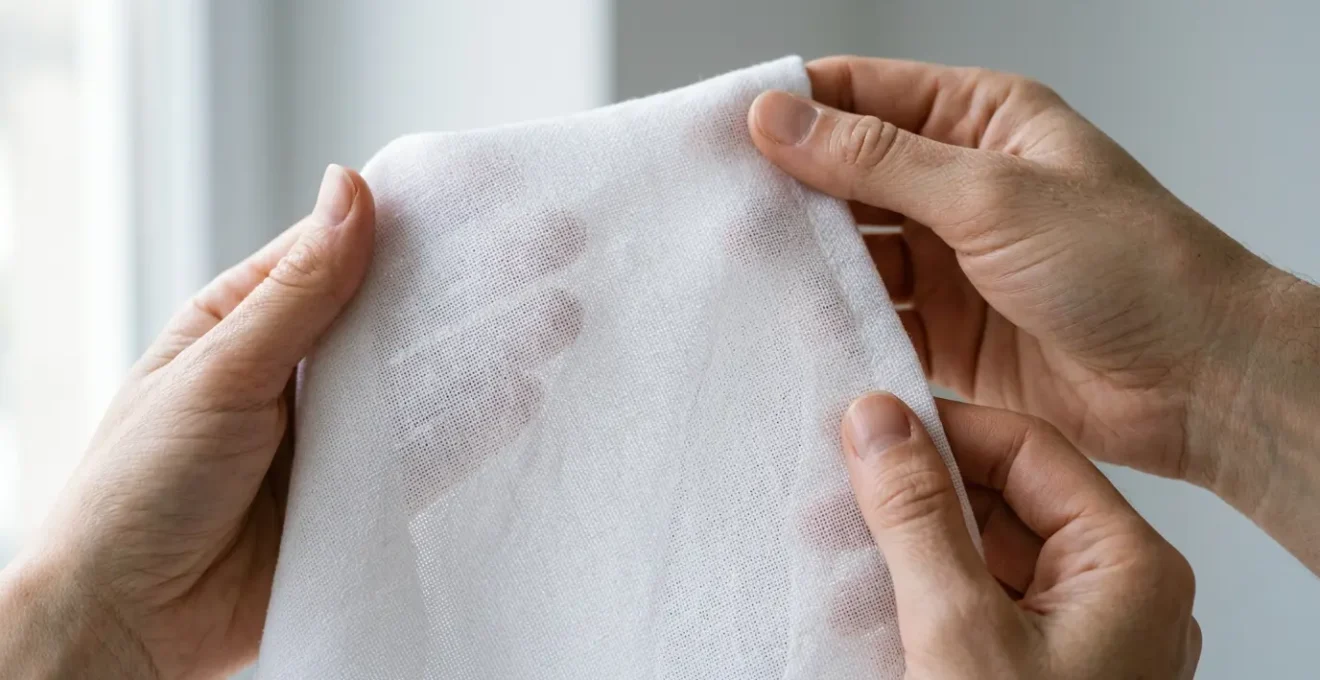
The single most common failure in a white shirt is improper opacity. A shirt that reveals the silhouette of what’s underneath immediately projects cheapness, regardless of its price. Store lighting is designed to flatter, using diffused, overhead sources that minimize transparency. Relying on a simple glance in the fitting room mirror is a recipe for disappointment once you step into natural daylight. To combat this, you must perform the « Hand Test, » a simple, tactile method for assessing a fabric’s true behavior.
The process is straightforward. First, place one hand flat inside the shirt, pressing it firmly against the fabric. Now, hold that section of the shirt up to the brightest, most direct light source in the store—ideally near a window or a harsh spotlight. Observe the contrast. How clearly can you see the outline of your fingers? Can you discern the difference in skin tone between your palm and your fingers? A high-quality, densely woven fabric will diffuse the light, blurring the details of your hand into a vague shape. A low-quality fabric will act like tracing paper. This assessment goes beyond a simple « see-through » check; it evaluates the fabric’s light-diffusion properties, a key indicator of weave density and yarn quality. While you’re at it, pay attention to the color; a superior white fabric will appear luminous, not grayish or thin, under direct light.
This hands-on inspection is crucial because opacity is a quantifiable metric in the textile industry. Though you don’t have lab equipment, your eyes can approximate the same judgment. In fact, many fabric manufacturers use a standardized system where a 1-5 scale measures opacity. By making the Hand Test a non-negotiable step, you are moving from a subjective guess to an objective, repeatable analysis of a garment’s foundational property.
As shown in the image, pressing the fabric against a light source reveals its true character. A truly opaque material will mask the details of your skin tone, ensuring a clean, solid appearance in any lighting condition. This simple, physical interaction with the material gives you more reliable data than any fitting room mirror ever could.
Why Clean Nails Matter More Than Shoes in a Minimalist Look?
In a complex, patterned, or layered outfit, the viewer’s eye has multiple points of interest to land on. A bold color, an intricate print, or a statement accessory can distract from minor imperfections. However, a minimalist ensemble anchored by a simple white shirt operates on the principle of visual economy. With no patterns or loud colors to hide behind, every single detail is magnified. In this stark context, small points of neglect become glaring focal points.
This is why the state of your hands—specifically, your nails—can make or break the entire look. Chipped polish, untidy cuticles, or dirt under the nails will draw the eye with disproportionate force, instantly undermining the intended message of clean, deliberate elegance. The eye seeks detail, and on a blank canvas, the smallest flaw becomes the most interesting detail. While a great pair of shoes certainly contributes to a polished appearance, they exist at the periphery of a typical social interaction. Your hands, however, are frequently in the viewer’s central field of vision, gesturing, holding a glass, or resting on a table. They are a primary communication tool.
This phenomenon is rooted in the psychology of perception. A study on minimalist aesthetics confirmed the core principle: the fewer visual elements present, the more weight each individual element carries. As experts in the field of fashion psychology note:
In a visually ‘busy’ outfit, the eye is distracted. With a simple white shirt, any imperfection becomes the immediate focal point.
– Fashion Psychology Research, Study on minimalist fashion and visual perception
Therefore, investing five minutes in nail care before wearing a minimalist outfit provides a far greater return on investment than agonizing over the perfect shoes. It demonstrates a commitment to detail at the micro-level, which is the very essence of the « less is more » philosophy. It signals that your simplicity is a conscious choice, not a result of neglect. In the world of high-impact minimalism, meticulous grooming isn’t an accessory; it’s a structural component of the look.
Cream vs. Stark White: Which Shade Makes Teeth Look Whiter?
The choice between a stark, optic white and a softer cream or off-white seems like a simple matter of preference. However, from a product developer’s perspective, it’s a calculated decision based on the principle of simultaneous contrast. This visual phenomenon dictates that the appearance of a color is affected by the colors surrounding it. When it comes to a white shirt, the « surrounding colors » are your skin tone and, most noticeably, your teeth.
A stark, blue-toned white is the brightest possible shade. When placed next to your teeth, it creates a direct and often unforgiving comparison. If your teeth are not themselves a perfectly brilliant white, the starkness of the shirt will accentuate any yellow or off-white tones, making them appear duller by contrast. This is the risk of optic white: it sets an impossibly high bar for everything around it. It is clean, sharp, and modern, but it demands a level of perfection that can be hard to maintain.
A cream or ecru shirt, on the other hand, works on the principle of harmony rather than contrast. Because it already has a subtle yellow or warm undertone, it softens the comparison with your teeth. Instead of highlighting the difference, it creates a more forgiving, analogous color palette. This makes your teeth appear whiter and brighter in relation, as they are being compared to a less intense shade of white. The cream shirt essentially « lowers the bar, » allowing your natural smile to look its best. It’s a strategic choice that leverages color theory to create a more flattering and effortless effect.
Case Study: The Simultaneous Contrast Effect
The principle behind this is well-documented in color science. As demonstrated in research on opacity and color perception, the context in which a color is viewed dramatically alters how it is perceived. The illuminance and surrounding tones can make the exact same fabric appear different. A stark white shirt under warm indoor lighting might look fine, but in cool, natural daylight, its blue undertones become more prominent, creating a harsher contrast with skin and teeth. Choosing a cream shade is a way to control this variable and ensure a consistently flattering look across different environments.
Ultimately, the decision depends on your goal. For a high-impact, crisp, and almost clinical look, stark white is powerful—if you can match its intensity. For a warmer, more approachable, and universally flattering elegance, cream is the smarter, more strategic choice.
The « One In, One Out » Rule: Does It Actually Keep Your Wardrobe Minimal?
The « One In, One Out » rule is a popular gateway into wardrobe minimalism. The premise is simple: for every new item you bring into your closet, an old one must leave. On the surface, it seems like an effective tool for preventing wardrobe bloat and maintaining a set number of garments. However, from a systems-thinking perspective, the rule has a fundamental flaw. It focuses exclusively on quantity, not on quality or coherence. It maintains a number, but it does not inherently create a better, more functional wardrobe.
The danger of this rule is that it can promote a cycle of mediocre replacements. You might discard a worn-out t-shirt only to replace it with another of similar, fast-fashion quality. The total number of items in your closet remains the same, but the overall standard of your wardrobe has not improved. You’re simply treading water in a sea of disposability. This behavior is incredibly common; studies reveal that the average American household spends $160 monthly on clothing but consistently wears only about 20% of what they own. The « One In, One Out » rule can inadvertently perpetuate this 80% of unworn churn.
A truly minimalist and intellectually elegant wardrobe is not about a magic number; it’s a curated system where every piece serves a purpose, works with every other piece, and meets a high standard of quality. The focus should be on elevating the average quality of the entire collection, not just maintaining its size. As one analysis on capsule wardrobes points out, the rule’s limitation is its narrow focus.
The rule maintains a number, but doesn’t guarantee an increase in overall quality, versatility, or coherence.
– Capsule Wardrobe Research, Sustainable and Responsible Consumption Study
A more effective approach is the « Upgrade » or « Trade-Up » philosophy. Instead of a simple one-for-one swap, the goal is to only introduce a new item if it is of demonstrably higher quality or offers significantly more versatility than the item it replaces. This shifts the focus from maintaining a count to continuously improving the system’s overall function and longevity. It transforms the closet from a mere holding pen for clothes into a thoughtfully engineered collection of high-performing assets.
Lining and Seams: Why Inside Quality Defines the « Old Money » Look?
True luxury in a garment is not found in the logo on the outside, but in the construction on the inside. The « Old Money » aesthetic, which prioritizes quiet quality over loud branding, is defined by details that are felt by the wearer and only noticed by a discerning eye. The most telling of these hidden markers is the quality of the internal seams and finishing. A product developer knows that how a manufacturer treats the parts no one is « supposed » to see reveals their true commitment to craftsmanship.
Most mass-market shirts use an overlock (or serged) seam. It’s fast, cheap, and effective at preventing fraying. You can spot it easily: it’s that web of thread that runs along the raw edge of the fabric inside the shirt. While functional, it’s the manufacturing equivalent of a shortcut. It adds bulk, can be itchy against the skin, and is a clear indicator of cost-focused production. A high-quality shirt, by contrast, will almost always feature more complex and time-consuming seam constructions.
The gold standard is the French seam. This technique involves stitching the seam twice, enclosing the raw edges of the fabric within the seam itself. The result is an incredibly clean, neat, and durable finish on the inside of the garment, with no raw or serged edges visible. It is smoother against the skin, stronger over time, and requires significantly more skill and time from the seamstress. It is a deliberate investment in structural integrity and wearer comfort—hallmarks of a superior product. When you turn a shirt inside out and see clean, enclosed French seams, you know the maker cared about the garment’s longevity, not just its initial hanger appeal.
This macro view of a French seam showcases the difference. The clean, enclosed finish is a testament to superior craftsmanship. This is not just an aesthetic choice; it’s an engineering decision that enhances the garment’s durability and comfort. Inspecting the inside of a shirt is like looking under the hood of a car—it tells you everything you need to know about its build quality.
How to Spot Low-Quality Blends in « Luxury » Items Before Buying?
The term « luxury blend » has become a dangerously vague marketing phrase. Brands often use it to describe fabrics containing a small percentage of a premium material (like cashmere or silk) blended with a majority of cheaper synthetics like polyester or viscose. While blends can sometimes enhance performance (e.g., adding stretch), they are more often used to cut costs while maintaining a high price point. A true perfectionist must learn to read the fabric not just by its label, but by its physical behavior. Polyester, for example, can be woven to feel deceptively soft at first touch, but its tells are unmistakable.
Before even looking at the care tag, you can perform several diagnostic tests. Synthetics like polyester and nylon are essentially plastic; they do not absorb moisture. A high-quality cotton, however, is highly absorbent. This difference in fabric behavior is your primary tool for detection. Furthermore, the density of the weave is a key quality marker. While you can’t count threads in the store, textile quality experts recommend that a thread count of 80-120 TPI provides optimal comfort and durability for cotton shirts. A looser weave, often found in cheaper garments, will feel flimsy and lack structure.
To arm yourself against deceptive marketing, you must internalize a series of practical, in-store tests that reveal a fabric’s true composition. These quick checks can save you from the disappointment of a « luxury » item that pills, holds static, or feels clammy after just a few wears.
Your Checklist: 4 Expert Tests to Identify Fabric Quality
- The Water Absorption Test: If possible (or with a fabric swatch), place a single drop of water on the fabric. Pure cotton will absorb it almost instantly, darkening the area. A synthetic blend will cause the water to bead up and sit on the surface, as plastic repels water.
- The Transparency Check: As covered in the Hand Test, hold the fabric up to a strong light. High-quality, long-staple cotton has a natural opacity. If it looks overly thin or transparent, it’s likely a lower-grade cotton or a blend with flimsy synthetics.
- The Touch & Wrinkle Test: Crush a corner of the shirt tightly in your fist for a few seconds. Pure, high-quality cotton will wrinkle significantly. A fabric that springs back with very few wrinkles is a major red flag for a high polyester content. While wrinkle-resistance sounds good, it comes at the cost of breathability and a natural drape.
- The Burn Test (For At-Home Use): If you have a swatch or can spare a thread from an inside seam, this is the definitive test. Natural fibers like cotton burn to a fine, gray ash and smell like burning paper. Synthetics melt into hard, black beads and emit a chemical odor.
By employing this forensic approach, you shift the power back to yourself. You are no longer reliant on the brand’s description; you are making an informed judgment based on empirical evidence.
Is Organic Cotton Softer? The Truth About Fiber Length and Processing
One of the most pervasive myths in sustainable fashion is that « organic » is a synonym for « soft » or « high-quality. » This is a fundamental misunderstanding of what the term means. The « organic » certification is an agricultural standard. It guarantees that the cotton was grown without the use of synthetic pesticides, herbicides, or GMOs. This is incredibly important for environmental health and the well-being of farm workers, but it has absolutely no bearing on the physical properties of the cotton fiber itself.
The softness, strength, and durability of a cotton fabric are determined primarily by one factor: fiber length, also known as « staple. » Longer fibers can be spun into finer, smoother, and stronger yarns. These yarns, in turn, create fabrics that are softer to the touch, more resistant to pilling, and last significantly longer. A non-organic, extra-long staple (ELS) cotton like Supima or Pima will always be softer and of higher quality than a short-staple organic cotton. As a product developer, this is a critical distinction.
This truth is evident in the data. For instance, according to cotton industry standards, Supima cotton fibers measure 3.5 cm or more, while conventional upland cotton (which can be grown organically) has fibers as short as 2.2 cm. This 35% or more increase in length is what creates the luxurious hand-feel, not the farming method. This is a point frequently clarified by textile experts.
Organic is an agricultural standard, not a measure of softness. Softness is determined by fiber length. A non-organic Supima cotton will always be softer than a short-staple organic cotton.
– Sustainable Fashion Analysis, Pima & Supima Cotton Vs Organic Cotton Comparison
Therefore, the perfectionist’s quest should not be for « organic cotton » but for « long-staple cotton. » If you can find a product that is both long-staple *and* organic, you have found the best of both worlds: superior quality and environmental responsibility. But if forced to choose one for the sake of quality and longevity alone, fiber length is the metric that matters most.
Key Takeaways
- True quality is hidden: Focus on internal construction like French seams over external branding.
- Fabric behavior trumps labels: Use physical tests (light, water, wrinkle) to identify material composition, as « luxury blend » can be misleading.
- Softness is science, not a label: The softness and durability of cotton are determined by fiber length (staple), not the « organic » certification.
The 333 Method: Can You Really Survive a Season with 33 Items?
After mastering the art of selecting individual, high-quality pieces, the final frontier for the perfectionist is building a coherent system. The « 333 Method » is one of the most well-known frameworks for creating a capsule wardrobe. It’s not just a decluttering tactic; it’s a rigorous design challenge that forces you to think like a curator. The question isn’t just about survival on a limited number of items, but whether such a constrained system can truly deliver on the promise of effortless style, versatility, and mental clarity.
The results from those who have undertaken this challenge suggest that it can. By limiting your wardrobe to a small, hard-working collection of pieces that you genuinely love and that are all interoperable, you eliminate decision fatigue. The morning routine is simplified, packing for a trip becomes trivial, and you develop a much stronger sense of your own personal style because you are forced to be deliberate about every single item you own. The framework encourages you to invest in quality and versatility over quantity and novelty.
Case Study: Project 333 Challenge
Created by author Courtney Carver, Project 333 is a minimalist fashion challenge that has been successfully completed by thousands of people worldwide. The rules are simple: dress with only 33 items for 3 months. This count includes clothing, accessories, jewelry, and shoes, but excludes sentimental jewelry (like a wedding ring), underwear, sleepwear, and workout clothes. Participants consistently report profound benefits beyond just a tidier closet, including significant savings in time and money, a reduction in stress and anxiety related to getting dressed, and the surprising discovery that no one else even notices they’re wearing a limited selection of clothes.
A system like the 333 Method is the ultimate expression of the « less is more » philosophy. It proves that a wardrobe’s power lies not in its size, but in its coherence and the quality of its components. A single, perfectly constructed white shirt becomes infinitely more valuable in this context, as it can be combined in numerous ways with other well-chosen pieces. It’s the move from being a consumer of clothing to being the designer of your own highly functional, elegant wardrobe system.
By embracing the mindset of a product developer, you transform the act of shopping from a passive consumption of goods into an active analysis of quality and design. The goal is no longer to simply acquire a white shirt, but to curate a collection where every piece, no matter how simple, meets a rigorous standard of excellence. This is the foundation of true and lasting style.