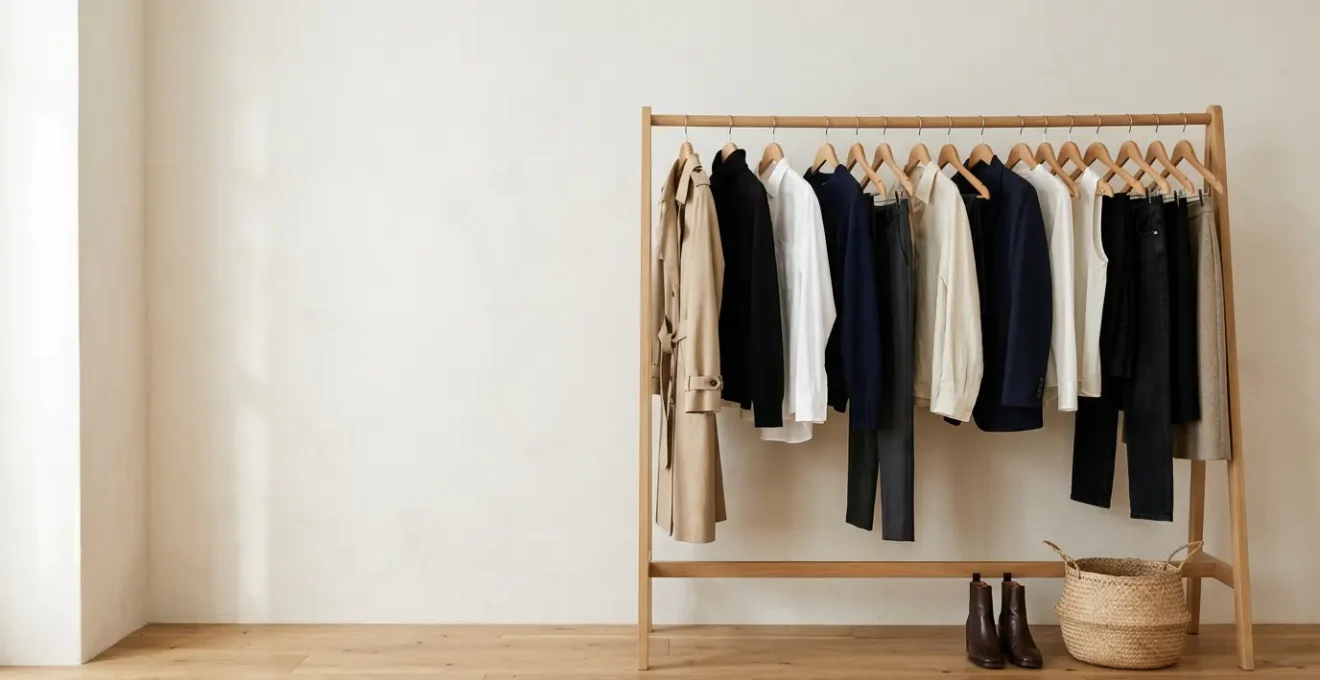
The 333 Method is less about fashion and more about reclaiming your mental energy by transforming your wardrobe into a high-efficiency decision-making tool.
- It forces you to build a cohesive « Wardrobe Operating System » where every piece has a purpose, drastically reducing daily cognitive load.
- Success depends on mastering the logistics: a functional color palette, a smart laundry routine, and strategies to overcome the inevitable « boredom trap. »
Recommendation: Instead of seeing it as a restriction, approach the 333 Method as a systematic experiment in productivity to eliminate one major source of daily decision fatigue.
That feeling of staring into a full closet and thinking, « I have nothing to wear, » isn’t about a lack of clothes. It’s a symptom of decision fatigue. Every morning, you’re faced with a mountain of choices that drains your cognitive resources before your day has even truly begun. The common advice is to « organize your closet » or « buy better basics, » but these are temporary fixes for a systemic problem. They don’t address the underlying issue: your wardrobe isn’t working for you; you’re working for it.
The 333 Method, a challenge created by Courtney Carver, proposes a radical solution: live with just 33 items for 3 months. This count typically includes clothing, accessories, jewelry, outerwear, and shoes, but excludes underwear, sleepwear, and workout clothes. At first glance, it sounds like a restrictive fashion diet. Many dismiss it as unrealistic, something only a minimalist in a temperate climate could achieve. But what if the true purpose of this method isn’t about deprivation, but about designing a powerful productivity system?
The real key to the 333 Method isn’t the number 33. It’s the methodology of intentional reduction. By treating your wardrobe as a « Wardrobe Operating System » (WOS), you can engineer away the friction points that cause stress and waste time. It’s about turning your closet from a source of anxiety into a streamlined, reliable tool. This guide will move beyond the basic rules to give you the operational tactics—from color theory to psychological hacks—needed to build and sustain a capsule that gives you back your time and mental clarity.
This article will provide a complete framework for implementing the 333 Method as a productivity tool. We will explore the foundational principles and the practical solutions to the most common challenges you’ll face.
Summary: A Minimalist’s Guide to Using the 333 Method for Personal Productivity
- The 3-Color Rule: How to Ensure Every Item Matches Everything Else?
- Capsule Wardrobe Laundry: How Often Do You Really Need to Wash Jeans?
- The Boredom Trap: What to Do When You Hate Your curated Capsule?
- The 4-Season Capsule: Which Items Work in Both Summer and Winter?
- Vacuum Bags: Do They Ruin the Shape of Your Stored Coats?
- When to Switch from Linen to Light Wool: A Guide for Trans-Seasonal Dressing
- Shopping Your Closet: How to Find « New » Outfits in Old Clothes?
- The Psychology of Impulse Buying: How to Stop the « Add to Cart » Dopamine Hit?
The 3-Color Rule: How to Ensure Every Item Matches Everything Else?
The backbone of any successful capsule wardrobe isn’t the individual pieces, but the color palette that unites them. Without a coherent color strategy, even the most beautiful 33 items will fail to create effortless outfits, defeating the entire purpose of reducing decision fatigue. The goal is to build a system where nearly every top works with every bottom. A simplified « 3-Color Rule » is the most effective way to establish this visual coherence.
This approach involves selecting a core of neutral base colors, a few main colors that reflect your personal style, and one or two accent shades for personality. Your base colors (like black, navy, gray, or beige) should form the foundation of your investment pieces—coats, trousers, and shoes—as they provide the most versatility. Your main colors are the workhorses of your wardrobe, while accents add a pop of interest and prevent monotony. Crucially, a limited palette does not mean a boring one.
The secret to creating a rich, dynamic look within these constraints is to introduce texture as a fourth dimension. Varying the materials within the same color family—pairing a chunky oatmeal knit with a smooth silk camisole or a grained cognac leather—adds depth and sophistication. This makes your outfits visually interesting without adding more colors, ensuring your curated collection feels expansive, not restrictive.
As the image above illustrates, combining different textures in a similar color story creates a tactile and visually appealing result. It is this intentional combination of color and material that elevates a simple capsule into a powerful and expressive wardrobe system. Building this foundation correctly is the first and most critical step in creating a closet that truly works for you.
Capsule Wardrobe Laundry: How Often Do You Really Need to Wash Jeans?
One of the first practical challenges of a reduced wardrobe is laundry. With fewer items in rotation, you might assume you’ll be washing clothes constantly, but the reality is often the opposite. A capsule wardrobe forces you to become more intentional about clothing care, which extends the life of your garments and often reduces your laundry load. The key is to understand that not every item needs to be washed after a single wear. Over-washing is a primary cause of fabric degradation and color fading.
Jeans are a perfect example. While many people throw them in the wash after a few wears, this is often unnecessary and detrimental to the denim. Most stains can be spot-cleaned, and airing them out is usually enough to refresh them. In fact, experts suggest a much longer interval between washes. For standard denim, this can be as long as ten wears; laundry expert Patric Richardson recommends washing after 9-10 wears to preserve the fit and color. For raw denim, the interval is even longer to allow for the development of unique fade patterns.
This principle extends to other fabrics as well. Natural fibers like merino wool have inherent anti-microbial and odor-resistant properties, allowing for multiple wears before washing. In contrast, synthetic performance fabrics and cotton t-shirts worn close to the skin often require washing after each use. Mastering this wear-to-wash ratio is a crucial skill for making your capsule wardrobe a low-friction system.
The following guide breaks down the recommended washing frequency for common fabrics found in a capsule wardrobe. Adhering to these guidelines not only simplifies your laundry routine but also acts as a form of long-term investment in the quality and lifespan of your 33 items.
| Fabric Type | Recommended Wears Before Washing | Care Notes |
|---|---|---|
| Denim (Jeans) | 6-10 wears | Spot clean stains between washes; air dry to preserve fit and color |
| Raw Denim | 15+ wears (up to 6 months) | Hand wash in cold water; avoid wringing to preserve unique fade patterns |
| Cotton T-shirts | 1-2 wears | Wash after each wear if sweating or visible soil |
| Merino Wool | 5-8 wears | Air out between wears; spot clean when possible |
| Synthetics/Performance Fabrics | 1-2 wears | Wash after each wear to remove odor and bacteria buildup |
The Boredom Trap: What to Do When You Hate Your curated Capsule?
The most common reason people abandon their capsule wardrobe is not a lack of items, but a perceived lack of options. This « boredom trap » is a psychological friction point. After a few weeks, you fall into a pattern of wearing the same 3-4 trusted outfits, and the rest of your carefully curated capsule feels invisible. The problem isn’t your clothes; it’s your habits. To overcome this, you need a systematic method to force creativity and rediscover the versatility you originally built into your collection.
The solution is to intentionally break your established patterns. One of the most effective techniques is « Outfit Unbundling. » This involves identifying your go-to outfit combinations and then placing a temporary ban on wearing those specific pairings. By forcing each piece to find a new partner, you unlock dozens of combinations that were previously overlooked. This process of intentional recombination makes old clothes feel new again, injecting novelty back into your wardrobe without buying anything.
Documenting these new outfits with a quick photo on your phone can be incredibly powerful. This creates a personal lookbook, a visual library of pre-approved combinations you can turn to on mornings when you feel uninspired. It’s a proactive strategy that replaces the anxiety of « what to wear » with a simple choice from a list of outfits you’ve already created and loved. It transforms your capsule from a source of frustration back into a tool for efficiency.
Your Action Plan: The ‘Outfit Unbundling’ Technique
- Identify your 3-5 most frequently worn outfit combinations and write them down with each component listed separately.
- Implement a 2-week ban on wearing those exact combinations together—force each piece to find new partners in your wardrobe.
- Use the ‘333 Method’ mini-challenge: Select 3 tops, 3 bottoms, and 3 shoes from your capsule and create as many new outfit combinations as possible for 10 days.
- Document each new outfit with a quick photo to build a visual reference library of fresh combinations you’ve tested and approved.
- At the end of the challenge, evaluate which pieces truly aren’t working and consider the ‘one-in, one-out’ swap rule to refresh your capsule without abandoning the system.
The 4-Season Capsule: Which Items Work in Both Summer and Winter?
A major point of skepticism around capsule wardrobes is their viability across four distinct seasons. The idea of relying on the same 33 items through both a summer heatwave and a winter freeze seems impossible. However, the key to a successful 4-season capsule is not having items that magically work for all temperatures, but in building a modular system based on trans-seasonal items and strategic layering. A 4-season capsule is actually composed of a core set of year-round items supplemented by a small, rotating selection of seasonal-specific pieces.
Truly trans-seasonal items are the heroes of this system. These are pieces that work as a standalone item in one season and a base layer in another. A high-quality silk or tencel blouse, a fine-gauge merino wool cardigan, a classic trench coat, and well-fitting dark-wash jeans are prime examples. The trench coat that protects you from spring showers can be layered over a wool sweater for a mild winter day. The silk blouse worn on its own in summer can be worn under a blazer in the fall.
This approach requires a shift in thinking from a complete wardrobe overhaul each season to a more subtle, system-based adjustment. It’s about how you combine items, not just what items you own.
Case Study: The Seasonal Color Palette Adaptation Strategy
A recent analysis of seasonal color palettes demonstrates that successful trans-seasonal dressing is achieved by thoughtfully selecting which shades from your established palette to feature in each season. For example, a person with a « Dark Autumn » color palette can build a cohesive year-round wardrobe by shifting focus within their existing range of colors. In summer, they might lean into the softer, lighter shades like leaf-green and soft caramel. As winter approaches, they transition to featuring the deeper tones from the same palette, such as khaki, olive, and rich earth tones. This proves that you don’t need a different wardrobe; you need a strategy to utilize different facets of the same cohesive color family, ensuring visual harmony while adapting to changing temperatures and light.
The layering matrix, as shown above, is the mechanical core of this strategy. A functional trans-seasonal wardrobe is built on three layers: a base layer (like a camisole or t-shirt), a mid-layer for insulation (like a cardigan or sweater), and an outer layer for weather protection (like a coat or blazer). By mastering the art of combining these layers, a small collection of clothes gains exponential versatility.
Vacuum Bags: Do They Ruin the Shape of Your Stored Coats?
A practical consequence of a seasonal capsule is the need to store off-season clothing. For those in small living spaces, vacuum bags seem like a miracle solution, compressing bulky winter coats and sweaters into manageable, space-saving packages. However, this convenience comes with a significant risk. Using vacuum bags improperly can cause irreversible damage to certain fabrics, particularly natural fibers and structured garments that are the cornerstones of a high-quality capsule wardrobe.
The intense compression of vacuum storage can crush natural fibers like down and wool, permanently flattening them and destroying their insulating properties. For a down jacket, this means a permanent loss of loft and warmth. For a structured wool coat, it can lead to flattened fibers and creases that are impossible to remove, ruining the garment’s shape and drape. Leather and suede should never be stored in vacuum bags, as the lack of air can cause them to dry out, crack, and become distorted.
However, not all fabrics are vulnerable. Durable synthetic fills, like those in a polyester puffer jacket, can generally withstand short-term compression (up to 6 months). Likewise, basic cotton and linen items can be vacuum-sealed, as any stubborn wrinkles can typically be steamed out. The critical factor is knowing which materials can handle the pressure and which require breathable storage to maintain their integrity.
The following guide, based on an analysis of fabric safety in storage, provides a clear framework for deciding the right storage method for each item in your off-season capsule. Making the right choice is essential for protecting the investment you’ve made in your clothes.
| Fabric/Item Type | Vacuum Bags Safe? | Recommended Storage Method | Risk if Improperly Stored |
|---|---|---|---|
| Synthetic Fills (Polyester Puffer Jackets) | Yes (short-term) | Vacuum bags for travel/seasonal rotation | Loss of loft if compressed beyond 6 months |
| Down Jackets & Comforters | No | Large breathable cotton bags; hang when possible | Permanent clumping of down; loss of insulation permanently |
| Structured Wool Coats | No | Breathable garment bags on padded hangers | Flattened fibers; permanent creases; loss of shape |
| Cashmere & Silk | No | Acid-free tissue paper in archival boxes | Fiber damage; irreversible creasing; texture loss |
| Leather & Suede | Never | Breathable cotton garment bags; climate-controlled space | Cracking; drying out; permanent distortion |
| Heavy Knit Sweaters | No | Flat storage in breathable boxes with acid-free tissue | Stretching; loss of elasticity; permanent deformation |
| Cotton & Linen Basics | Yes | Vacuum bags acceptable; can withstand heat for de-wrinkling | Stubborn wrinkles but generally recoverable with steaming |
When to Switch from Linen to Light Wool: A Guide for Trans-Seasonal Dressing
Knowing precisely when to rotate your seasonal items is one of the finer points of mastering a 4-season capsule. There’s no universal date on the calendar; the switch from summer fabrics like linen to autumn-weight materials like light wool is a subtle art guided by environmental cues. Misjudging this transition can lead to being uncomfortably hot or cold, creating friction in your otherwise smooth system. The key is to pay attention to fabric properties and the specific signals of the changing season.
Linen is a summer hero because of its exceptional breathability and moisture-wicking properties. Its hollow fibers allow air to circulate freely, making it feel cool against the skin. Light wool, such as merino, serves a different function. It’s a natural insulator that excels at thermoregulation. It traps a layer of air to keep you warm when it’s cool, but its fibers also breathe to release excess heat and moisture, preventing you from overheating. This makes it the ideal transitional fabric.
The signal to switch is not just the daytime high temperature, but the change in the daily temperature range. The moment you start feeling a distinct chill in the early morning or after sunset is your first cue. Other environmental signs include a consistent drop in evening temperatures below 15°C (60°F), or the feeling of a cool breeze that makes bare arms uncomfortable. This is when a light merino sweater, which can be worn alone or layered under a jacket, becomes more practical than a linen shirt. The transition isn’t an abrupt swap of the entire wardrobe, but a gradual phasing in of warmer base and mid-layers as the environment dictates.
Ultimately, this decision becomes intuitive. It’s about building a sensory connection to your environment and understanding how your core fabrics perform. You’ll learn to recognize « light wool weather » just as you recognize the need for a raincoat. This attunement is a core benefit of a minimalist wardrobe, moving you from passively following a calendar to actively responding to your surroundings.
Shopping Your Closet: How to Find « New » Outfits in Old Clothes?
The ultimate goal of the 333 Method is to break the cycle of consumption by proving that you already have everything you need. « Shopping your closet » is the practice of finding novelty and excitement within your existing collection. It’s a mindset shift from passive consumption to active creation. The feeling of « needing » something new often stems from styling ruts, not from a genuine lack of clothing. By applying systematic creativity, you can make your 33 items feel like 100.
This process requires you to see your clothes not as fixed outfits, but as individual components in a modular system. Every item is a potential partner for several others. A blazer isn’t just a blazer; it’s a potential dress when belted. A cardigan can be worn backward to create a new neckline. A dress can become a skirt when a sweater is layered over it. This is the essence of intentional recombination, a deliberate effort to explore every possible permutation of your wardrobe.
Digital wardrobe apps can be useful for this, but an analog approach can be even more powerful for breaking mental patterns. Laying out your items on your bed or floor, or using photos to create a visual matrix, helps you see the components outside of their usual context. This allows you to experiment with pairings you’d never consider when simply pulling from a hanger.
Case Study: How 9 Items Can Generate 27+ Outfits
The viral ‘333 method’ challenge developed by fashion creator Rachel Spencer perfectly illustrates this principle. By selecting just 3 tops, 3 bottoms, and 3 pairs of shoes from an existing wardrobe, participants are forced to create an astonishing number of fresh combinations. The method’s success comes from its constraints, which push wearers to pair items they wouldn’t normally combine. Spencer’s approach proves that wardrobe boredom is often a failure of imagination, not a lack of clothes. By systematically rotating every compatible item through predetermined formulas, users discover their existing capsule has far more potential than they believed, effectively making old clothes feel new again.
Whether you use a digital app or a hands-on approach with photos, the goal is the same: to systematize creativity. By treating your closet like a puzzle with interchangeable pieces, you unlock its hidden potential and find the novelty you crave without spending a dime.
Key Takeaways
- The 333 Method is a productivity system first, and a fashion challenge second. Its goal is to reduce cognitive load.
- Success depends on building a « Wardrobe Operating System » with a cohesive color palette and smart layering.
- Overcoming friction points like laundry logistics and boredom requires systematic, not emotional, solutions.
The Psychology of Impulse Buying: How to Stop the « Add to Cart » Dopamine Hit?
Maintaining a 33-item capsule is not just an organizational challenge; it’s a psychological one. The biggest threat to your carefully curated system is the allure of the new—the impulse buy. Online shopping, with its one-click checkouts and targeted ads, is designed to trigger a dopamine hit, a short-lived pleasure spike associated with reward and novelty. This neurological response can easily override your logical commitment to minimalism. In fact, studies show that a staggering 55% of consumers make impulse purchases most frequently when shopping for clothes, making fashion the top category for unplanned spending.
Breaking this cycle requires creating a « purchase firewall »—a deliberate, non-emotional process that you must go through before any new item can enter your wardrobe. The goal is to create distance between the impulse and the action. The most powerful tool for this is time. By enforcing a mandatory waiting period of 48-72 hours, you allow the initial dopamine-fueled excitement to fade, enabling your rational brain to take over. This simple delay is often enough to reveal that the « need » was actually just a fleeting « want. »
During this waiting period, you can deploy a rational interrogation checklist. This is a series of questions designed to test whether the item truly fits into your Wardrobe Operating System. Does it fill a genuine functional gap? Does it work with at least three other items you already own? And, most importantly, which of your current 33 items are you willing to remove to make space for it? If you can’t answer these questions easily, the item doesn’t belong. This turns the decision from an emotional reaction into a strategic assessment.
Action Plan: The Purchase Interrogation Checklist
- Compatibility Test: Can I name 3 existing items in my current 33-piece capsule that this new item will work with? If not, it doesn’t fit the system.
- Gap Analysis: Is this purchase filling a genuine functional gap (e.g., I have no waterproof coat) or an emotional need (e.g., I’m bored or seeking novelty)?
- The « One-In, One-Out » Rule: Am I willing to physically remove one item from my current capsule to make room for this new piece? If I can’t identify what to remove, I don’t need it.
- Versatility Check: Will this item work across at least 2 different seasons or occasions within my lifestyle? Single-use pieces violate capsule principles.
- The 48-Hour Rule: Wait 48-72 hours before purchasing. If the desire persists and the item still passes all 4 questions above, then and only then consider the purchase.
By implementing these strategies, you are not just managing a small wardrobe; you are actively training your brain to prioritize long-term satisfaction over short-term gratification. This is the ultimate expression of the 333 Method: a tool not just for a better closet, but for a more intentional life. Begin today by applying this framework to reclaim your mental energy, one decision at a time.