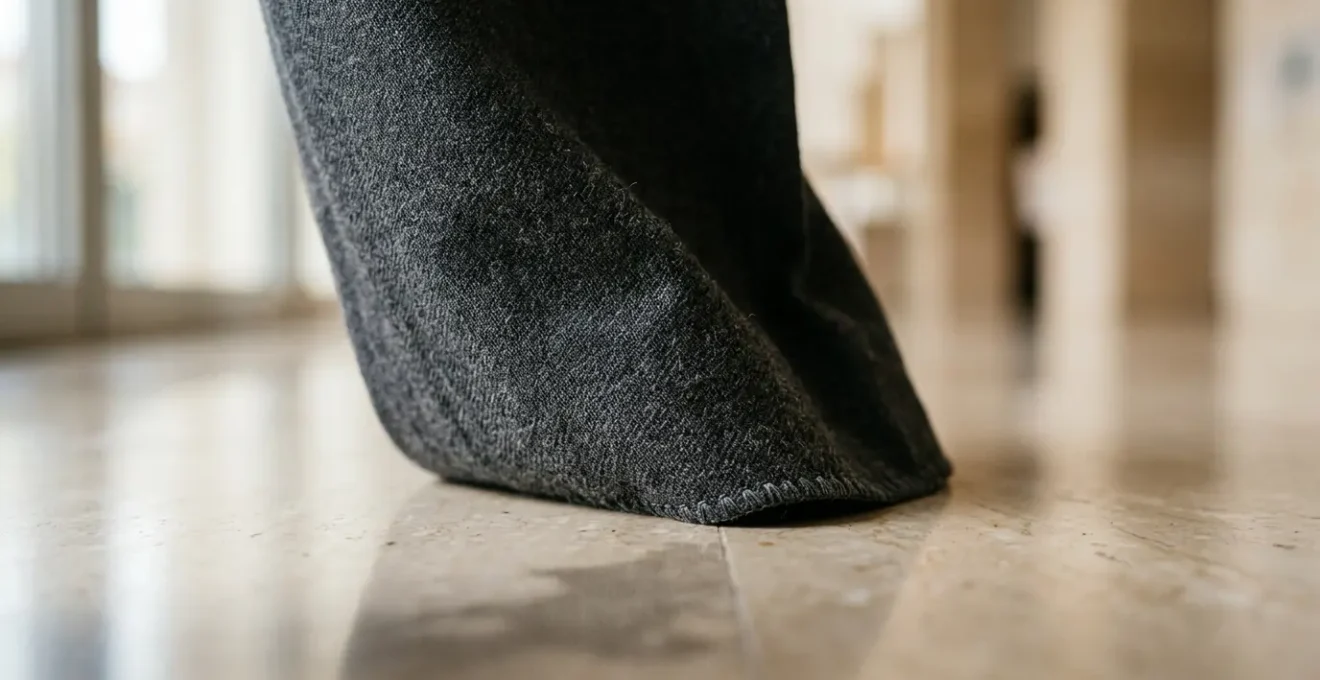
For a petite frame, the secret to successfully wearing wide-leg trousers isn’t avoiding them; it’s mastering the hem’s precise relationship with your shoes to create an unbroken vertical line.
- The trouser’s « break point »—where the hem interacts with the shoe—is the most critical measurement for elongating the leg.
- A high-waisted cut is non-negotiable as it redefines your body’s proportions to a visually lengthening 1/3 torso to 2/3 legs ratio.
Recommendation: Always decide on your primary footwear *before* hemming. A single pair of trousers cannot be perfectly hemmed for both high heels and flats without compromising the silhouette.
For many petite women, wide-leg trousers feel like a fashion paradox—a style admired on others but deemed impossible for a shorter frame. The common fear is that the added volume will overwhelm the silhouette, making one appear shorter and wider. Conventional advice often cycles through generic tips like « wear heels » or « choose a high waist, » but these are merely pieces of a much more intricate puzzle. They are the « what, » but not the « why » or, more importantly, the « how. » Without a master tailor’s understanding of geometry and proportion, these rules can easily fail.
The truth is, the power to create a taller, leaner illusion has less to do with the trousers themselves and more to do with a series of precise measurements that work in concert. It’s an exercise in optical engineering. The true key lies not just in hemming your pants, but in understanding the non-negotiable, mathematical relationship between the hem’s break point, the architecture of your shoe, the position of the rise on your torso, and the structural drape of the fabric. This is where most attempts go wrong and where a tailor’s perspective becomes essential.
This guide moves beyond the surface-level advice. We will deconstruct the silhouette from a measurement expert’s point of view. We will analyze how to establish the perfect hem length for different shoes, why rise is more important than the waistband, and how elements like pleats and even the lapel of your jacket contribute to the final, elongating effect. By mastering this formula, you can transform wide-leg trousers from a source of frustration into your most powerful tool for commanding presence.
To navigate these sartorial mechanics, this article breaks down the essential measurements and style choices into clear, manageable sections. The following summary outlines the key areas we will cover to perfect your wide-leg trouser game.
Summary: A Tailor’s Blueprint for Wide-Leg Trousers
- Flats or Heels: Can You Wear the Same Pants for Both?
- High-Waist vs. Mid-Rise: Which Cut Hides a Bloated Stomach?
- The « Puddle » Trend: How to Clean Hems That Drag on the Ground?
- Tucked or Cropped: How to Avoid Looking Frumpy in Wide Legs?
- Pleats vs. Flat Front: Which Construction Flatters Wide Hips?
- Sneakers or Loafers: Which Flat Shoe is Acceptable for a Business Meeting?
- Peak vs. Notch Lapel: Which Style Actually Slims the Torso?
- How to Shop the Men’s Section if You Have Hips?
Flats or Heels: Can You Wear the Same Pants for Both?
From a tailoring perspective, the answer is an emphatic no. The idea of a single pair of wide-leg trousers serving both heels and flats is the primary reason silhouettes fail. The critical measurement is the « break point »—the precise location where the hem grazes the shoe. For an elongating effect, this line must be clean and uninterrupted. With heels, the hem should fall about a half-inch from the floor, creating a long, continuous column. With flats, the hem must be significantly shorter, just barely « kissing » the top of your foot or the ground to avoid pooling fabric that visually shortens the leg.
Attempting to find a compromise length results in trousers that are too short for heels (exposing the ankle and breaking the line) and too long for flats (creating a sloppy, dragging effect). The shoe choice dictates the hem, not the other way around. As style advisor Audrey Madison Stowe notes, « Heels are very helpful in extending your leg line. So, if your outfit feels ‘off,’ try adding a subtle heel or platform. » This underscores that the goal is always to maximize the vertical line. Furthermore, even with flats, the shoe’s construction matters. For instance, footwear styling experts confirm that pointed and almond-toe shoes create the illusion of longer legs when paired with wide-leg pants, as they extend the visual line forward.
Therefore, the most strategic approach is to dedicate each pair of wide-leg trousers to a specific heel height category. A pair hemmed for 3-inch heels will not work with loafers, and a pair tailored for sneakers will look cropped with boots. This discipline is the foundation of a successful wide-leg trouser wardrobe for a petite frame.
Your 5-Point Hemming Audit Checklist: Achieving the Perfect Break
- Footwear Dedication: Identify the single pair of shoes (or shoes with the exact same heel height) you will primarily wear with the trousers.
- Measure in Motion: Put on the shoes and trousers. Stand, walk, and sit in front of a full-length mirror. Observe how the hem moves.
- Mark the Break Point: The ideal hem should be no more than 1/2 inch off the ground at the back of the heel. For flats, it should just skim the top of the shoe without bunching.
- Verify the Front Crease: Ensure the front of the trouser leg falls in a clean, straight line without a significant « break » or fold. A slight bend is acceptable, but a sharp horizontal crease is a sign the pants are too long.
- Final Tailor’s Check: Pin the hem and review from all angles. The line should be consistent and parallel to the floor. This is the mark your tailor must follow.
High-Waist vs. Mid-Rise: Which Cut Hides a Bloated Stomach?
For both comfort and creating a flattering silhouette, a true high-rise is unequivocally superior, especially on days when you feel bloated. A common misconception is that any pant labeled « high-rise » will work. However, the precise placement of the waistband is the determining factor. From a tailoring standpoint, a true high-rise sits at the natural waist—the narrowest part of your torso, typically at or just above the belly button. This anatomical placement is key.
When a waistband is positioned at the natural waist, the fabric drapes cleanly over the lower abdomen rather than constricting it. As menswear expert Simon Crompton explains, a true high-rise « allows the fabric to skim over the stomach instead of squeezing it. » In contrast, a mid-rise cut, which typically sits an inch or two below the belly button, often lands directly at the widest point of the lower stomach. This placement can create a pressure point, accentuating bloating and potentially causing the dreaded « muffin top » effect by bisecting the midsection horizontally.
Beyond comfort, the high-rise cut is an essential tool for proportional engineering. By placing the waistband higher, you visually raise your waistline, which in turn lengthens the appearance of your legs. This creates the highly desirable 1/3 torso to 2/3 legs ratio, a fundamental principle for making a petite frame appear taller. A mid-rise cut creates a more balanced 1/2 to 1/2 proportion, which does little to elongate the body. The following table breaks down the technical differences and their impact on fit.
| Feature | High-Rise (10-12+ inches) | Mid-Rise (8-9.5 inches) |
|---|---|---|
| Waistband Position | At or above natural waist/belly button | Just below natural waist, 1-2 inches below belly button |
| Stomach Coverage | Maximum coverage, skims over midsection | Moderate coverage, can create pressure point |
| Bloating Comfort | Superior – sits at narrowest torso point | Variable – may constrict at widest stomach point |
| Leg Lengthening Effect | Strong elongating effect | Moderate elongating effect |
| Best For | Hourglass, apple shapes, those seeking waist definition | Balanced proportions, relaxed fit preference |
The « Puddle » Trend: How to Clean Hems That Drag on the Ground?
The « puddle » or « floor-duster » trend, where wide-leg trouser hems intentionally pool around the shoe, presents a significant maintenance challenge. From a fabric care perspective, this style requires a proactive and meticulous cleaning protocol, as the hemline is in constant contact with dirt, grime, and moisture from the ground. Allowing stains to set into the fibers—especially on delicate materials like wool or silk—can lead to permanent discoloration and fabric degradation. The key is immediate post-wear treatment.
Do not wait for a full wash. As soon as you take the trousers off, inspect the hems. For minor dirt and dust, a stiff garment brush can be effective. For more significant soiling or liquid stains, spot treatment is non-negotiable. According to the styling team at Care of Carl, you should « Spot treat the area using a cloth, detergent, and water. Avoid excessive rubbing, regardless of the material, as it can cause fabric damage. » This gentle approach is crucial for preserving the fabric’s integrity. Using a soft-bristle toothbrush can help work a stain-removing solution into the fibers without being overly abrasive.
The type of cleaning depends heavily on the fabric. For durable materials like denim or cotton twill, you can often pre-treat the hem and then machine wash the garment inside-out on a gentle, cold cycle. However, for fine wool, silk, or viscose trousers, full submersion in water should be avoided. A targeted spot-clean of the hemline only is the safest method to prevent shrinkage, water marks, or damage to the fabric’s drape. If the soiling is extensive or the fabric is particularly precious, a professional dry cleaner with experience in handling delicate textiles is the most prudent choice to restore the garment without causing harm.
Tucked or Cropped: How to Avoid Looking Frumpy in Wide Legs?
To prevent a « frumpy » or visually shortened appearance, the upper body’s styling must be deliberate and rooted in proportional geometry. With the volume of wide-leg trousers on the bottom half, leaving a top untucked disrupts the silhouette’s balance. This creates a 1/2 torso to 1/2 leg proportion that can make the body appear blocky and short. The solution is to redefine the waistline as a clear dividing point, and the most effective way to do this is by tucking in your top.
As fashion editor Nina Anders expertly points out in her analysis, « Tucking a top creates an elongating 1/3 (torso) to 2/3 (legs) proportion. » This simple action of tucking a shirt, even partially, immediately raises the visual waistline and dedicates more length to the legs, creating a powerful optical illusion of height. A fitted top, such as a knit or a bodysuit, is ideal because it minimizes bulk at the waist, creating a seamless line under the trousers. A perfectly seamless tucked line is the goal for maximum elongation.
However, a full tuck is not the only option. For a more relaxed feel that still respects the rules of proportion, the « French tuck »—tucking only the very front of your top—offers a casual yet intentional look. Alternatively, if you prefer not to tuck, the key is to choose a top that is cropped. A cropped top or a cropped third piece, like a blazer or jacket that ends at your natural waist, achieves the same proportional goal. It terminates the torso line at the desired high point, allowing the full length of the trousers to create an unbroken vertical sweep. The critical error to avoid is wearing a top that ends at the hip, as this visually cuts the body in half and negates all the elongating work of the high-waisted trousers.
Your Tucking Technique Masterclass: A Spectrum of Options
- The Full Tuck: For maximum polish and waist definition, completely tuck a fitted knit or silk blouse into the waistband. This is ideal for formal or professional settings.
- The French Tuck (or Side Tuck): For a relaxed but structured look, tuck only the front 3-4 inches of your top, letting the sides and back hang loose. This works best with slightly oversized shirts or sweaters.
- The Bodysuit Solution: The ultimate technique for a flawless line. A fitted bodysuit eliminates all bunching and creates the cleanest possible silhouette, ensuring a smooth transition from torso to leg.
- The Cropped Layer Alternative: Instead of tucking, pair your trousers with a cropped jacket or blazer that ends precisely at your natural waist. This provides the same 1/3 to 2/3 proportion without a tuck.
Pleats vs. Flat Front: Which Construction Flatters Wide Hips?
The choice between pleats and a flat front for wide-leg trousers is less about the construction itself and more about the structural drape of the fabric. This is a crucial distinction often missed. Pleats are not inherently unflattering for wider hips; they only become so when executed in the wrong material. Stiff, structured fabrics like heavy cotton, twill, or linen have a tendency to « pop » open at the pleats, adding horizontal volume precisely where you want to minimize it. This creates visual width across the hips and stomach.
Conversely, when crafted from a fluid, drapey fabric, pleats can be incredibly flattering. Materials with excellent drape, such as viscose, Tencel, silk, or wool crepe, allow the pleats to hang vertically in a straight, uninterrupted line from the waistband down. Instead of pulling open, they glide smoothly over the hips, creating vertical columns that draw the eye downward and produce a slimming effect. This is the secret to making pleats work.
Case Study: The Impact of Fabric Drape on Pleated Trousers
An analysis of wide-leg trouser styles reveals a stark contrast in how pleats perform based on material. When a pair of forward-facing pleats were constructed in a rigid cotton canvas, they consistently pulled open on a curvy fit model, adding perceived inches to the hip measurement. The same trouser pattern, when constructed in a high-quality wool crepe, transformed entirely. The pleats remained closed, hanging vertically and creating a continuous, slimming line that elegantly skimmed over the body’s curves rather than fighting against them. This demonstrates that for pleated trousers, fabric choice is the primary determinant of a flattering fit, superseding the pleat design itself.
If you have wider hips and are uncertain, a flat-front trouser is always a safe and reliable option. It provides a clean, smooth plane across the front, offering no risk of added bulk. However, do not dismiss pleats entirely. By prioritizing fabrics with a soft hand and fluid movement, you can successfully wear pleated wide-leg trousers that offer both sophisticated detail and a flattering, elongating line.
Sneakers or Loafers: Which Flat Shoe is Acceptable for a Business Meeting?
In a modern business context, the line between formal and casual has blurred, but for a meeting where impressions count, the choice of flat shoe is still governed by clear sartorial codes. When paired with tailored wide-leg trousers, a polished leather loafer is the superior and more professional choice over a sneaker. The loafer’s inherent structure, low profile, and traditional association with suiting make it a natural fit for a business environment.
The key difference lies in how the shoe interacts with the trouser hem. As the editorial team at Who What Wear notes, « With tailored wide-leg trousers, a polished loafer allows for a clean ‘break’ or ‘kiss’ at the floor, which reads as formal. » This clean interaction maintains the integrity of the trouser’s vertical line. In contrast, even a minimalist leather sneaker typically has a thicker, more substantial sole and a higher vamp (the part of the shoe covering the top of the foot). This added bulk can disrupt the drape of the trouser leg, causing it to bunch or sit awkwardly, which instantly reads as more casual.
While a pristine, minimal leather sneaker (in white or black) may be acceptable in more creative or tech-focused industries, the loafer remains the universally appropriate and safer option for corporate, finance, or legal settings. The material and finish also play a role in the formality hierarchy: a patent or high-shine leather loafer is the most formal, followed by smooth leather, with suede being the most relaxed, business-casual option.
This hierarchy helps navigate the nuances of professional dress codes when opting for flats.
| Shoe Type | Formality Level | Best Industry Context | Wide-Leg Compatibility |
|---|---|---|---|
| Patent Leather Loafer | Highest (Professional) | Law, Finance, Corporate | Excellent – allows clean trouser break |
| Smooth Leather Sneaker (minimal) | High (Modern Professional) | Tech, Creative, Startups | Good – requires precise hem length |
| Suede Loafer | Medium (Business Casual) | Marketing, Education, Consulting | Very Good – versatile formality |
| Canvas Sneaker | Low (Casual) | Casual Fridays, Creative Studios | Fair – disrupts formal trouser line |
Peak vs. Notch Lapel: Which Style Actually Slims the Torso?
When pairing wide-leg trousers with a blazer, the lapel style is a subtle but powerful tool for shaping the torso and enhancing the overall elongating effect. While both peak and notch lapels are classic, the peak lapel is superior for creating a slimming optical illusion. This is a matter of pure visual geometry. A notch lapel features a small, horizontal « notch » where the collar meets the lapel, creating a horizontal line that can visually widen the chest and shoulders.
In stark contrast, a peak lapel features sharp points that sweep upwards and outwards towards the shoulder. As the styling team at Classic Six explains, « Peak lapels create strong diagonal lines that draw the eye upwards and inwards, creating the illusion of height and a narrower waist. » This upward movement counteracts the horizontal volume of the wide-leg trousers and directs attention towards the face, contributing to a taller, more streamlined appearance. The diagonal lines effectively « pinch » the torso visually, making it appear narrower.
This effect is amplified when combined with a blazer of the correct length and fit. A styling analysis published on Wardrobe Oxygen demonstrates that blazer proportions are critical. A blazer that is shorter (ending between the waist and high hip) and more tailored will complement a fuller leg. A long, boxy, or oversized blazer, especially one with notch lapels, can overwhelm a petite frame and completely erase the waist definition that is so essential for balancing wide-leg trousers. Therefore, for maximum slimming and heightening effect, the ideal combination is a tailored, waist-to-hip length blazer with prominent peak lapels.
Key Takeaways
- The hem-to-shoe « break point » is the single most important measurement; dedicate each pair of trousers to a specific heel height.
- A true high-rise, sitting at the natural waist, is essential for creating an elongating 1/3 torso to 2/3 legs proportion.
- Fabric is paramount: pleats require fluid, drapey material (like wool crepe) to hang vertically and slim the hips, while stiff fabrics will add bulk.
How to Shop the Men’s Section if You Have Hips?
Shopping in the men’s section for trousers can be a transformative strategy for women with hips, offering access to higher quality fabrics and different cuts. However, it requires a complete shift in approach. The cardinal rule is to ignore the waist size on the label completely. Men’s trousers are cut with a smaller hip-to-waist ratio, so you must first fit the widest part of your body—your hips and seat. This will almost certainly mean selecting a pair where the waist is several sizes too large. This is not a problem; it is the strategy.
Focus on cuts labeled « Straight Fit » or « Relaxed Fit. » These styles are designed with more room through the hip and thigh, which is essential for accommodating curves without pulling or straining the fabric. Avoid any cut labeled « Slim Fit, » as it will be too narrow in the seat and thighs. Another critical measurement to look for is a high back-rise, which provides adequate room for the seat and prevents the dreaded « gapping » at the back of the waistband when you sit or bend over. As tailoring expert Ethan Wong advises, you should « Buy pants 1-2 sizes larger than you normally wear. » This ensures you have enough fabric for the trousers to drape properly over your hips.
The final, non-negotiable step is to budget for tailoring. Once you have a pair of trousers that fits perfectly through the hips and thighs, a tailor can easily and affordably alter the waist. Taking in the waist via the center-back seam is a standard alteration that will create a custom fit. This strategic approach—fit the hips first, then tailor the waist—unlocks a world of high-quality trousers that may provide a better drape and construction than many womenswear equivalents.
The Strategic Guide to Buying Men’s Trousers for a Curvy Figure
- Fit the Hips First: Take trousers into the dressing room and pull them on. The primary goal is a smooth, comfortable fit across your hips and seat, with no pulling at the pockets or strain across the fabric.
- Ignore the Waist Gap: A large gap at the waistband is expected and desired. This indicates you have enough room in the hips and that the waist can be easily tailored.
- Target « Straight » or « Relaxed » Fits: Specifically look for these style names, as they are engineered with more generous proportions in the seat and thigh area.
- Assess the Rise: Check for a comfortable back-rise that provides ample coverage and prevents the waistband from dipping too low in the back.
- Consult a Tailor: Take your purchase directly to a trusted tailor and explain that you need the waist taken in, likely through the center-back seam, for a perfect fit.
By applying these precise, measurement-based principles, wide-leg trousers can be transformed from an intimidating trend into a powerful and flattering staple. The next step is to assess your own wardrobe and identify which pair can be perfected with this new sartorial knowledge.