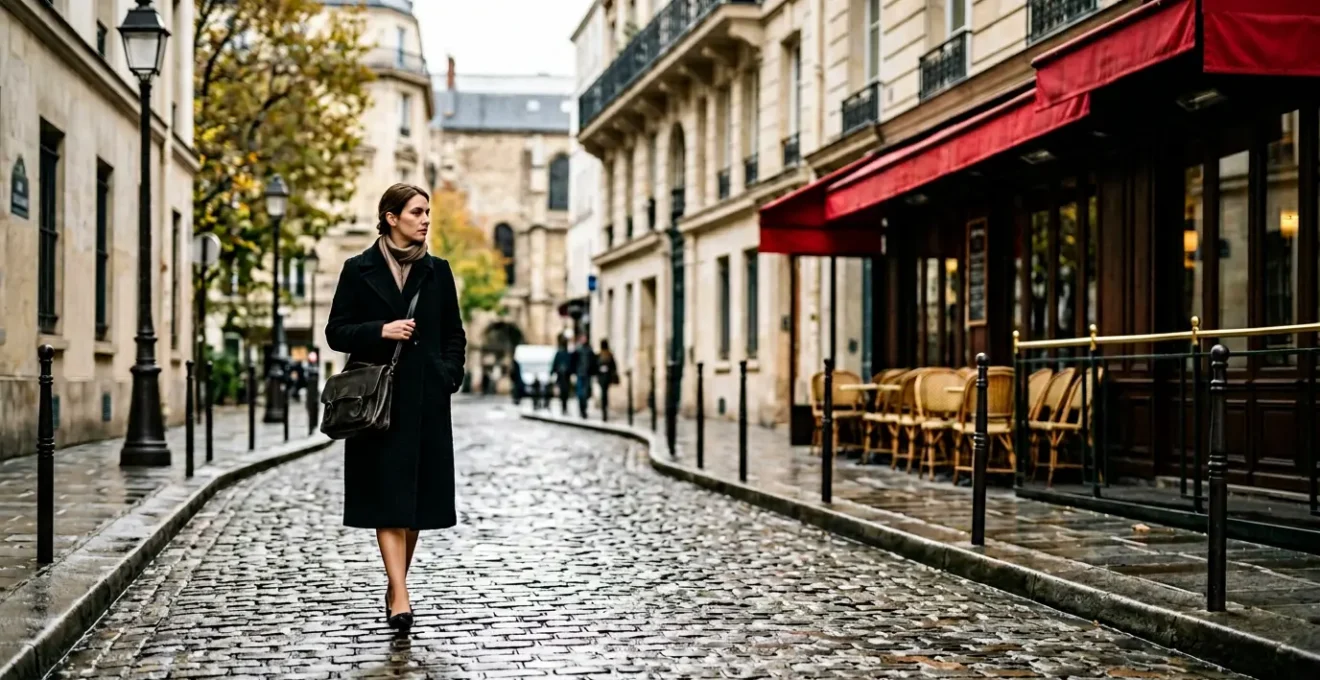
Saint-Germain’s « intellectual chic » isn’t a fashion trend; it’s a direct result of the neighborhood’s urban design and cultural history.
- Right Bank style is performative, born from Haussmann’s wide boulevards designed for public display.
- Left Bank style is introspective, rooted in preserved, human-scale streets that favor personal discovery over overt declaration.
Recommendation: To truly understand Parisian style, learn to read a district’s streets, shops, and museums as a complete cultural text.
You arrive in Paris, a city synonymous with style, yet the code seems to shift with every arrondissement you cross. The brash, logo-centric energy of the Champs-Élysées feels a world away from the quiet, curated boutiques of Saint-Germain-des-Prés. As a culture-focused traveler, you sense there is a deeper logic at play, a story that goes far beyond the simplistic advice found in most fashion guides.
You’ve likely read the clichés: trench coats, effortless hair, a philosophical book tucked under one arm. But this postcard image barely scratches the surface of a complex fashion ecosystem. The famous dichotomy between the Right Bank (Rive Droite) and Left Bank (Rive Gauche) is real, but its origins are often misunderstood, reduced to a mere list of stereotypes. It’s not just about flashy versus discreet; it’s about two fundamentally different ways of experiencing the city.
What if the secret to Parisian style, particularly the elusive ‘intellectual chic’ of Saint-Germain, lies not in the clothes themselves, but in the very streets you walk upon? This is an exploration of fashion as urban sociology, an analysis of how the city’s physical form shapes its aesthetic soul. The style of a Parisian is a spatial philosophy, an unconscious response to the architecture that surrounds them. It’s a dialogue between the individual and the city itself.
We will journey from the grand, performative stages of Haussmann’s boulevards to the restored medieval alleys of the Marais. Together, we will decode the unspoken dress codes of each bank, investigate the cultural institutions that anchor them, and ultimately reveal why Saint-Germain remains the true epicenter of a style defined by thought, not just by appearance.
This guide offers a historical and sociological lens to understand the deeper currents of Parisian fashion. Below, we’ll explore the key districts and concepts that reveal how the city’s structure created its world-renowned style.
Summary: Why Saint-Germain-des-Prés Is the Undisputed Intellectual Heart of Parisian Style
- From Arcades to Mega-Stores: How Haussmann Changed Shopping Forever
- Right Bank vs. Left Bank: Which Dress Code Applies for Dinner Tonight?
- The Secret Museums Hidden Inside Famous Fashion Districts
- How the Marais Transformed from Medieval Slum to Trendy Hub in 40 Years
- The 2-Hour Route for Photographers Chasing « Emily in Paris » Vibes
- Café de Flore: Is It Just a Tourist Trap or a Fashion Institution?
- Musée Galliera or Musée des Arts Décoratifs: Which Fashion Exhibition is a Must?
- Why Saint-Germain is the Best District for Finding Intellectual Chic Fashion?
From Arcades to Mega-Stores: How Haussmann Changed Shopping Forever
Before the mid-19th century, shopping in Paris was an intimate, often cramped affair conducted in narrow streets and covered passages. The city’s medieval layout dictated a certain scale of commerce. But the arrival of Baron Haussmann and his radical transformation of Paris changed not only the city’s map but also its social dynamics. His vision was one of grand perspectives, wide boulevards, and imposing apartment blocks—a city built for circulation, sanitation, and spectacle.
This new urban fabric gave birth to a new kind of consumerism. As urban historians note, this was a deliberate shift in social behavior. The new boulevards were not just for getting from one place to another; they were public stages. This philosophy is perfectly captured by the observation that « The wide boulevards were designed for seeing and being seen, turning shopping from a necessity into a social performance. » This is the origin of the Right Bank’s performative style, where fashion becomes a tool for public declaration.
It was on these new arteries that the world’s first department stores, or *Grands Magasins*, like Printemps and Galeries Lafayette, took root. They were cathedrals of commerce, designed to overwhelm the senses and encourage a new, large-scale form of shopping. The legacy of this transformation is immense; the area remains a global shopping magnet, attracting 37 million visitors annually to its department stores alone. Haussmann didn’t just build streets; he built the physical and ideological foundation for modern luxury retail.
Right Bank vs. Left Bank: Which Dress Code Applies for Dinner Tonight?
The dress code for a Parisian evening is less about a specific set of rules and more about a state of mind dictated by geography. The Haussmannian legacy of performance finds its ultimate expression on the Right Bank. This is the realm of explicit luxury and declared status. As fashion district analyses often point out, « The Right Bank is the undisputed king of high fashion. The ‘Golden Triangle’ (Avenue Montaigne, George V, Champs-Élysées) and Rue Saint-Honoré host the flagship stores of Chanel, Dior, and Hermès. » Here, style is a statement, often articulated through recognizable brands and impeccable tailoring—a public display of success and taste.
The Left Bank, and Saint-Germain-des-Prés in particular, proposes a radically different philosophy. Having largely escaped Haussmann’s sweeping changes, its geography of smaller streets, hidden courtyards, and human-scale buildings fosters an introspective style. The ‘dress code’ here is one of personal narrative. It values discretion, quality, and an « aesthetic of provenance »—the idea that an item’s worth comes from its story, craftsmanship, or the intelligence with which it was chosen, not its logo.
The essence of this Left Bank aesthetic is captured not in grand gestures, but in quiet details and textures. It is a language of subtle signals understood by those who share the same cultural values.
As this image suggests, the focus is on patina, quality materials, and objects with a sense of history. It’s about building a personal collection of meaningful pieces over time—a practice of curated consumption that stands in direct opposition to the fast-paced, trend-driven performance of the Right Bank. The choice is not between formal and casual, but between declaration and conversation.
The Secret Museums Hidden Inside Famous Fashion Districts
To view Paris’s shopping districts as merely commercial zones is to miss the rich historical layers embedded within them. The city is an urban palimpsest, where centuries of history coexist, often in the most unexpected places. Wandering through a bustling fashion district can simultaneously be a journey back in time, provided you know where to look. These « secret » museums are not just repositories of art; they are preserved fragments of the very lifestyles that shaped the city’s character.
These institutions offer a quiet counter-narrative to the relentless modernity of retail. They are pockets of history that reveal the social and cultural DNA of a neighborhood, reminding us that before these streets were lined with storefronts, they were home to aristocrats, artists, and intellectuals. They are essential stops for any traveler seeking to understand the soul of a place, not just its surface.
Case Study: The Time Capsule on Boulevard Haussmann
A prime example is the Musée Jacquemart-André, located at No. 158 Boulevard Haussmann. While surrounded by the grand department stores and frantic energy of a major commercial artery, this magnificent Second Empire mansion is a perfectly preserved time capsule. It displays the vast collection of Italian and Flemish art amassed by Nélie Jacquemart and Édouard André in the exact setting they designed. Visiting the museum is like stepping into the private world of the 19th-century Parisian elite, offering an intimate glimpse into the wealth, taste, and lifestyle that Haussmann’s boulevards made possible.
These heritage sites act as crucial anchors, providing context and depth to the shopping experience. They prove that in Paris, culture and commerce are not separate activities but are deeply, and often beautifully, intertwined.
How the Marais Transformed from Medieval Slum to Trendy Hub in 40 Years
The story of the Marais is one of the most dramatic tales of urban transformation in modern Paris. Once the aristocratic heart of the city in the 17th century, it had fallen into disrepair by the 20th, becoming an overcrowded, dilapidated, and largely forgotten « slum. » Its magnificent *hôtels particuliers* (private mansions) were crumbling, and the district was slated for the kind of wholesale demolition that defined much of post-war urban planning.
The pivotal moment that saved the Marais from oblivion was a shift in cultural policy, spearheaded by the then-Minister of Culture, André Malraux. As academic analyses of the period show, on August 4, 1962, a law was promulgated that marked a radical new approach to heritage. Instead of just protecting individual monuments, the « Malraux law » aimed to preserve the character of entire historic districts. This initiated a massive, decades-long project of urban renewal and restoration in the Marais.
This careful preservation of the medieval and Renaissance street plan—with its narrow, winding roads and hidden courtyards—created an urban environment fundamentally different from Haussmann’s grand boulevards. This human-scale environment proved to be the perfect breeding ground for a new kind of commerce: small, independent boutiques, artisan workshops, and avant-garde galleries. The act of shopping here became one of discovery and exploration.
The result is the trendy, vibrant hub we know today. The Marais’s success demonstrates how a spatial philosophy based on preservation can foster a unique economic and aesthetic ecosystem. It is a testament to the idea that sometimes, the most innovative act is to protect the past, allowing its character to shape the present.
The 2-Hour Route for Photographers Chasing « Emily in Paris » Vibes
The global success of shows like « Emily in Paris » has created a specific, often clichéd, visual language for the city: bright colors, famous landmarks, and a relentlessly cheerful aesthetic. For the culture-focused traveler, however, the real beauty of a neighborhood like Saint-Germain-des-Prés lies in its texture, its history, and its mood—qualities often lost in the hunt for the perfect Instagram shot. Chasing the « vibe » often means missing the soul.
An alternative approach to photographing the district is to adopt the mindset of its intellectual heritage: to observe, to reflect, and to capture the subtle poetry of the everyday. This means turning your lens away from the obvious and focusing on the details that tell the true story of the place. It’s about capturing the feeling of the neighborhood, not just its likeness. The following plan is a strategy for seeing Saint-Germain with the eyes of a historian and a sociologist, not just a tourist.
Action Plan: Capturing an Authentic Saint-Germain
- Begin with narrow cobblestone passages around Rue de Buci, focusing on the interplay of texture and shadow, especially in the gentle morning light.
- Photograph the worn patina of historic building details: search for unique door handles, brass mailboxes, and weathered stone facades that speak of age.
- Capture solitary, contemplative moments: a reader silhouetted in the warm light of a café window, or empty chairs on a rain-slicked terrace after a shower.
- Experiment with desaturated colors or classic black-and-white processing to emphasize form, texture, and mood over the bright, saturated aesthetics of social media.
- Focus on negative space and thoughtful composition; create images that feel quiet and reflective rather than crowded with landmarks.
This photographic route is not about collecting trophies but about engaging in a dialogue with the neighborhood. It’s a way to create a visual record that reflects the district’s true character: thoughtful, layered, and enduring.
Café de Flore: Is It Just a Tourist Trap or a Fashion Institution?
For many visitors, the iconic Art Deco facade of the Café de Flore on Boulevard Saint-Germain represents a crossroads of perception. On one hand, it is undeniably a major tourist destination, with prices and crowds to match. It is easy to dismiss it as a place that trades on a past glory it no longer embodies. Yet, to do so would be to ignore its deep, continuous, and living relationship with the worlds of literature, art, and, most importantly, fashion.
The café’s legacy is built on the ghosts of its past clientele—Jean-Paul Sartre and Simone de Beauvoir holding court, forging existentialism over coffee. This intellectual heritage is the bedrock of its identity. As one fashion industry insider eloquently stated when reflecting on its importance:
The decadent and intelligent clientele make it the city’s place to be. As someone who writes and works in fashion spending time in a place frequented by Jean Paul Sartre, Simone de Beauvoir, and then Yves Saint Laurent and Karl Lagerfeld brings out the stan in me.
– Fashion industry insider, Fashion Insiders On Why Café de Flore Is a Fashion Week Landmark
This seamless lineage from thinkers to designers is crucial. The café became a place where creative energy was not just consumed but generated. Its status as a fashion institution is not merely symbolic; it is concrete. Over the years, its famous terrace and interior have served as the backdrop for a roster of events including fashion shows for Chanel, Yves Saint Laurent, Chloé, and Paco Rabanne. It is a place where fashion history was, and still is, being made. So, while it may perform the role of a tourist trap by day, it remains an authentic cultural institution.
Musée Galliera or Musée des Arts Décoratifs: Which Fashion Exhibition is a Must?
For the fashion-conscious traveler in Paris, choosing between the city’s two premier fashion museums can be a challenge. Both the Palais Galliera, the Musée de la Mode de la Ville de Paris, and the Musée des Arts Décoratifs (MAD) mount world-class exhibitions. However, they operate from two very different philosophical standpoints. The right choice depends entirely on what question you are asking about fashion.
The Palais Galliera is a temple to fashion as an object of art. Its focus is often on the designer as an auteur and the garment as a masterpiece of craftsmanship. The MAD, on the other hand, is an institution of decorative arts and design, and it situates fashion within a broader cultural context. A comparative analysis of the city’s offerings reveals this fundamental difference in their approach, which can be summarized as follows:
| Criterion | Musée Galliera | Musée des Arts Décoratifs (MAD) |
|---|---|---|
| Primary Focus | Fashion as Object (the ‘What’) | Fashion as Concept (the ‘Why’) |
| Approach | Chronological designer history, garment craftsmanship | Fashion intersecting with design, art, culture, society |
| Exhibition Style | Focus on individual pieces, trends timeline | Contextual framework showing cultural roots of style |
| Ideal For | Fashion purists seeking garment details | Contextualists exploring intellectual fashion framework |
| Intellectual Chic Alignment | Moderate—celebrates craft but not cultural depth | High—mirrors article’s exploration of style’s cultural roots |
For the traveler seeking to understand the ‘why’ behind Parisian style—the very theme of this exploration—the Musée des Arts Décoratifs is the essential destination. Its exhibitions consistently frame fashion not in a vacuum, but as a response to social change, artistic movements, and technological innovation. It treats style as a cultural document, making it the perfect intellectual complement to a physical exploration of the city’s streets.
Key Takeaways
- Parisian style is inseparable from its urban environment; Haussmann’s boulevards encourage « performative » fashion, while preserved districts foster « introspective » style.
- « Intellectual chic » is less about specific items and more about a philosophy of curated consumption and valuing an aesthetic of provenance over logos.
- To truly understand Paris, look beyond landmarks to the textures, hidden histories, and cultural institutions that give each neighborhood its unique fashion soul.
Why Saint-Germain is the Best District for Finding Intellectual Chic Fashion?
We arrive at the central question. After exploring the performative nature of the Right Bank and the discovery-based culture of the Marais, it becomes clear why Saint-Germain-des-Prés holds its title as the heart of intellectual chic. It is not just one factor, but a perfect convergence of history, urbanism, and culture. The district represents a powerful resistance to the Haussmannian model of spectacle. Its preserved, human-scale streets create a spatial philosophy that favors intimacy and thoughtfulness over grand public display.
This is the ground where literary and philosophical movements flourished, creating a deep-seated cultural value for ideas over appearances. As the neighborhood’s intellectual reputation grew, it began to attract a new kind of commerce. In the 1960s, the fashion world took notice, and as one historical analysis notes, « luxury brands such as Yves Saint Laurent, Louis Vuitton and Dior compete to own a boutique in the chic Saint-Germain des Prés district. » This creates a fascinating tension: the very culture of anti-ostentation has become a highly desirable brand, attracting the forces of global luxury it once defined itself against.
Yet, the core ethos of the Left Bank persists, perfectly embodied in its approach to shopping. It’s an ethos of deliberate choice, not impulsive buying.
The Left Bank Ethos: Shopping as Curation
The Left Bank shopping experience embodies a quieter personality, characterized by small ateliers, vintage boutiques, and artisan discoveries. The joy lies in uncovering pieces with provenance. Le Bon Marché, the district’s iconic department store, exemplifies this with its curated, almost museum-like approach to retail, allowing for calm browsing even on the busiest days. This represents shopping as an act of editing a personal collection—one great piece at a time—rather than racing through racks. It is the perfect expression of the intellectual chic philosophy: conscious consumption over overt wealth display.
Saint-Germain-des-Prés remains the epicenter of intellectual chic because it is a place where style is still treated as a form of self-expression rooted in culture, not just a transaction. It’s a neighborhood that asks you to think about what you wear, not just what it costs.
Now, equipped with this new lens, it’s time to revisit the streets of Paris. Instead of just shopping, start reading the city. Explore a boutique, visit a museum, or simply sit at a café, and ask yourself: what story is this place telling me? That is the true heart of Parisian style.