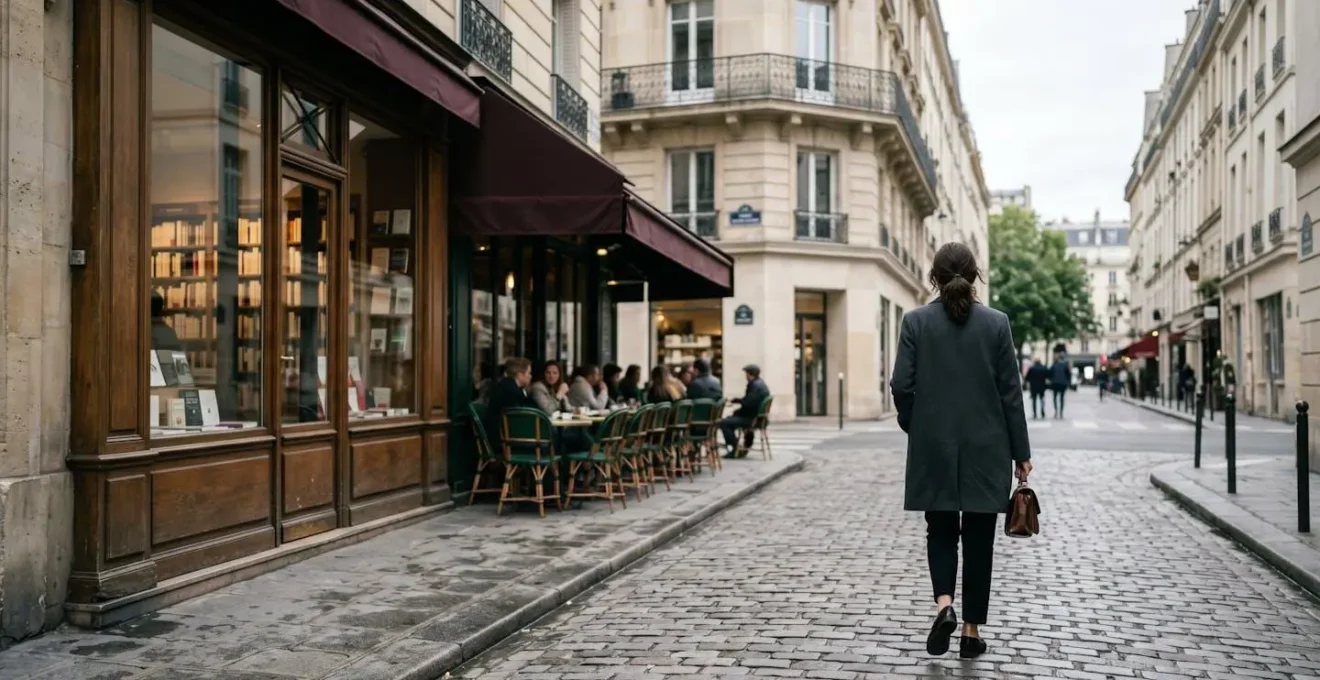
True Saint-Germain style has little to do with brands and everything to do with a philosophy of intellectual authenticity.
- It is built on cultural engagement and personal history, not just on shopping for the latest trends.
- It values the story behind a piece—its craftsmanship, its patina, its « intellectual provenance »—over visible logos.
Recommendation: Cultivate your wardrobe by focusing on quality materials, timeless cuts, and pieces that tell a story, reflecting a life rich in culture and thought.
The pursuit of « Parisian chic » often leads down a well-trodden path of clichés: a striped marinière, a slick of red lipstick, a perfectly tied scarf. For the discerning woman, however, true elegance lies beyond these surface-level signifiers. It resides in a specific corner of Paris, a place where style is not merely worn but is thought, debated, and lived. This is Saint-Germain-des-Prés, the enduring epicenter of intellectual chic. Many guides will point you toward specific shops or tell you to invest in a trench coat, but they miss the fundamental point.
This approach mistakes the uniform for the philosophy. The understated elegance of the Rive Gauche woman is not an accident of « effortless » style; it is a deliberate, curated expression of an inner world. It is a wardrobe deeply connected to literature, art, and a certain existentialist heritage that values authenticity above all. But what if the key to this coveted aesthetic wasn’t about what you buy, but about how you think? What if your wardrobe could become a library of personal stories and cultural touchstones, rather than a collection of brand names?
This guide moves beyond the platitudes to decode the sartorial philosophy of Saint-Germain. We will explore its iconic institutions not as tourist spots but as fashion classrooms, uncover the secrets of its discreet boutiques, and understand the mindset that transforms a simple outfit into a statement of intellectual identity. By the end, you will understand why this district’s style is not a fleeting trend, but a timeless way of being.
To help you navigate this unique sartorial world, this article breaks down the essential elements of the Saint-Germain style. The following summary outlines the key pillars we will explore, from its hallowed cafes to the very philosophy that defines its dress code.
Summary: Unlocking the Essence of Rive Gauche Style
- Café de Flore: Is It Just a Tourist Trap or a Fashion Institution?
- Where to Buy Rare Perfumes That Are Not Sold at Sephora?
- Bonpoint and Beyond: Why is French Children’s Fashion So Expensive?
- How to Master the « Bobo » Look With Just 3 Key Pieces from the Left Bank?
- Which Art Gallery is Worth Visiting Between Two Fittings?
- Right Bank vs. Left Bank: Which Dress Code Applies for Dinner Tonight?
- Musée Galliera or Musée des Arts Décoratifs: Which Fashion Exhibition is a Must?
- Why Saint-Germain-des-Prés Remains the Intellectual Heart of Parisian Style?
Café de Flore: Is It Just a Tourist Trap or a Fashion Institution?
To dismiss Café de Flore as a mere tourist trap is to overlook its vital, living role as a catwalk and crucible for Parisian style. While the crowds do flock for a photo, the real magic happens at the tables occupied by editors, designers, and modern-day intellectuals. It is a place where history and the present moment are in constant, stylish dialogue. The ghosts of Sartre and de Beauvoir mingle with the creative directors of today, all seeking inspiration from the same red banquettes and mosaic floors.
This legendary café’s enduring relevance is cemented during Paris Fashion Week. As one fashion insider noted for Highsnobiety, its allure is undeniable. The decadent and intelligent clientele make it the city’s place to be. As someone who writes and works in fashion spending time in a place frequented by Jean Paul Sartre, Simone de Beauvoir, and then Yves Saint laurent and Karl Lagerfeld brings out the stan in me.
The café transforms into an unofficial headquarters for the fashion elite. It has served as a backdrop for shows by Chanel and Saint Laurent, but its more subtle role is as a meeting point for industry insiders between appointments. It functions as a living case study of its dual identity: a historical landmark that is also an active participant in contemporary culture. Observing the patrons is a lesson in studied carelessness—the art of looking impeccably put-together without appearing to have tried. It’s not just about the coffee; it’s about absorbing the ambiance of a place where great ideas and great style have always coexisted.
As the image suggests, the Flore aesthetic is in the details: the texture of a cashmere cuff, the patina on a leather bag, the weight of a porcelain cup. It’s a sensory experience that grounds you in a tradition of quality and thoughtfulness. This is where you understand that intellectual chic is less about being seen and more about what you see and feel.
Where to Buy Rare Perfumes That Are Not Sold at Sephora?
The Saint-Germain approach to fragrance follows the same philosophy as its fashion: it prioritizes story, craftsmanship, and individuality over mass-market appeal. Forget the sprawling, brightly-lit halls of department stores. The real olfactory treasures are found in intimate, atelier-like boutiques that feel more like apothecaries or private libraries. These are places where scent is treated as a form of personal expression, a final, invisible accessory that speaks volumes about your taste and intellect.
The goal is to find a signature scent that feels like it was made just for you, a fragrance with intellectual provenance. These are not the perfumes advertised in glossy magazines, but rather complex compositions from master perfumers who focus on rare ingredients and artistic integrity. Boutiques like L’Artisan Parfumeur, Diptyque (born on Boulevard Saint-Germain), and the exquisite Officine Universelle Buly offer this very experience. They provide a sanctuary for the senses, inviting you to take your time and discover a narrative in a bottle.
The experience at a place like Buly is a perfect example of this philosophy in action. As described by Urbansider, it’s a journey back in time:
L’Officine Universelle Buly, originating in 1803, has been brought back to life in recent years. The shop is reminiscent of an ancient apothecary and features an array of moisturizing creams, botanical-based lotions and exotically flavored toothpastes, all elegantly displayed in hand-illustrated packaging.
– Urbansider, The Best Shopping in Saint Germain
Choosing a perfume here is not a transaction; it’s a cultural act. It’s about appreciating the heritage, the art of the packaging, and the quality of the raw materials. It aligns with the Rive Gauche mindset that the most luxurious things in life are those that carry a deep sense of history and authenticity, things that cannot be found everywhere.
Bonpoint and Beyond: Why is French Children’s Fashion So Expensive?
The seemingly exorbitant price of French children’s fashion, epitomized by Saint-Germain’s own Bonpoint, can be perplexing. Why spend so much on clothes that will be outgrown in a season? The answer lies in a quintessentially Rive Gauche philosophy that views these garments not as disposable items, but as cultural investments and future heirlooms. It’s an extension of the adult wardrobe’s focus on quality, craftsmanship, and timelessness.
Bonpoint, a brand that has been one of the most sought-after labels for kids aged 0-12 since 1975, is not just selling clothes; it’s selling a piece of a certain French ‘art de vivre’. The philosophy centers on celebrating childhood with pieces made from the finest materials—cashmere, Liberty prints, soft cotton—and constructed with meticulous attention to detail in their Parisian atelier. Features like adjustable waistbands and generous hems are designed to extend the life of a garment, allowing it to be passed down through a family. This transforms a simple dress or coat into an object imbued with memory and history.
This approach treats children’s clothing with the same seriousness as couture. As the brand’s heritage suggests, these are pieces designed to last. Generations of elegant children have grown up wearing Bonpoint’s creations, from the Kennedys to the Obamas, the fashion house’s designs are considered heirloom staples of childhood. The high cost reflects not just the superior materials, but this belief in longevity and the value of passing on well-made, beautiful things. It’s a direct rejection of the fast-fashion mentality, even for the youngest members of the family.
Ultimately, the expense is a testament to a culture that values beauty and quality in every aspect of life. It’s about instilling an appreciation for craftsmanship from a young age and understanding that some things are worth investing in because they carry more than just a price tag—they carry a story.
How to Master the « Bobo » Look With Just 3 Key Pieces from the Left Bank?
The « Bobo » (bourgeois-bohème) look is the modern incarnation of Saint-Germain’s intellectual chic. It’s a style that perfectly balances sophistication with a relaxed, artistic sensibility. However, mastering it isn’t about buying a pre-packaged outfit. It’s about curating a few conceptual pieces that communicate a worldview. This look is an attitude, a way of signaling your cultural values without saying a word. It’s about rediscovering your roots and personal history in a contemporary context.
Rather than a prescriptive shopping list, the Bobo look is built on three core principles. Mastering these concepts will do more for your style than acquiring any specific item. It is the art of curating a wardrobe that reflects a rich inner life. The secret is to focus on pieces that embody these ideas:
- Invisible Luxury: This is the cornerstone. It’s a perfectly cut, unbranded cashmere sweater, a structured coat in a sublime fabric, or trousers with impeccable tailoring. The value is in the tactile quality and the cut, not a logo. It whispers elegance to those who know, rather than shouting a brand name to the masses.
- Intellectual Provenance: Your accessories should tell a story about where you’ve been and what you care about. This could be a canvas tote bag from a small art gallery exhibition, a book you’re actually reading from the iconic Gallimard publisher, or a vintage scarf found in a hidden market. These items demonstrate that your style is an authentic extension of your cultural life.
- Beautiful Wear: The Bobo philosophy rejects the obsession with newness. Embrace pieces that show their history. A well-loved leather satchel with a rich patina, a pair of boots that have walked city streets for years, or vintage denim that has molded to your body. These items celebrate longevity and personal history, embodying a powerful anti-fast-fashion statement.
By focusing on these three pillars—quality over branding, cultural signifiers over fashion trends, and history over novelty—you capture the true spirit of the Rive Gauche. It’s a deeply personal and sustainable approach to style that is both timeless and profoundly modern.
Which Art Gallery is Worth Visiting Between Two Fittings?
In Saint-Germain-des-Prés, fashion and art are not separate pursuits; they are neighbors engaged in a constant, inspiring dialogue. The streets are a living museum where chic boutiques sit alongside prestigious art galleries. To truly absorb the district’s aesthetic, one must engage with its art scene. A visit to a gallery between shopping stops is not a distraction; it’s an essential part of the style education, a way to train your eye and connect with the creative spirit that defines the area.
The district boasts an incredible density of galleries, creating an ecosystem where visual art and sartorial expression naturally intertwine. You can find major international players like Galerie Kamel Mennour, which often showcases contemporary giants in stunning ‘hôtels particuliers’ (private mansions), creating a powerful juxtaposition of modern art and historic architecture. The area is a paradise for art lovers and fashion enthusiasts alike, a place where you can discover both classic and contemporary works just steps from your favorite designer’s boutique.
Beyond the traditional commercial galleries, Saint-Germain is home to unique cultural spaces that further blur the lines. The Espace Fondation EDF, a reconverted electrical substation, hosts thought-provoking exhibitions on societal themes, while the historic Collège des Bernardins, a 13th-century Cistercian building, presents a dialogue between heritage and contemporary creation through art, concerts, and conferences. Visiting these places provides a deeper context for the Rive Gauche aesthetic, reminding you that style here is intrinsically linked to a broader cultural curiosity.
Action Plan: Auditing Your Personal Style-Culture Dialogue
- Points of Contact: List all the channels where your style currently intersects with culture. Do you buy books? Visit museums? Attend concerts? Note these cultural touchpoints.
- Collect & Inventory: Look through your wardrobe and identify existing pieces of « intellectual provenance. » This could be a t-shirt from a museum, jewelry from an artisan, or a bag from a trip.
- Coherence Check: Confront your aesthetic with your values. Does your wardrobe reflect your intellectual and artistic interests, or is it dictated by trends? Identify any disconnects.
- Memorability Audit: Separate your unique, story-filled pieces from the generic ones. The goal is to understand what makes your style memorable and personal, and what is simply filler.
- Integration Plan: Based on your audit, create a small, actionable plan. It might be deciding to buy your next souvenir from a gallery shop instead of an airport, or seeking out a local designer on your next trip.
Right Bank vs. Left Bank: Which Dress Code Applies for Dinner Tonight?
The Seine is more than a river dividing Paris; it’s a symbolic line separating two distinct philosophies of life and, consequently, of style. Understanding the difference between the Rive Droite (Right Bank) and Rive Gauche (Left Bank) is crucial to navigating the city’s social and sartorial codes. This is not a myth; as journalist Philippe Labro observed, « You don’t see the same people, the same look, not even the same body language. » This sartorial split, which can be traced back to the 11th-12th century origins of the city’s development, remains palpable today.
The Right Bank, home to the grand avenues, luxury flagships of the Golden Triangle, and opulent palaces, embodies a style of deliberate, glamorous statement dressing. It’s about being seen, making an impact, and showcasing success. Logos, high heels, and structured, head-to-toe « looks » are the currency here. The Right Bank is chic, sophisticated, and unapologetically polished. In contrast, the Left Bank, the historical domain of artists, writers, and academics, champions an intellectual, intimate, and understated elegance. The dress code is built on the Italian concept of sprezzatura—a studied carelessness that conceals the immense thought put into an outfit.
The difference is a matter of philosophy. On the Left Bank, your most important accessory is your intellect, your conversation, and your cultural references. The clothes are a backdrop for the person, not the main event. The following table, based on a comparative analysis of the two banks’ cultures, breaks down these unwritten rules:
| Aspect | Left Bank (Rive Gauche) | Right Bank (Rive Droite) |
|---|---|---|
| Philosophy | Sprezzatura (studied carelessness) | Deliberate statement dressing |
| Key Characteristic | Intellectual, artistic, intimate | Chic sophistication, glamorous |
| Typical Outfit | Great sweater, perfect jeans, conversation-piece jewelry | Logos, heels, structured ‘look’ |
| Body Language | Leaning into conversation, gesticulating, comfort-focused | Posture-conscious, being seen, visual impact |
| Shopping Style | Boutique hotels, artisanal items, hidden gems | Golden Triangle luxury flagships (Chanel, Dior, Hermès) |
| Dining Example | Brasserie Lipp – understated, intellectual atmosphere | Loulou (Musée des Arts Décoratifs) – see-and-be-seen |
| Main Accessory | Your intellect and cultural references | Designer handbag or statement piece |
So, for dinner tonight? If you are on the Left Bank, opt for an outfit that prioritizes beautiful materials and a personal touch over overt branding. If you’re on the Right Bank, embrace the glamour and make a statement. Knowing the code is the ultimate sign of a true insider.
Musée Galliera or Musée des Arts Décoratifs: Which Fashion Exhibition is a Must?
For the fashion-conscious visitor, Paris offers two premier destinations for costume and design: the Musée Galliera on the Right Bank, the city’s official fashion museum, and the Musée des Arts Décoratifs, with its extensive fashion and textile collections, housed within the Louvre palace. Both mount world-class exhibitions. Yet, for the woman seeking to understand the soul of Saint-Germain style, the answer to « which one is a must? » is, counterintuitively, perhaps neither. The true Rive Gauche education happens outside these grand institutions.
The Left Bank itself has become a byword for a particular style of life, with connotations of high style, the avant-garde, and intellectualism. To truly experience it, one must immerse oneself in its own, more intimate venues. The most « must-see » exhibition may not be the blockbuster show, but a smaller, more focused presentation at a place like the Fondation Azzedine Alaïa in the Marais, just across the river. This foundation, dedicated to the legendary couturier who valued craftsmanship above all, offers a purer, more personal connection to the art of fashion, perfectly echoing the Rive Gauche spirit.
Furthermore, the ultimate « exhibition » is arguably Le Bon Marché Rive Gauche itself. Opened in 1852 as the world’s first modern department store, it remains a temple of style that is deeply embedded in the district’s history. Far more than a place to shop, its architecture, curated selection, and cultural events make it a living museum of Parisian chic. Wandering its aisles offers a more tangible connection to the heritage of craftsmanship and the evolution of taste than viewing clothes behind glass.
The Saint-Germain philosophy suggests that fashion is not something to be passively observed in a museum, but to be actively lived and discovered. The essential « must-do » is therefore not to choose between Galliera and Arts Déco, but to embrace a mindset of curiosity. The real sartorial lesson lies in exploring the smaller foundations, the heritage department stores, and the very streets where history, creativity, and high fashion intersect.
Key Takeaways
- Style as Philosophy: Rive Gauche chic is an intellectual posture, valuing authenticity and personal history over fleeting trends.
- Intellectual Provenance: The most valuable accessories are not branded goods, but items that tell a story about your cultural life (e.g., a bookstore tote, an artisan’s jewel).
- The Beauty of Wear: Embracing patina and longevity in clothing is a core principle, a direct counterpoint to fast fashion’s obsession with newness.
Why Saint-Germain-des-Prés Remains the Intellectual Heart of Parisian Style?
Saint-Germain-des-Prés’ status as the heart of intellectual style is not an accident of geography but the direct legacy of a philosophical movement. The district’s sartorial identity was forged in the smoky cafes and jazz clubs of the post-war era, where the existentialists—Jean-Paul Sartre, Simone de Beauvoir, Albert Camus—held court. The area became the epicenter of this major 1940s-1950s cultural movement, and their philosophy of authenticity, freedom, and responsibility became encoded into the very way people dressed.
This was not fashion for fashion’s sake; it was a uniform of substance. Existentialism rejected bourgeois artifice in favor of what was real and essential. This translated into a preference for understated, functional, and timeless clothing. As The Parisian Touch brilliantly observes in its analysis of this « Philosophical Dressing, » their wardrobes were a direct reflection of their ideas:
Their wardrobes were coded in philosophy: the simplicity of a trench coat, the austerity of wool trousers, the worn-in leather satchel that held drafts of essays and love letters alike.
– The Parisian Touch, Philosophical Dressing: Sartre, Beauvoir, & the Existentialists
This principle—that your clothes should serve your life, not the other way around—remains the bedrock of Rive Gauche style. It’s a look built on durable, high-quality pieces that gain character with age, reflecting a life of thought and experience. This heritage continues to inspire the fashion industry, with brands creating ‘Existential retail’ experiences that urge customers to ponder ‘what truly matters’ rather than just consume. It is a powerful legacy that prioritizes personal meaning over external validation.
Today, while the existentialists are gone, their spirit endures. The intellectual chic of Saint-Germain is still defined by this search for authenticity. It’s found in the preference for an independent bookstore over a chain, an artisan-made object over a mass-produced one, and a perfectly worn-in blazer over the latest « it » item. It is a style that asks not « what brand is that? » but « what is the story behind it? » This is why Saint-Germain-des-Prés is, and will remain, the true intellectual heart of Parisian style.
Now that you understand the philosophy, the next step is to begin curating a wardrobe that is not just a collection of clothes, but a reflection of your own intellectual and cultural identity.