A €50,000 haute couture dress is not an overpriced garment; it’s a meticulously engineered financial instrument that powers the global luxury market.
- It acts as a ‘loss-leader laboratory’, funding the research and development for mainstream fashion trends.
- It subsidizes the preservation of endangered craftsmanship, now recognized as a UNESCO-level cultural asset.
Recommendation: Instead of viewing the price as a cost, see it as an investment in a brand’s entire ecosystem, from fragrance to accessories.
The figure is staggering: €50,000, €100,000, sometimes even more, for a single dress. For the uninitiated, the world of haute couture seems like an exercise in pure extravagance, a baffling expenditure that defies logic. The common explanations—that it uses « nice fabrics » or is « handmade »—feel entirely insufficient to bridge the gap between a standard luxury garment and a piece that costs as much as a sports car. This reaction is understandable, but it stems from a fundamental misunderstanding of the product.
Viewing a haute couture dress through the lens of a consumer product is the primary error. It is not, in its essence, just clothing. To truly understand its price, one must adopt the perspective of a luxury industry analyst. The €50,000 price tag is not an arbitrary number but the sum of a complex equation involving legally protected scarcity, immense labor costs, research and development expenditure, and a powerful marketing strategy.
This article will deconstruct that price tag. We will move beyond the platitudes of « artistry » and « craftsmanship » to analyze the dress as a strategic asset. We will explore the legally defined barriers to entry, quantify the human capital invested in a single sleeve, and reveal how this seemingly unprofitable venture fuels a multi-billion dollar ecosystem of perfume, lipstick, and ready-to-wear. It is an economic model where the dress itself is only the beginning of the story.
To fully grasp the intricate financial and cultural mechanisms that underpin this exclusive world, this analysis will break down the key pillars that constitute the true value of a haute couture piece. The following sections will guide you through the legal frameworks, the unparalleled craftsmanship, the client experience, and the strategic marketing that all contribute to its final cost.
Summary: What Actually Justifies the €50,000 Price Tag of a Haute Couture Dress?
- Haute Couture vs. Ready-to-Wear: What Legal Criteria Define the Label?
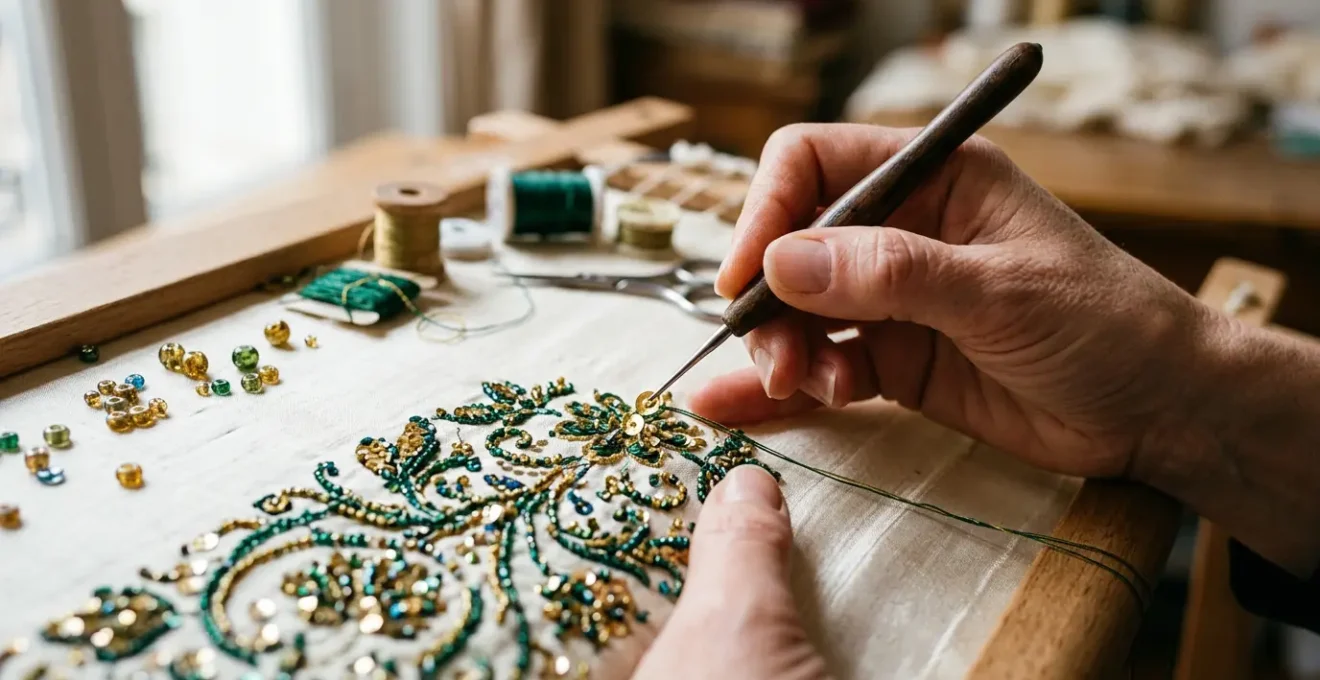
- Why Does It Take 200 Hours to Embroider a Single Chanel Sleeve?
- How Does a Private Fitting at Dior 30 Montaigne Actually Work?
- Is Haute Couture Still Relevant or Just a Marketing Loss Leader?
- Why Did Yves Saint Laurent’s 1966 « Le Smoking » Shock the World?
- Why Was Grasse’s Know-How Listed as Intangible Cultural Heritage?
- Schiaparelli’s Return: How a Dead Brand Became the Hottest Name in Couture?
- How Luxury Brands Use « Heritage » to Justify Price Increases?
Haute Couture vs. Ready-to-Wear: What Legal Criteria Define the Label?
The first component of a couture dress’s price is not material, but legal. The term « haute couture » is not a subjective descriptor for expensive clothing; it is a legally protected and controlled designation. As CoutureNotebook aptly puts it:
Haute Couture is like Champagne, an ‘appellation contrôlée’ as the French say, which means that the name’s use is rigidly defined, strictly controlled and legally protected since 1945.
– CoutureNotebook, Haute Couture Definition, Clients & Prices article
This protection is granted by the French Ministry of Industry and managed by the Fédération de la Haute Couture et de la Mode. To earn and maintain this title, a house must meet a stringent set of criteria: design custom-made clothes for private clients with one or more fittings, have an atelier in Paris that employs at least 20 full-time technical staff, and present a collection of at least 50 original designs to the public every fashion season. This creates an immediate and formidable barrier to entry. According to the Fédération, there are only 13 official houses holding the ‘haute couture’ accreditation, with a handful of ‘correspondent members’.
This enforced scarcity is the foundational layer of value. Unlike a ready-to-wear brand that can scale production globally, a couture house is geographically and operationally constrained by law. The price, therefore, must reflect the cost of maintaining this Parisian infrastructure and adhering to these rules, while serving an infinitesimally small market. It is the price of membership in the world’s most exclusive club.
Checklist: Spotting True Haute Couture
- Designation: Is the brand an official member or guest member on the Fédération de la Haute Couture et de la Mode’s calendar?
- Atelier: Does the house maintain a dedicated workshop in Paris with at least 20 full-time staff?
- Process: Are the garments custom-made for private clients, involving multiple, in-person fittings?
- Collection: Does the house present two collections a year, each with at least 50 unique looks?
- Handiwork: Is the vast majority of the work, from sewing to embroidery, performed by hand?
Why Does It Take 200 Hours to Embroider a Single Chanel Sleeve?
The second, and most significant, cost driver is the immense investment in human capital. The platitude « it’s handmade » drastically undersells the reality. We are not talking about simple sewing. A single haute couture garment is the culmination of thousands of hours of labor by master artisans, known as *petites mains* (little hands), who possess skills that are often centuries old and on the verge of extinction.
Industry sources reveal that one dress can take more than 1,000 hours of work, with a team of four to ten specialists working on it. This labor is not interchangeable; it involves specialized ateliers for pleating (plissage), feather work (plumasserie), embroidery (broderie), and more. The cost of a dress, therefore, is not just for fabric, but for the salaries and preservation of these unique skill sets. To secure this supply chain of talent, major houses have actively acquired these small, often struggling, ateliers.
Case Study: Chanel’s « Economic Moat » with Métiers d’Art
In 2002, Chanel created the subsidiary company Paraffection to acquire and preserve endangered Parisian ateliers, including the famed embroiderer Lesage and feather-maker Lemarié. This was not just an act of patronage but a strategic move to create an economic moat, securing exclusive access to the world’s best craftsmanship. By owning the means of production, Chanel ensures its competitors cannot easily replicate its quality. This investment is reflected in the price: a Lesage-embroidered jacket can cost around $60,000. The Yves Saint Laurent « Sunflowers » jacket, embroidered by Lesage, reportedly required over 770 hours of handwork for the embroidery alone, justifying its astronomical value through sheer, quantifiable human effort.
This strategy transforms craftsmanship from a simple labor cost into a protected, intangible cultural asset. The price of the dress is a direct subsidy for the survival of this artisanal ecosystem. You are not just buying a sleeve; you are paying for the 200 hours it took to embroider it and the decades of experience required to make those 200 hours possible.
How Does a Private Fitting at Dior 30 Montaigne Actually Work?
Beyond the legal framework and the physical creation, a significant portion of the price is allocated to the service: the client experience. Buying haute couture is not a retail transaction; it is an intimate, bespoke service reserved for an incredibly small group of individuals. While numbers are hard to pin down, industry estimates suggest that there are no more than 4,000 haute couture clients worldwide. For this elite clientele, the process is as important as the product.
It begins with a private appointment at a historic salon, like Dior’s at 30 Avenue Montaigne. The client views the collection, often with the creative director present. Once a look is chosen, it is not simply altered; it is entirely recreated for the client’s body. A wooden mannequin (*mannequin de bois*) is built to the client’s exact measurements. This is followed by a series of fittings, typically three or more, where a toile (a prototype of the garment in cotton canvas) is adjusted directly on the client’s body. These fittings can happen in Paris or the atelier’s team can fly anywhere in the world to accommodate the client.
This level of personalization is absolute. As fashion expert von Nordheim explains, the goal is total perfection:
In haute couture you have fittings until the garment sits on the body like [it is] sprayed on.
– Fashion expert von Nordheim, European CEO
The cost must therefore cover not just the dress but this entire high-touch service infrastructure: the salaries of the dedicated client advisors, the premier-es d’atelier (heads of workshop), the travel expenses, and the immense overhead of maintaining these palatial flagship locations. It’s a cost structure more akin to commissioning a piece of architecture than to buying clothes. The price reflects a level of service and personalization that has no parallel in any other industry.
Is Haute Couture Still Relevant or Just a Marketing Loss Leader?
This is the central question for any analyst. If the client base is so small and the costs are so high, how does it make financial sense? The answer is that for most houses, direct profitability is not the primary goal. Haute couture operates as a « Loss-Leader Laboratory »—a strategic investment in marketing and innovation that pays dividends across the entire brand.
While the couture division itself may not be a major profit center, it is far from irrelevant. Research shows the Haute Couture Market was valued at USD 1.3 Billion in 2024 and is expected to reach USD 1.7 Billion by 2034. More importantly, it functions as the pinnacle of the brand pyramid, creating a powerful halo effect. As StyleCaster notes, brands « use it as a marketing vehicle to sell everything from perfume to lipstick to the average consumer. » This is the concept of perceived value arbitrage: the astronomical price and artistry of a single dress create a perception of quality and desirability that « trickles down » to more accessible products.
The millions spent on a couture show generate billions in media impressions, reinforcing the brand’s creative leadership. That media exposure, centered around the most extreme and artistic expression of the brand, is what convinces a consumer to buy a €40 lipstick or a €150 bottle of perfume. The couture dress is the engine of the dream, and the dream is what sells the mass-market products, which are the true profit drivers. In this model, the couture division’s budget is more accurately categorized as a marketing and R&D expense rather than a standalone business unit’s cost of goods sold. It is the price of maintaining cultural relevance and aspirational status.
Why Did Yves Saint Laurent’s 1966 « Le Smoking » Shock the World?
The function of haute couture as a « Loss-Leader Laboratory » is not just about marketing; it is fundamentally about innovation. Couture is the high-risk R&D department of the fashion industry. Freed from the commercial constraints of ready-to-wear, designers can experiment with new silhouettes, materials, and concepts. Many of the most transformative ideas in fashion history began as high-priced, limited-run couture experiments. Perhaps the most famous example of this is Yves Saint Laurent’s « Le Smoking. »
Case Study: YSL’s « Le Smoking » as R&D Prototype
When Yves Saint Laurent introduced « Le Smoking, » a tuxedo suit for women, in his 1966 haute couture collection, it was a radical act. It challenged every gender norm of the era and was initially met with shock and derision by the press. The initial couture version was a high-risk creative prototype, a wearable manifesto of female empowerment produced for a handful of daring clients. However, Saint Laurent immediately recognized its revolutionary potential and used the couture version as the blueprint for his ‘Saint Laurent Rive Gauche’ ready-to-wear line. This move democratized the style, making it accessible to a broader audience and forever changing the female wardrobe. The couture piece was the initial, high-cost investment that funded a cultural and commercial revolution.
This case study perfectly illustrates the model. The couture piece acts as the cultural shockwave, the initial high-impact event that grabs attention and tests a new idea. Its high price funds the initial development and de-risks the concept. If successful, the idea is then scaled and adapted for the much larger and more profitable ready-to-wear market. Without the protected, experimental space of the couture atelier, such a revolutionary—and initially controversial—design may never have been greenlit. The price of a modern couture dress includes a premium for this innovative function, funding the ideas that will become next decade’s mainstream fashion.
Why Was Grasse’s Know-How Listed as Intangible Cultural Heritage?
The concept of « heritage » in luxury is often dismissed as a mere marketing buzzword. However, recent official recognitions are forcing a re-evaluation, framing it as a quantifiable, protectable asset. This shift is crucial to understanding the final layers of a couture dress’s price. The connection lies in the idea of *savoir-faire* (know-how) as a form of cultural property.
In 2018, the skills related to perfume in Grasse, France—the cradle of modern perfumery—were added to UNESCO’s list of Intangible Cultural Heritage of Humanity. This set a powerful precedent. It affirmed that a specific, localized set of artisanal skills could be deemed as culturally valuable as a historic monument. This logic is now being applied to fashion. In fact, recent cultural recognition confirms that in December 2025, haute couture was added to France’s intangible cultural heritage list, a preliminary step towards a full UNESCO bid.
This reframes the entire economic model. The high price of a couture dress is not just for a product; it is a form of modern patronage. It is the primary funding mechanism that keeps these heritage skills alive. As Pascal Morand, Executive President of the Fédération, states, haute couture is « ‘a laboratory’ of savoir-faire and creativity. It is a symbol of French identity. » The price tag is, in part, a contribution to the preservation of that identity. It supports the schools that train the next generation of embroiderers and feather-workers and subsidizes the ateliers that would otherwise be economically unviable.
The price of the dress is effectively a tax-deductible donation to a living museum. It ensures that the knowledge of how to create a perfect silk flower by hand or embroider with a Lunéville hook is not lost to history. This cultural preservation component is an intangible value that is increasingly being made tangible through official heritage designations.
Schiaparelli’s Return: How a Dead Brand Became the Hottest Name in Couture?
The strategic power of haute couture is not just a relic of the 20th century. The successful revival of the house of Schiaparelli provides a compelling modern case study in how to leverage the « couture-only » strategy to build astronomical brand value from virtually nothing.
After closing its doors in 1954, the Schiaparelli name lay dormant for decades. When it was revived, the new owners made a high-risk strategic decision: instead of launching a full range of products, they focused exclusively on the most extreme and artistic expressions of the brand—haute couture and surrealist jewelry. They bypassed ready-to-wear entirely, concentrating their resources on creating viral, headline-grabbing moments on the red carpet. This is a pure demonstration of perceived value arbitrage.
Case Study: Schiaparelli’s Viral Celebrity Strategy
By placing a single, unforgettable piece—like the gold-gilded lung necklace on Bella Hadid at Cannes or Lady Gaga’s dove of peace brooch at the presidential inauguration—Schiaparelli generated more brand awareness and cultural heat than years of traditional advertising could. These couture pieces, priced upwards of $50,000 and justified by hundreds of hours of work, were not designed to be sold in volume. They were designed to be seen. This strategy catapulted a « dead » brand back into the center of the global cultural conversation, giving it a perceived value on par with established houses like Chanel and Dior, which are also among the few official members recognized by the Chambre Syndicale.
The Schiaparelli case proves that in the modern media landscape, a single, spectacular couture creation can be a more effective marketing tool than a multi-million dollar ad campaign. The price of that one-of-a-kind dress is an investment in creating a cultural moment. This moment then builds the brand’s desirability to a point where it can later launch more profitable ventures like fragrances or accessories on the back of its ultra-exclusive, art-world reputation. The couture piece is the entry ticket to the conversation.
Key takeaways
- Haute Couture is a legally protected ‘appellation’ with strict criteria, not just expensive clothing.
- The price covers thousands of hours of unique craftsmanship from specialized ateliers, preserving an intangible cultural heritage.
- Couture functions as a brand’s R&D department and marketing engine, creating a halo effect that drives sales of more accessible products like perfume and lipstick.
How Luxury Brands Use « Heritage » to Justify Price Increases?
Ultimately, all these components—the legal protection, the thousands of human hours, the bespoke service, the R&D function, and the cultural preservation—are bundled together under the single, powerful marketing concept of « heritage. » This is the final and most encompassing justification for the price tag. « Heritage » is the narrative that transforms a collection of costs into a coherent and desirable story of value.
The price of a couture dress is a statement. It signals a brand’s commitment to the highest standards of quality and creativity. While current market pricing reveals that haute couture prices start around $20,000 and can escalate to over $100,000, this price is not simply an exchange of money for goods. It is the entry fee into that brand’s story. It is the physical embodiment of the brand’s accumulated history, skill, and creative vision. The price must be high because the perceived value of the heritage it represents is immeasurable.
This entire economic and cultural structure rests on the shoulders of the artisans themselves. Their skill is the foundational asset. The late François Lesage, whose embroidery atelier is a cornerstone of Chanel’s Métiers d’Art and the very definition of heritage, put it most profoundly:
A country that loses its craftsmanship is a country that is dying.
– François Lesage, Founder of Maison Lesage, Seamwork Magazine
So, what justifies the €50,000 price tag? It is the cost of ensuring that this craftsmanship, and the culture it represents, does not die. It is a price that pays for the past (heritage), the present (labor), and the future (innovation) of fashion, all stitched into a single, extraordinary garment.
Now, when you see an astronomically priced dress on the runway or the red carpet, you can analyze it not with bafflement, but with a new understanding of the complex financial and cultural machine it represents. The next logical step is to apply this analytical lens to the broader luxury market and observe how this « halo effect » influences the pricing and perception of everything from handbags to watches.