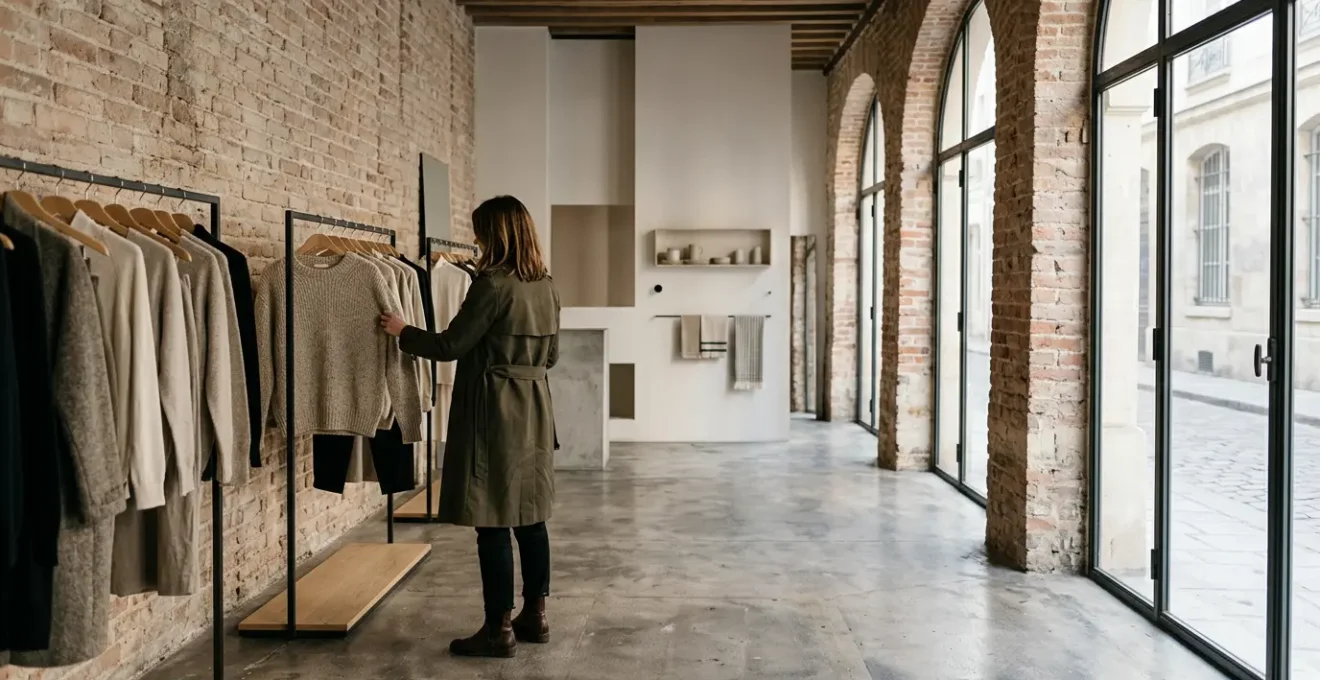
Spotting the next big thing in Le Marais isn’t about which stores you visit, but about understanding the hidden system that turns raw talent into a trend.
- Learn to decode quality in vintage pieces to identify future classics, often for less than a fast-fashion copy.
- Understand how concept store buyers use street style, graduate shows, and trade fairs as predictive data to decide what you’ll be wearing next season.
Recommendation: Shift your mindset from a passive consumer to an active curator; the real discoveries happen when you start thinking like a professional trend-hunter.
You’ve seen it: that person walking down Rue de Turenne with a coat that has the perfect cut, a bag no one else carries, a silhouette that feels both timeless and completely new. It’s the kind of originality that can’t be bought in a global flagship store. You’re a fashion-forward individual, and your goal in Le Marais is to find those unique pieces that tell a story, the ones that will have everyone back home asking, « Where did you get that? » The problem is, most guides point you to the same crowded, well-trodden paths.
The standard advice is to visit the big-name concept stores and wander the main arteries like Rue des Francs-Bourgeois. While these places are essential checkpoints, they often represent the final stop in a long journey of discovery. By the time a designer is featured there, they are already on the mainstream radar. You’re catching the wave as it crests, not as it begins to form. This approach will get you beautiful things, but it won’t satisfy the deep desire of a true trend-hunter: the thrill of unearthing talent before everyone else.
But what if the key wasn’t about having a better map of stores, but a better understanding of the system itself? The real secret to finding emerging designers is to stop thinking like a tourist and start thinking like a professional buyer. It’s about learning to decode the entire « hype supply chain »—from the calculated « peacocking » at Fashion Week that signals the next It-item, to the « garment autopsy » of an ’80s coat in a dusty vintage shop that reveals the DNA of quality craftsmanship.
This guide will deconstruct that system for you. We will explore why even the most famous stores are still vital hunting grounds, how to strategically approach vintage shopping based on your mission, and how professional buyers scout the talent that will define next season. It’s time to move beyond the surface and learn the method behind the magic of Le Marais.
This article provides a complete framework for shifting your perspective. Below is a summary of the key strategies we will cover to transform you from a simple shopper into a discerning trend-spotter in the heart of Paris.
Contents: Your Roadmap to Becoming a Marais Trend-Hunter
- Why « Merci » is Worth the Hype Despite the Tourist Crowds?
- Kilo Shop or High-End Vintage: Which Store Matches Your Budget?
- Where to Eat the Best Falafel After Shopping Rue des Rosiers?
- Why You Should Never Plan a Marais Shopping Spree on a Saturday Afternoon?
- How Do Concept Stores Choose the Brands That Will Define Next Season?
- Hailey Bieber’s Coat: How to Dupe the Look for Under $150?
- Thrift Flip Sourcing: How to Spot Potential in Ugly oversized Garments?
- Why « Peacocking » During Fashion Week Is a calculated Business Move?
Why « Merci » is Worth the Hype Despite the Tourist Crowds?
Any guide will tell you to visit Merci, and the crowds inside can be overwhelming. It’s easy to dismiss it as a tourist magnet, but for a trend-hunter, that would be a strategic mistake. Merci isn’t just a store; it’s a living incubator and a crucial final link in the hype supply chain. Its primary function is to act as a launchpad for young talent, placing them shoulder-to-shoulder with established names to give them context and credibility. The constant flow of international visitors isn’t a bug; it’s a feature that provides designers with unparalleled exposure.
As the founders themselves state, their mission is explicit. In their own words, they see the store’s role as a powerful platform for discovery:
Merci is, moreover, very pleased to act as a developer or launch-pad to the young designers who, thanks to this sounding-board, can make themselves known to the many customers and international personalities who visit Merci.
– Merci Founders Statement, TripAdvisor – Merci Paris Official Description
The real value for a spotter lies in observing their curatorial choices. Merci uses its famous atrium for about ten thematic exhibitions a year, each a masterclass in trend forecasting. These aren’t just product displays; they are narrative statements that frame emerging ideas. By analyzing these themes, you can understand the cultural currents the world’s best buyers are tapping into.
Case Study: Merci’s Thematic Exhibition Strategy
Merci’s exhibitions demonstrate how they elevate emerging talent. The « Imparfait, Nobody’s Perfect » exhibition, for example, celebrated uniqueness by showcasing artist Nadia Gallardo’s deformed jars alongside Bernard Heesen’s twisted jugs, creating a context for fashion that values imperfection. Similarly, the « So Wax » exhibition unveiled contemporary African fashion beyond stereotypes, featuring young designers like Maison Château Rouge. For a trend-hunter, visiting these exhibitions isn’t about shopping; it’s about seeing which new names are being legitimized and which narratives are about to hit the mainstream.
So, brave the crowds, but do it with a mission. Analyze the exhibitions, note the new names in the fashion section, and understand that you are standing in a real-time gallery of what’s next. It’s a place for market research, not just retail therapy.
Kilo Shop or High-End Vintage: Which Store Matches Your Budget?
Le Marais is a vintage paradise, but « vintage shopping » is a dangerously generic term. A trend-hunter doesn’t just « go vintaging »; they operate with a specific mission. The two dominant models, the Kilo Shop and the high-end *dépôt-vente*, serve entirely different strategic purposes. Your choice between them depends not on your budget, but on your objective: are you sourcing raw material for reinvention or studying the masters for reference?
The Kilo Shop approach is about volume and potential. Here, you are a textile prospector. Your goal is to sift through mountains of garments to find high-quality fabrics (wool, silk, linen), unique hardware like buttons and clasps, or pieces from defunct brands with surprisingly good construction. It’s about seeing a garment not for what it is, but for what it could become—a source for a thrift flip, a silhouette study, or a raw material library. This is where you hunt for potential.
The high-end vintage or consignment store, like Passion Luxe or Nuovo, is a completely different game. Here, you are an archivist. The pieces are pre-curated, authenticated, and priced for their design legacy. Your mission is to study impeccable construction, luxury linings, and the signature tailoring of great designers. This is where you learn what quality truly looks and feels like. While the initial cost is higher, the value proposition is strong. An analysis of the secondhand market shows that pre-owned luxury can be 33% more affordable than fast fashion on a cost-per-wear basis, offering a smarter long-term investment.
The following matrix breaks down the strategic mindset required for each approach, helping you decide which battlefield to enter based on your goals.
| Criteria | Kilo Shop Approach | High-End Vintage (Dépôt-Vente) |
|---|---|---|
| Primary Mission | Raw material sourcing for thrift flips & silhouette study | Archive study for construction & designer references |
| Average Price Range | €15-€50 per piece | €150-€800 for quality pieces |
| Quality Indicators | Good fabric (wool, silk, linen), unique buttons, defunct brand labels | Impeccable stitching, luxury lining, recognizable designer construction |
| Best Le Marais Examples | Demain Rétro (collaborative with Studio U, Blédard, Vintage Therapy) | Passion Luxe (Dior, Chanel, Vuitton), Nuovo (curated high-end) |
| Skill Required | Fabric knowledge, deconstruction potential assessment | Designer history, authentication, trend forecasting |
Ultimately, both are valid. But a true trend-hunter knows which tool to use for which job. Are you dissecting the past to create the future, or are you investing in a piece of history?
Where to Eat the Best Falafel After Shopping Rue des Rosiers?
This might seem like a culinary detour, but it’s a perfect metaphor for the trend-hunter’s mindset. The Rue des Rosiers is famous for falafel, with several shops competing for your attention. Most tourists just join the longest queue, assuming it’s the best. A local, however, knows how to read the subtle signals that separate authentic quality from well-marketed hype. This exact skill—distinguishing signal from noise—is what separates a successful designer-spotter from a regular shopper.
Just as you would analyze a garment, you can « autopsy » a falafel. Is the pita warm and pliable, or is it a dry, pre-made shell? Is the interior of the falafel ball green with fresh herbs, or a uniform, pasty brown? Are the pickles crisp, providing an audible crunch, or are they limp and sad? These are all data points. The tourist sees a sandwich; the trend-hunter sees a system of quality indicators. The queue itself is a signal: what is the ratio of locals to tourists? Sometimes the slightly shorter queue next door is the real insider’s choice.
This exercise in sensory analysis sharpens the same skills you need in a boutique. It trains your brain to look past the obvious and focus on the details that signify true craftsmanship. Before you can spot an emerging designer’s potential, you must first be able to spot a perfectly made falafel. It’s about appreciating the craft in everything.
To put this theory into practice, use the following framework the next time you’re on Rue des Rosiers. It’s a fun way to hone your analytical skills while enjoying one of Le Marais’s most iconic treats.
Your Checklist: The Falafel Authenticity Test
- Pita Freshness Check: Press gently – authentic pita should be warm, slightly elastic, and have visible char marks from a traditional oven.
- Sauce Balance Assessment: Evaluate the tahini-to-vegetable ratio – premium falafel maintains distinct flavors without one overwhelming the other.
- Vegetable Crispiness Test: Fresh pickles and cucumbers should provide an audible crunch; wilted vegetables indicate pre-preparation and a focus on volume over quality.
- Falafel Texture Analysis: Break open one piece – the interior should be fluffy and green with visible herbs (parsley, cilantro), not dense, dry, or uniformly brown.
- Queue Observation Strategy: Note the local-to-tourist ratio in the line. A heavy tourist presence might indicate fame, but a line of locals often indicates consistent quality.
By applying this level of critical thinking to a simple lunch, you are actively training yourself to see the world through the eyes of a curator. It’s a delicious form of practice.
Why You Should Never Plan a Marais Shopping Spree on a Saturday Afternoon?
The single biggest mistake a serious fashion hunter can make is to venture into Le Marais on a Saturday afternoon. The neighborhood transforms into a slow-moving river of people, and the shopping experience becomes a frantic, competitive sport. For a tourist, this is part of the « vibrant atmosphere. » For a trend-hunter, it’s a disaster. The goal of discovery requires a state of calm, open curiosity—a mindset that is physically impossible to maintain amidst the Saturday chaos.
The issue is twofold: sensory overload and a shift in boutique dynamics. The sheer volume of people creates decision fatigue. It becomes impossible to appreciate the subtle details of a garment’s construction when you’re being jostled. Your brain switches from a mode of thoughtful discovery to a defensive, transactional state. Furthermore, boutique owners and staff, who are your most valuable sources of information, are in survival mode. They don’t have time to share the story of a young designer or explain the sourcing of a particular fabric; they are simply trying to manage the crowd.
To truly discover emerging talent, you need space—physical space to examine clothes and mental space to engage in meaningful conversation. The image below captures the ideal environment for discovery: an intimate, unhurried moment of connection between a designer or owner and an engaged customer.
This atmosphere is not a matter of luck; it’s a matter of strategy. The key is timing. The best window for discovery is Tuesday or Wednesday mornings between 10 AM and 1 PM. This is often when new deliveries have just been unboxed, giving you the first look at fresh inventory and a full range of sizes. More importantly, the stores are quiet, and the staff is relaxed and eager to talk. This is when you can ask questions, hear the stories behind the brands, and build a real connection. Another strategic time is Thursday evening around 6 PM, which often marks the start of *vernissages* (gallery openings), creating a social, networked atmosphere where you might meet designers themselves.
Avoiding the Saturday crush isn’t about avoiding people; it’s about creating the optimal conditions for your mission. It’s about choosing to engage with the neighborhood on your own terms, when it’s ready to reveal its secrets.
How Do Concept Stores Choose the Brands That Will Define Next Season?
The pieces you see in a top-tier concept store like The Broken Arm or L’Éclaireur are not the result of random chance. They are the final output of a rigorous, year-long process of scouting, vetting, and forecasting. For a trend-hunter, understanding this process is like getting the answer key to the test. If you know where buyers are looking for talent, you can look there too—and see it months before it ever hits a shelf.
Buyers operate on multiple fronts, constantly scanning for signals. They aren’t just waiting for brands to come to them; they are actively hunting. One of their most fertile hunting grounds is graduate fashion shows from prestigious schools like the Institut Français de la Mode (IFM) or Studio Berçot. This is where they spot raw, unadulterated talent and can begin tracking a designer’s career from its very inception. Another key venue is specialized trade shows, which act as a curated marketplace for new brands.
Events like Tranoï or the Paris Design Week Factory are critical. The latter is a perfect example of the filtering process in action; in 2024, there were over 300 applications for 124 spots, according to its president. Being selected for such an event gives a young brand immediate legitimacy and exposure to a concentrated audience of professional buyers. By paying attention to the rosters of these shows, you are essentially getting a preview of the buyers’ shortlist.
This scouting process is a methodical system for identifying potential. By adopting the same multi-channel approach, you can build your own trend-spotting framework and start identifying the names to watch.
The Buyer’s Playbook: Where to Scout Talent
- Graduate Fashion Shows: Follow end-of-year showcases from top schools like IFM and Studio Berçot online to see the purest forms of new talent.
- Specialized Trade Shows: Monitor the exhibitor lists for Tranoï and Paris Design Week Factory. These lists are a curated directory of brands that are ready for the next step.
- Social Media Deep Dives: Look for brands on Instagram with high engagement, a coherent aesthetic, and a strong community, even with a small following. Buyers use this as a measure of a brand’s organic appeal.
- High-End Flea Markets: Explore the specialized dealers at Puces de Saint-Ouen. Emerging designers often source inspiration here, and buyers monitor these vintage trends to predict upcoming collection themes.
- Design Week Pop-Ups: During Paris Design Week, target the pop-up spaces in Le Marais (like Espace Commines and Galerie Joseph) where emerging studios gain credibility by exhibiting alongside established names.
By shifting your focus from the store to the sources, you move from being a consumer of trends to a predictor of them.
Hailey Bieber’s Coat: How to Dupe the Look for Under $150?
When a celebrity like Hailey Bieber is photographed in a stunning, oversized wool coat, the internet immediately floods with « dupes »—cheap, fast-fashion copies that mimic the silhouette but none of the quality. A trend-hunter knows this is a fool’s errand. The real art is not to copy the look, but to achieve the *same effect* of effortless quality and timeless design, on a budget. The answer isn’t a polyester knockoff; it’s the « Investment Dupe. »
The « Investment Dupe » strategy involves leveraging Le Marais’s *dépôt-ventes* (consignment stores) to find a high-quality, beautifully constructed vintage piece from a legacy designer for the same price as—or less than—a new, lower-quality item. Instead of a €100 fast-fashion coat that will lose its shape in a season, you can find a €150 vintage Max Mara, Jil Sander, or Claude Montana coat with superior fabric and tailoring that will last a lifetime.
The key is to train your eye to see beyond the trend and focus on the intrinsic qualities of the garment: the fabric’s weave, the precision of the stitching, the weight of the lining, and the overall construction. These are the elements that create the luxurious « drape » and silhouette you admire in the celebrity photo, and they cannot be replicated with cheap materials. A close-up look reveals the difference between true craftsmanship and a fleeting copy.
This approach requires patience and a discerning eye, but the payoff is immense. You acquire a piece with a story, superior quality, better cost-per-wear value, and actual resale potential.
Case Study: The Dépôt-Vente Strategy for an ‘Investment Dupe’
Paris consignment stores like Passion Luxe in Le Marais are prime hunting grounds. Here, you can find authenticated pieces from legacy brands in the €140-€200 range. For example, a vintage 1980s Claude Montana shoulder coat, purchased for around €150, offers a silhouette identical to many modern celebrity-worn pieces. However, its superior wool construction, cost-per-wear value, and potential for appreciation make it an infinitely smarter purchase than a contemporary fast-fashion equivalent, which has zero resale value the moment you buy it.
Stop chasing disposable trends. Hunt for timeless quality instead. You’ll not only get the look for less in the long run, but you’ll also own a piece of design history.
Thrift Flip Sourcing: How to Spot Potential in Ugly oversized Garments?
Walking into a Kilo Shop can be an assault on the senses. Racks overflow with seemingly « ugly » or unflatteringly oversized garments from past decades. The average shopper sees chaos. The trend-hunter sees a library of raw materials. The ability to spot potential in these forgotten clothes is an advanced skill, one that relies on a forensic method I call the « Garment Autopsy. »
The Garment Autopsy is the practice of evaluating a piece of clothing not for its current form, but for its fundamental components: fabric, construction, and hardware. An ’80s blazer with enormous shoulder pads might be unwearable as is, but if it’s made of pure herringbone wool and has horn buttons, you’ve found gold. The blazer itself is just the shell; the valuable wool and buttons are the real prize. You have to learn to deconstruct the garment in your mind and see its potential for a thrift flip, or simply as a source of high-quality materials for a future project.
This requires a tactile, hands-on approach. You must learn the feel of natural fibers versus synthetics, identify high-quality seam work like French seams, and recognize the weight and material of vintage buttons. As one professional vintage seller explained, this deep knowledge is built over years of hands-on work and requires an almost obsessive dedication to restoration and materials.
Over the course of years I’ve built up many contacts and quite a lot of knowledge. In my house there are always buckets of vintage items soaking, needles with every color of thread stuck in a pincushion, bags of metal zippers, jars of vintage buttons. I have a very careful dry cleaner that I trust and an expert seamstress for things I can’t fix myself.
– Professional Vintage Seller, Vintage Fashion Guild
This testimony reveals that sourcing is not just shopping; it’s a craft. By adopting a similar mindset, you can start to see the hidden value that others miss.
Your Checklist: The « Garment Autopsy » Method
- Fabric Feel Test: Separate natural fibers (wool, silk, linen) from synthetics. Natural fabrics often have a more irregular texture, respond to your body temperature, and have a slight ‘catch’ when rubbed between your fingers.
- Seam & Construction Integrity Check: Inspect the interior. French seams, flat-felled construction, or hand-finished edges are all indicators of pre-1990s quality tailoring that is worth preserving.
- Button & Hardware Assessment: Examine closures for natural materials (horn, shell, wood) versus plastic. Quality hardware is a huge signal of overall garment value and can be harvested for other projects.
- Label Archaeology: Research defunct but prestigious department store labels (e.g., I. Magnin, Bonwit Teller). These often indicate superior manufacturing standards compared to modern equivalents.
- Deconstruction Potential Evaluation: Ask yourself: « Can this oversized sleeve become a bag? » or « Can this silk lining be used for a new project? » Viewing garments as a material library transforms ‘ugly’ into opportunity.
With this method, you’re no longer at the mercy of what’s on the rack. You become a creator, seeing potential and value where everyone else sees junk.
Key Takeaways
- True discovery means thinking like a buyer: analyze the system, don’t just shop the stores.
- Vintage is a tool for study and investment. Differentiate your mission between sourcing raw materials (Kilo Shop) and archiving quality (dépôt-vente).
- Quality has tells. Whether in a falafel or a coat lining, learn to spot the signals of craftsmanship to separate the authentic from the hype.
- Timing is a strategic advantage. Avoid the chaos of Saturday afternoons and choose quiet weekday mornings to have meaningful interactions and first pick of new arrivals.
Why « Peacocking » During Fashion Week Is a calculated Business Move?
To the casual observer, the street style circus outside a Paris Fashion Week show looks like pure vanity. But for the trend-hunter, this « peacocking » is the very first, and most public, link in the hype supply chain. It’s a highly calculated business move where trends are born and validated in real-time. What an influencer or editor chooses to wear to a show is often a more powerful indicator of what’s next than what’s on the runway itself.
This is where emerging designers get their first big break. PR agencies will often loan pieces from unknown brands to key influencers. When that influencer is captured by a legion of street style photographers, the designer gains instant global visibility at a fraction of the cost of a traditional marketing campaign. As one analysis notes, this has become a primary engine of trend creation.
Photographers capture the outfits of attendees, making stars of stylists and fashion insiders. This street style has evolved from documentation into a major driver of trends, often influencing design itself.
– Vogeinsight Fashion Analysis, Paris Fashion Week: Your Complete Guide
Fashion buyers from concept stores around the world monitor this phenomenon obsessively. They treat street style galleries as a live feed of predictive data. When they see a specific item—a particular bag shape, a style of belt, or a piece from a new designer—appearing on multiple, credible insiders, they recognize it as a validated signal. This social proof gives them the confidence to place orders for their stores, knowing that a narrative and demand are already being built.
Case Study: The PFW Street Style to Concept Store Shelf Pipeline
The process is a direct supply chain. Analysis of Paris Fashion Week street style often reveals micro-trends before they hit the mainstream. For instance, specific accessories like ‘big-buckle belts’ or ‘pouch bags’ appeared repeatedly on influencers outside the shows. This « organic » endorsement was a key signal for buyers. They use this data as social proof, placing orders for concept stores like Merci or The Broken Arm 3-6 months later. By the time you see that item in-store, its success has been predicted and engineered months in advance on the streets of Paris.
Therefore, paying attention to PFW street style isn’t about celebrity-watching. It’s about front-row access to a live market research report. By identifying the emerging brands and key pieces being « seeded » during fashion week, you can anticipate what will be arriving in Le Marais’s most exclusive boutiques in the next season.
Now that you have the complete framework, from spotting trends on the street to deconstructing them in a vintage shop, it’s time to put it into practice. Walk the streets of Le Marais not just as a visitor, but as a true trend-hunter, equipped with the knowledge to see what others miss.
Frequently Asked Questions About Shopping in Le Marais
What’s the best day and time to discover emerging designers in Le Marais?
Tuesday or Wednesday mornings between 10 AM and 1 PM offer the ideal window. New deliveries typically arrive overnight, giving you first pick of sizes, and boutique owners are more relaxed and open to sharing designer stories during these quiet periods.
Why should Saturday afternoons be avoided for serious fashion discovery?
Saturday crowds trigger sensory overload and decision fatigue, creating a defensive, transactional mindset. Discovering emerging designers requires a calm, curious state where you can appreciate details, engage in conversations, and make thoughtful purchasing decisions.
What’s special about Thursday evenings in Le Marais?
Thursday evenings around 6 PM mark the beginning of vernissages (gallery openings) throughout the neighborhood. This creates networking opportunities where you can meet designers, buyers, and fashion insiders in a relaxed social setting.