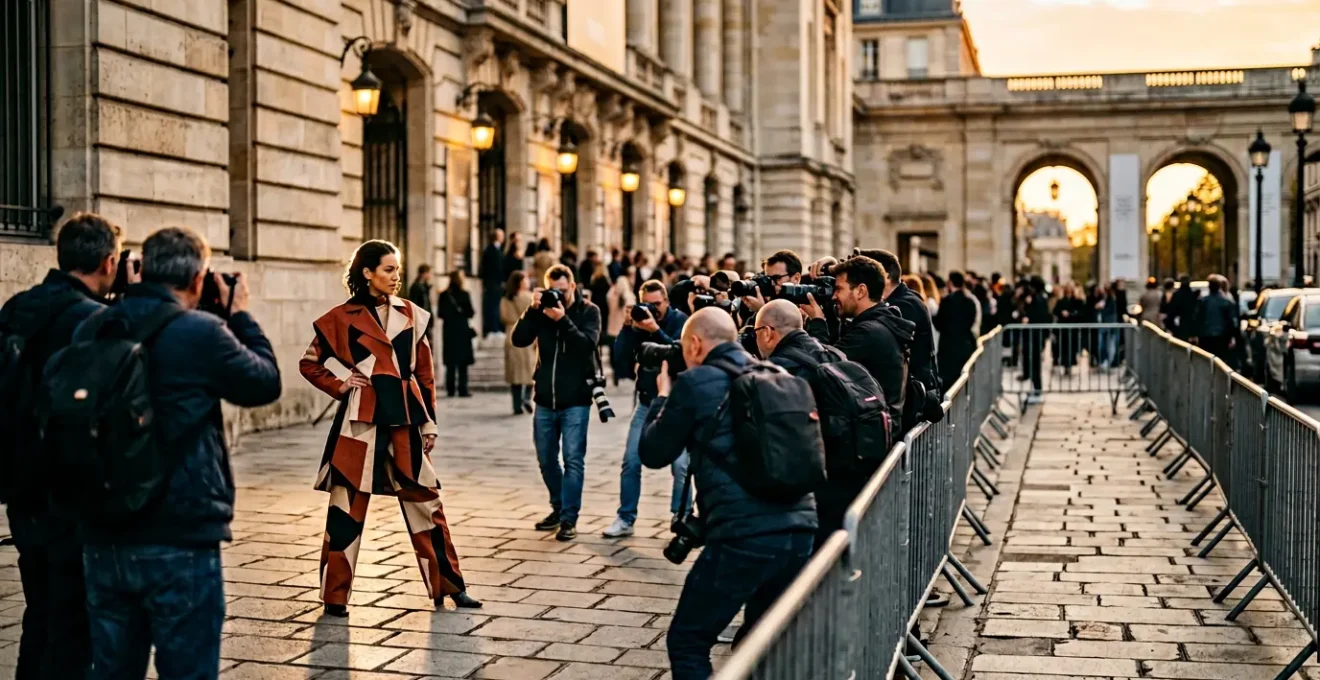
Dressing for Fashion Week street style is no longer about personal expression; it’s a high-stakes marketing operation with measurable returns.
- A single viral outfit isn’t just a « look, » it’s an asset that can generate millions in Media Impact Value (MIV), a key industry metric.
- Chasing fleeting micro-trends is a losing game; the real strategy lies in building a lasting personal brand that attracts investment.
Recommendation: Shift your mindset from « What should I wear? » to « What is the strategic ROI of this outfit? » to truly master the art of being seen.
For any aspiring influencer, the dream is the same: to be captured by a street style photographer during the chaotic ballet of Fashion Week. The common advice echoes across countless blogs and videos—wear bright colors, sport an outlandish silhouette, be bold. The goal, it seems, is simply to get noticed. This romantic notion of spontaneous, personal expression being discovered is a powerful and enduring myth in the fashion industry.
But what if this entire premise is outdated? As a strategist who dissects the mechanics of digital influence, I can tell you that the game has fundamentally changed. The influencers who consistently get photographed and featured aren’t just lucky or uniquely stylish; they are executing a calculated business strategy. The street is no longer a runway for personal taste; it’s a high-stakes trading floor where outfits are assets and a photographer’s flash is the stock ticker.
This article will deconstruct the « peacocking » phenomenon. We will move beyond the surface-level advice and analyze it as a professional marketing endeavor. We’ll introduce core business concepts like Media Impact Value (MIV), dissect the lifecycle of a trend, and explore how to transform fleeting attention into a sustainable personal brand. It’s time to stop thinking like a fashion victim and start operating like a fashion-focused media strategist.
This guide provides a strategic breakdown, moving from the history of street style to the practical economics of a viral look, and finally, to building a brand that outlasts the hype. Follow along to understand the system and make it work for you.
Summary: Why « Peacocking » at Fashion Week Is a Calculated Business Move
- The Scott Schuman Effect: How Blogs Changed the Way We Dress?
- Hailey Bieber’s Coat: How to Dupe the Look for Under $150?
- The « Clean Girl » Aesthetic: Is It Actually Accessible or Just Elitist?
- Static vs. Walking: Which Pose Shows Off the Outfit Details Best?
- Micro-Mini Skirts: Will This Trend Survive Past Next Winter?
- TikTok Aesthetics: How « Old Money » Became a Costume for Gen Z?
- Core vs. Trend: How to Identify Styles That Will Last More Than 3 Months?
- How Social Media Micro-Trends Are Destroying Personal Style?
The Scott Schuman Effect: How Blogs Changed the Way We Dress?
To understand where we are, we must first understand where we came from. The genesis of modern street style can be traced back to pioneers like Scott Schuman of The Sartorialist. His approach was revolutionary because it was journalistic and deeply personal. He captured authentic moments of style on real people, celebrating the individual’s ability to interpret fashion. This era was about documentation, not performance. The subject was often unaware, their outfit a genuine reflection of their day, not a costume designed for the camera.
This initial movement democratized fashion, suggesting that style wasn’t just dictated by magazines but lived on the streets. However, as these blogs gained influence, the dynamic began to shift. The very act of observation changed the behavior of the observed. Today, the scene outside a fashion show is starkly different. Street style photography has become a profitable business with growing crowds of photographers vying for a shot. The « street » has transformed into a professional stage.
The camera’s focus has shifted from capturing candid moments to fulfilling commercial obligations. As one analyst notes, « Scott Schuman is the pioneering force behind The Sartorialist… photographing real people… in intimate, respectful ways. » This stands in stark contrast to today’s reality, where photographers are often paid by brands to capture specific influencers wearing specific items. The spontaneity is gone, replaced by a calculated performance where every detail, from the choice of accessory to the angle of a pose, is a strategic decision aimed at generating commercial value.
Hailey Bieber’s Coat: How to Dupe the Look for Under $150?
The title of this section reflects a common search query, but it misses the strategic point entirely. The question isn’t how to acquire a cheap copy of Hailey Bieber’s coat. The real question is: what is the economic value of Hailey Bieber *wearing* that coat? This is where the concept of Media Impact Value (MIV®) becomes the most important tool in your strategic arsenal. MIV is an industry-standard algorithm that assigns a monetary value to marketing activities, quantifying the impact of a placement across all media channels.
Think of it as the ROI on an outfit. When a celebrity or influencer wears a brand, it’s not just a fashion choice; it’s a media event with a quantifiable financial impact. For instance, recent data shows a single celebrity fashion moment can generate $32.7M in MIV, as Zendaya did across two looks at the Met Gala. This isn’t just « exposure »; it’s a massive, measurable injection of value for the brands involved. And you, as an aspiring influencer, are a player in this same economy.
While you may not generate millions overnight, you are a media channel. Your content, your style, and your audience have a value. In fact, the influencer category accounted for 24.6% of the total fashion industry’s MIV in 2023. This confirms that brands see you as a critical part of their marketing mix. As Launchmetrics explains, « A high-profile Celebrity… might generate millions in MIV through widespread media coverage… Meanwhile, an Influencer with niche authority could provide more targeted but highly engaged exposure. » Your job is to understand and grow your specific MIV.
The « Clean Girl » Aesthetic: Is It Actually Accessible or Just Elitist?
Aesthetics like « Clean Girl » are not just trends; they are pre-packaged, highly marketable lifestyle brands. From a strategic perspective, they are a masterclass in signaling. The entire point, as one analysis puts it, is « to look put together and wealthy, without looking like you have had to work for it. » This « effortless » look is, in reality, the product of immense effort and, more importantly, significant investment.
The aesthetic itself is a form of « quiet luxury. » It eschews loud logos for subtle cues of wealth: flawless skin, perfectly maintained hair, minimalist-but-expensive-looking jewelry, and a lifestyle to match. This is where the inaccessibility and elitism become clear. The visual markers are not the clothes themselves, but the body and life they adorn. A lifestyle analysis reveals that achieving this look requires ginger shots, Pilates classes, consistent skincare routines with expensive products, and daily matcha. This represents a substantial, ongoing investment of both time and money.
For an influencer, adopting this aesthetic is a strategic choice to project a certain socio-economic status. It’s a calculated performance of wellness and wealth. You’re not just selling a look; you’re selling an aspirational lifestyle that is inherently exclusive. The very difficulty and cost of maintaining the « Clean Girl » aesthetic is what gives it value as a status symbol. It proves you have the resources—financial and temporal—to invest in yourself at this level. This is a powerful signal to both followers and luxury brands looking for aligned ambassadors.
Static vs. Walking: Which Pose Shows Off the Outfit Details Best?
Once you’re on the « street stage, » the work has only just begun. Your interaction with photographers is a performance, and your posing is your dialogue. The question of a static versus a walking pose isn’t about aesthetics; it’s about strategy and objectives. Each movement is a calculated decision designed to maximize the photographic potential of your outfit and fulfill specific commercial goals.
A static pose is your hero shot. It’s controlled, deliberate, and perfect for showcasing specific details: a handbag held just so, the sharp tailoring of a blazer, or an intricate piece of jewelry. This is where you communicate directly with brands. You are, in effect, creating a live product shot. Photographers know this, and as one industry analysis states, « Street style photographers need to get pictures of certain influencers to fulfil their clients’ wishes. » Standing still allows them to get that clean, commercially viable shot that their client—the brand—has paid for.
The walking pose, by contrast, sells a different fantasy. It creates a sense of dynamism, narrative, and « authenticity. » This is the « candid » shot that harkens back to the early days of street style, making the outfit feel lived-in and aspirational. It’s excellent for demonstrating the movement of a garment—the flow of a dress, the drape of a coat. This pose appeals to the consumer’s desire to see clothes « out in the wild, » as one photographer put it. It tells a story, making the viewer feel they’ve caught a glimpse of a stylish person’s real life, even though the entire sequence is often meticulously staged and repeated until the perfect shot is captured.
Micro-Mini Skirts: Will This Trend Survive Past Next Winter?
The micro-mini skirt is a perfect case study in the anatomy of a micro-trend: an item so potent with viral potential that its practicality is almost irrelevant. For a strategist, understanding the lifecycle of such trends is key to avoiding costly missteps. Engaging with a micro-trend is not a long-term style choice; it’s a short-term marketing tactic to tap into a fleeting cultural conversation.
The data is clear: the hamster wheel of trends is spinning faster than ever. According to Natalia Christina, a strategy director, « A perfect mixture of the need to satiate our feeds with ‘newness’ coupled with access to a never-ending vault of nostalgia means trends are being coined almost daily. » These items are designed for the screen, optimized for a single « look of the day » post before being relegated to the back of the closet. They are, in essence, viral bait.
Their lifespan is brutally short. While a macro-trend might last for years, industry data reveals that most fashion microtrends last between 3 and 5 months before they are considered « cringe » or outdated. Investing heavily in these items is a poor allocation of resources for an aspiring influencer aiming to build a sustainable brand. Wearing a micro-mini skirt in its peak moment might get you a spike in engagement, but wearing it a season too late can instantly date your content and mark you as out of touch.
Action Plan: Auditing a Trend for Strategic Value
- Source Identification: Where did it originate? A TikTok video, a runway show, a celebrity moment? This indicates its potential reach.
- Barrier to Entry: How easy/affordable is it to participate? Low barriers (e.g., a specific color) mean rapid saturation and a shorter lifespan.
- Brand Alignment: Does this trend align with your core brand identity, or is it a complete departure? A misaligned trend can confuse your audience.
- Shelf-Life vs. Investment: Is the cost of the item justified by its predicted (short) lifespan? Calculate the « cost per post. »
- Exit Strategy: How will you pivot away from the trend once it peaks? Plan your content transition in advance to stay ahead of the curve.
TikTok Aesthetics: How « Old Money » Became a Costume for Gen Z?
If micro-trends are fleeting moments, TikTok aesthetics are entire universes packaged for consumption. From « Cottagecore » to « Coastal Grandmother » and the enduring « Old Money, » these are not organic style evolutions. They are algorithmic aesthetics: highly defined, easily searchable, and visually coherent sets of codes that function as costumes for the digital stage. For Gen Z, adopting the « Old Money » aesthetic isn’t about inheriting wealth; it’s about performing a fantasy of it.
This performance is incredibly valuable in the attention economy. As Divya Mathur of Revolve notes, the specific terminology is crucial: « if you’re talking about something using the terminology that doesn’t feel relevant… it doesn’t feel relevant. » Tagging your post with `#oldmoney` is as important as wearing the string of pearls. You are participating in a massive, ongoing digital conversation that algorithms are primed to promote. You are essentially giving the platform exactly what it wants: content that fits neatly into a trending category.
This is the democratization of « peacocking. » You no longer need to be on the streets of Paris to participate. You can perform the « Old Money » aesthetic from your bedroom, and if you execute the codes correctly—the neutral palette, the classic silhouettes, the air of nonchalant privilege—the algorithm can grant you an audience far larger than any street style photographer could. These aesthetics are costumes that allow users to role-play different identities, and the most successful influencers are those who understand they are actors in this digital theater.
Core vs. Trend: How to Identify Styles That Will Last More Than 3 Months?
After navigating the minefield of micro-trends and algorithmic aesthetics, the ultimate strategic goal is to build a personal brand that endures. This requires differentiating between a fleeting « trend » and a foundational « core » style. Your core style is your brand’s DNA; it’s the consistent visual thread that makes you recognizable and builds trust with your audience. Trends can be layered on top of this core, but they should never replace it.
Identifying this core involves deep self-analysis. It’s about understanding your brand’s values, your unique point of view, and what you want to communicate beyond the clothes. It’s also about being aware of the fashion system’s inherent flaws. As Lindsay Peoples Wagner, former editor-in-chief of Teen Vogue, critically observed, « Street style upholds the kind of racism and fatphobia that has long run rampant in the industry. » A truly strong personal brand can be built by consciously moving against these norms, championing inclusivity and a perspective that is authentically yours. This authenticity is the ultimate defense against the disposability of trends.
The intrinsic joy of fashion is often eradicated when clothing is viewed as so disposable and the trend that it conforms to is likely to expire by the end of the month. Much relief can be found by stepping out of this relentless trend rotation and considering the clothes that truly appeal to you.
– Global Fashion Agenda, Examining the era of micro trends
This is not just an ethical stance; it’s a sound business strategy. Brands are increasingly looking for long-term partners, not just trend-chasers. With marketing investment data showing that nearly 60% of brands plan to increase their influencer marketing budgets, they are seeking reliable influencers with a clear, consistent brand identity. A strong core style signals stability and a loyal, engaged audience—assets far more valuable than a single viral post.
Key Takeaways
- Shift from Artist to Strategist: View every outfit as a marketing asset with a potential return on investment (ROI).
- Master the MIV Metric: Understand that Media Impact Value is the true currency of the industry, not just « likes » or « views. »
- Differentiate Core from Trend: Build a lasting personal brand on a solid « core » style and use fleeting trends as tactical, short-term tools.
How Social Media Micro-Trends Are Destroying Personal Style?
The relentless churn of micro-trends, accelerated by social media, presents the greatest threat to the development of true personal style. By encouraging a constant state of consumerism and a focus on « newness, » the system effectively discourages the introspection and experimentation required to build an authentic style identity. You’re so busy chasing the next « core » that you never have a chance to develop your own.
This cycle creates a homogenous landscape where personal style is replaced by a series of rotating costumes. You are not dressing as yourself; you are dressing as a « Mob Wife, » a « Tomato Girl, » or a « Clean Girl. » It’s a performance driven by algorithms, not individuality. The result is a fundamental disconnect from the joy of dressing and a portfolio of looks that feels disjointed and impersonal. This is brand destruction, not brand building.
However, there is a strategic opportunity in this chaos. A growing fatigue with the trend hamster wheel is palpable. Recent trend forecasting analysis reveals that consumers are getting off the hamster wheel, with fewer major micro-trends emerging. This marks a pivotal shift. As one editorial analysis notes, this move away from the « circus » era could herald a new one that « re-centers personal style above peacocking and marketing tactics. »
For the savvy influencer, this is the moment to lead. By understanding the system—the MIV, the trend cycles, the algorithmic rewards—you can consciously choose to step outside of it. The ultimate power move is not to perfectly execute the next micro-trend, but to build a compelling, consistent personal brand that is so strong it transcends trends altogether. This is how you reclaim personal style from the algorithm and build a brand that truly lasts.
Now that you have the strategic framework, start analyzing your own content through the lens of MIV and brand consistency. Audit your past looks and plan future ones not just as outfits, but as strategic moves in your career as a creator.