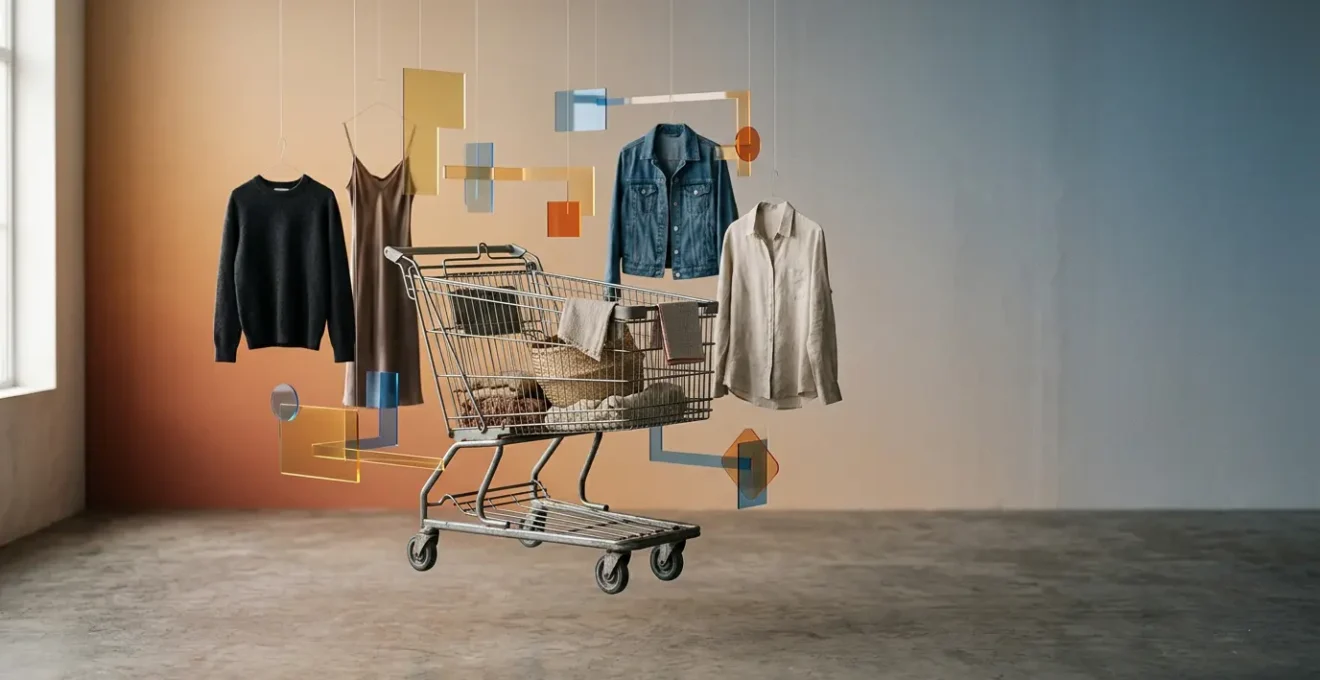
The real reason you can’t stop impulse buying isn’t a lack of willpower; it’s a series of predictable psychological traps designed to keep you spending.
- Emotional triggers like the Fear of Missing Out (FOMO) and boredom are deliberately exploited by marketing to create a chemical reward loop in your brain.
- Strategic systems like the 30-day wait and Cost Per Use calculation create ‘intentional friction’ to break this addictive cycle and re-engage your rational mind.
Recommendation: Stop fighting the symptoms and start diagnosing the cause by analyzing your own shopping patterns and emotional triggers.
You know the feeling. The late-night scroll, the targeted ad that seems to read your mind, the exhilarating click of « Complete Purchase. » A wave of satisfaction washes over you—a brief, potent high. This is the dopamine hit of impulse buying, a powerful chemical reward that brands have mastered. But it’s often followed by a familiar crash: the buyer’s remorse, the credit card bill, the closet full of clothes with the tags still on. For a recovering shopaholic, this cycle feels both irresistible and destructive.
Conventional wisdom offers simple but insufficient advice: « make a budget, » « use a shopping list, » or « just say no. » As a behavioral psychologist specializing in retail therapy, I can tell you this isn’t merely a financial problem; it’s a deeply psychological one. You are not weak-willed; you are caught in a perfectly engineered Dopamine Loop. The « Add to Cart » button has become a shortcut to feeling good, a temporary solution for boredom, anxiety, or low self-esteem. Resisting this requires more than willpower; it requires a new strategy.
The key isn’t to fight the impulse head-on but to understand and dismantle the triggers that create it. It’s about shifting your mindset from mindless consumption to intentional curation, adopting a « buy less, choose well » philosophy that brings not only financial relief but profound mental clarity. This is not about deprivation; it’s about liberation.
This article will guide you through the psychological underpinnings of your shopping habits. We will explore evidence-based frameworks to help you diagnose your triggers, create intentional friction in your buying process, and ultimately rewire your brain to find joy in what you already own, not what you could potentially buy.
Contents: The Psychology of Mindful Consumption
- The Wishlist Wait: Why Waiting 30 Days Kills 80% of Your Cravings?
- Cost Per Use: How to track if a purchase was actually « Worth It »?
- The Email Detox: How Newsletters Manipulate Your « Fear of Missing Out »?
- Shopping Your Closet: How to Find « New » Outfits in Old Clothes?
- Wedding Guest Guilt: Is It Okay to Wear the Same Dress to Every Wedding?
- The Boredom Trap: What to Do When You Hate Your curated Capsule?
- Rental Fashion: Is It Really Cheaper for Event Dressing?
- The 333 Method: Can You Really Survive a Season with 33 Items?
The Wishlist Wait: Why Waiting 30 Days Kills 80% of Your Cravings?
The most potent weapon against the dopamine loop is time. Impulse purchases are driven by immediate emotion—excitement, anxiety, or the desire for a quick fix. By deliberately introducing a waiting period, you create what psychologists call ‘intentional friction.’ This simple act of pausing allows the emotional intensity to fade and your rational brain to re-engage. It’s the difference between reacting and responding. The average consumer can spend hundreds on impulse buys, with 2024 data showing this figure at over $282 per month, a testament to how easily these split-second decisions add up.
The « 30-Day Rule » is a powerful application of this principle. The concept is simple: when you feel the urge to buy a non-essential item, you add it to a wishlist and commit to not purchasing it for a full 30 days. This isn’t about denial; it’s about observation. During this period, you can assess if the desire is a fleeting whim or a genuine need. Does the item solve a real problem in your life? Do you keep thinking about it, or does the initial excitement completely vanish after a week?
Research on consumer behavior consistently shows that a significant portion of unplanned purchases are driven by immediate triggers like marketing-induced FOMO. By implementing a mandatory waiting period, you are effectively short-circuiting this manipulation. More often than not, you’ll find that by day 30, the craving has disappeared, or you’ve realized you can live perfectly well without the item. This practice not only saves you money but also provides invaluable data on your own consumption patterns, revealing the difference between what your emotions want in the moment and what your life actually requires.
Cost Per Use: How to track if a purchase was actually « Worth It »?
To break the cycle of impulse buying, we must change how we define « value. » The retail world trains us to focus on the upfront price tag and the thrill of a « deal. » A more powerful and psychologically sound approach is Cognitive Reframing, shifting your evaluation from « How much does this cost now? » to « What is the true cost over its lifetime? » This is the essence of the Cost Per Use (CPU) metric. The formula is deceptively simple: take the total price of an item and divide it by the number of times you realistically expect to use or wear it.
A $50 fast-fashion top worn three times before it loses its shape or falls out of trend has a CPU of $16.67. In contrast, a well-made, timeless $300 jacket worn 100 times has a CPU of just $3. This calculation fundamentally alters your perception of value. Suddenly, the « cheap » item is revealed to be expensive in the long run, and the « expensive » item becomes a wise investment. This isn’t just theory; a 2025 study from the University of Bath found that simply showing consumers the « cost-per-wear » information significantly increased their preference for high-quality, durable clothing, even when the initial price was higher. It moves the decision from an emotional, short-term frame to a logical, long-term one.
Tracking your CPU after the fact is a form of personal accountability. Keep a simple note on your phone or a spreadsheet. Did that « investment piece » actually get worn? Or is it gathering dust? This data is not meant to induce guilt but to provide clarity. It becomes a diagnostic tool, helping you identify your real-life needs versus your idealized self’s wants. Over time, you build a powerful internal filter based on your own behavior, making it easier to resist future purchases that don’t align with your true value system.
As the image above suggests, true value lies in the craftsmanship and material quality that allow for repeated use. By focusing on CPU, you train your brain to seek out durability and longevity, not just the fleeting excitement of a low price tag. This shift is crucial for moving from a consumer mindset to an owner mindset.
The Email Detox: How Newsletters Manipulate Your « Fear of Missing Out »?
Your inbox is a battleground for your attention and wallet. Marketing emails are not friendly updates; they are sophisticated psychological tools designed to trigger one of the most powerful drivers of impulse buying: the Fear of Missing Out (FOMO). Subject lines blare with phrases like « 24-Hour Flash Sale!, » « Last Chance to Buy, » and « Almost Gone! » These are not informational; they are emotional triggers designed to create a sense of urgency and scarcity, bypassing your rational thought process and pushing you into an immediate, reactive purchase.
This tactic is incredibly effective. It hijacks your brain’s ancient survival mechanisms, which are wired to pay attention to scarcity and potential loss. The thought « What if this is the best deal I’ll ever get? » or « What if it sells out and I regret it forever? » creates a palpable anxiety that the « buy now » button promises to relieve. The data confirms this, with research revealing that 60% of millennials make impulsive purchases because of FOMO. Brands know that if they can make you feel like you’re about to lose an opportunity, you’re far more likely to act without thinking.
The most effective way to combat this is to go on an « email detox. » This involves aggressively unsubscribing from all retail newsletters. This isn’t about avoiding temptation; it’s about reclaiming your mental space. Every marketing email you receive is an unsolicited attempt to manipulate your emotions. By cutting off the source, you reduce the number of manufactured « emergencies » you have to process each day. You move from a reactive state, constantly defending against external triggers, to a proactive one where you only seek out shopping information when *you* have a genuine need. This simple act of digital decluttering is one of the most profound steps you can take to quiet the noise and regain control.
Shopping Your Closet: How to Find « New » Outfits in Old Clothes?
The desire for newness is a fundamental human trait, and it’s a primary driver of impulse shopping. We buy new clothes not just because we need them, but because we crave the feeling of a new identity, a fresh start, a novel experience. The good news is that this feeling can be recreated without spending a single dollar. The practice of « shopping your closet » is about reframing your existing wardrobe as a boutique of undiscovered possibilities.
The core of this practice is to break your habitual thought patterns. We tend to wear the same 20% of our clothes 80% of the time, pairing items in the same predictable ways. To find « new » outfits, you must introduce a system that forces creative combinations. This could involve challenging yourself to wear an item you haven’t touched in six months, or trying to style a single piece in five completely different ways. The goal is to see your clothes not as static items but as modular components of a larger system.
Documenting your experiments is crucial. When you discover a new combination that you love, take a photo. Create a personal « lookbook » on your phone. This serves two purposes: it provides a quick reference for days when you feel uninspired, and it builds a library of your authentic personal style. You begin to see what silhouettes, colors, and combinations truly make you feel confident. One of the most effective ways to start this process is with a structured challenge that limits your options to force creativity.
Action Plan: The 333 Method for Outfit Discovery
- Select three tops that reflect your core style and can transition between casual and elevated looks.
- Choose three bottoms in complementary silhouettes (e.g., structured trousers, relaxed jeans, a midi skirt) that pair with all selected tops.
- Pick three pairs of shoes spanning different formality levels (e.g., sneakers, ankle boots, loafers) to shift the outfit’s tone.
- Challenge yourself to create at least 9-15 distinct outfit combinations by mixing and matching these nine items.
- Document successful combinations with photos to build a personal outfit library and identify your authentic style patterns.
Wedding Guest Guilt: Is It Okay to Wear the Same Dress to Every Wedding?
The pressure to wear a new outfit for every special occasion—especially weddings—is a powerful and often unspoken driver of consumption. This « wedding guest guilt » is fueled by social media, where every event is documented and every outfit is on display. The fear of being seen in the same dress twice can feel surprisingly potent, leading to a closet full of single-use, high-cost garments. From a behavioral psychology perspective, this is a classic case of perceived social judgment overriding rational decision-making.
Let’s be unequivocally clear: it is absolutely okay to wear the same dress to every wedding. In fact, doing so is not a sign of sartorial failure but a mark of confidence, sustainability, and style intelligence. The idea that an outfit « loses its value » after one public appearance is a myth created and perpetuated by the fast-fashion industry. True style lies not in an endless rotation of new items, but in the ability to make a well-loved piece feel fresh and appropriate for different contexts.
The key to overcoming this guilt is to shift your focus from the garment itself to the art of styling. A timeless, well-fitting dress in a solid color or a classic print is a canvas. It can be completely transformed with a change of accessories. A dress worn with delicate gold jewelry and strappy heels for a summer daytime wedding can be re-worn for a formal evening affair with statement silver earrings, a bold clutch, and elegant pumps. Different hairstyles, makeup looks, and even a stylish wrap or jacket can create entirely new aesthetics.
As this image illustrates, the power of transformation lies in the details. By investing in a single, high-quality, versatile dress and a small collection of adaptable accessories, you are not only making a financially and environmentally sound choice, but you are also giving yourself a creative challenge. You are becoming a stylist, not just a consumer, finding joy in curation rather than acquisition. This is the ultimate expression of the « buy less, choose well » philosophy.
The Boredom Trap: What to Do When You Hate Your curated Capsule?
You’ve done the work. You’ve decluttered, curated a minimalist capsule wardrobe, and embraced the idea of « less is more. » But a few weeks in, a dreadful feeling creeps in: boredom. You open your closet and feel nothing but restriction. Every outfit feels stale, and the initial liberation has turned into a minimalist prison. This is the « Boredom Trap, » a common and demoralizing roadblock on the path to mindful consumption. It’s the moment when the impulse to « just buy something new » feels overwhelming.
When this happens, it’s crucial not to see it as a personal failure. Instead, view it as a critical diagnostic moment. Your boredom is not a sign that minimalism is wrong for you; it’s a sign that your *current capsule* is wrong for you. Often, we build capsules for an idealized version of ourselves—the person who goes to art galleries and chic cafes—rather than our actual selves, who might need comfortable clothes for working from home and running errands. As the legendary director Orson Welles is often quoted in this context:
The enemy of art is the absence of limitations. Limiting your clothing items… forces art.
– Orson Welles (quoted in minimalist fashion context)
If your capsule feels artless, it means the limitations are wrong, not the principle of limitation itself. It’s time to perform a « Wardrobe Autopsy » to understand what went wrong. This isn’t about blaming yourself; it’s about gathering data to build a better system next time. By asking targeted questions, you can pinpoint the flaws in your initial design and correct course without abandoning your goals.
Your Diagnostic Checklist: The Capsule Wardrobe Autopsy
- Assess if the capsule was built around an ‘idealized self’ rather than your actual lifestyle and daily needs.
- Evaluate whether the color palette energizes you or drains you emotionally when you open your closet.
- Check if the capsule lacks texture variety (e.g., all smooth cotton vs. incorporating knits, denim, structured fabrics).
- Identify whether the pieces reflect your authentic personality or conform to external ‘minimalist uniform’ pressure.
- Determine if you need a ‘Core + Accent’ model instead: stable basics plus a small rotating slot for novelty items.
Rental Fashion: Is It Really Cheaper for Event Dressing?
The need for novelty, especially for one-off events, is a major trigger for impulse purchases that end up as « closet orphans. » Rental fashion presents a compelling psychological and financial alternative. It allows you to indulge the desire for something new, trendy, or occasion-specific without the long-term commitment of ownership, storage, and a high Cost Per Use. It reframes the « dopamine hit » of a new item as an experience to be enjoyed, not an asset to be acquired.
Financially, the case for renting versus buying can be powerful. While buying pre-loved items is often a more affordable long-term strategy for core wardrobe pieces, rentals shine for high-cost, low-use categories like formal wear or bold trend pieces. An independent study found that building a wardrobe with pre-loved items can be significantly more affordable than buying new, but for that single-use gown, renting almost always wins on a pure CPU basis. However, the decision is not purely financial; it’s deeply psychological.
To decide whether to rent or buy, you need a framework that considers not just money, but your personal style, emotional attachment, and tolerance for risk. The following table acts as a decision-making tool, helping you diagnose the best path for your specific situation. As shown in an analysis from FashionUnited, understanding these personal factors is key.
| Decision Criteria | Rent (Best For) | Buy (Best For) |
|---|---|---|
| Style Alignment | Trend-driven piece or once-off aesthetic not part of your core style | Reflects your enduring personal style and can be reworn for multiple occasions |
| Emotional Value | Prioritize novelty and variety without attachment to the garment | Value memory-building and sentimental connection to special occasion pieces |
| Long-term Joy | Immediate dopamine hit without commitment or storage burden | Sustained satisfaction from ownership and the freedom to restyle repeatedly |
| Financial Reality | Cannot afford upfront purchase price of quality version but need elevated option | Can invest upfront and benefit from low cost-per-wear over multiple events |
| Damage Risk Tolerance | High-anxiety about potential damage fees outweighs enjoyment of wearing piece | Comfortable with care responsibility and prefer ownership control |
Key Takeaways
- Create Intentional Friction: Use tactics like the 30-day waiting period to allow emotional triggers to cool off before making a purchase.
- Reframe Value with Cost Per Use: Shift your focus from the initial price to the long-term value of an item, making quality a priority over quantity.
- Diagnose, Don’t Just Deprive: When a minimalist approach feels restrictive, use it as a diagnostic tool (like a « Wardrobe Autopsy ») to understand your true needs and style.
The 333 Method: Can You Really Survive a Season with 33 Items?
The 333 Method, or Project 333, is perhaps the most famous iteration of the capsule wardrobe challenge. Created by Courtney Carver in 2010, it proposes a simple but radical constraint: dress with 33 items or less for 3 months. This includes clothing, accessories, jewelry, and shoes. For many, the initial reaction is disbelief. How can one possibly survive, let alone thrive, with such a limited selection? But to view it as a survival test is to miss the point. From a psychological standpoint, Project 333 is not a deprivation chamber; it’s a ‘Wardrobe MRI’—a powerful diagnostic tool designed to give you an unvarnished look at your true wearing patterns and needs.
The severe constraint forces you to be incredibly intentional. You can no longer rely on having endless options. Instead, you must choose pieces that are versatile, that you genuinely love, and that truly work for your life. As a long-term case study of the project shows, participants consistently report that the constraint doesn’t rob them of personal style but rather forces them to discover it authentically for the first time. The noise of trends and impulse buys is silenced, leaving only the clothes that make them feel like themselves.
The reported psychological benefits are profound. The most common is a drastic reduction in decision fatigue. With fewer, more beloved options, getting dressed in the morning becomes a simple, stress-free process. This frees up mental energy for more important decisions throughout the day. Participants also report significant financial savings and a newfound appreciation for the items they do own. The challenge reveals what you truly value, separating the « want » from the « need » in the most practical way possible.
Can you survive a season with 33 items? The question is not about survival. The real question is: what would you learn about yourself if you tried? The 333 Method is an experiment, not a life sentence. It offers a structured way to press pause on consumption and listen to what your closet—and your life—is trying to tell you.
Start your own experiment today. You don’t have to commit to a full three months. Try it for one week. Pick a small number of items and see what you discover. This first step in diagnosing your own patterns is the most powerful move you can make to break the cycle of impulse buying and build a more intentional life.