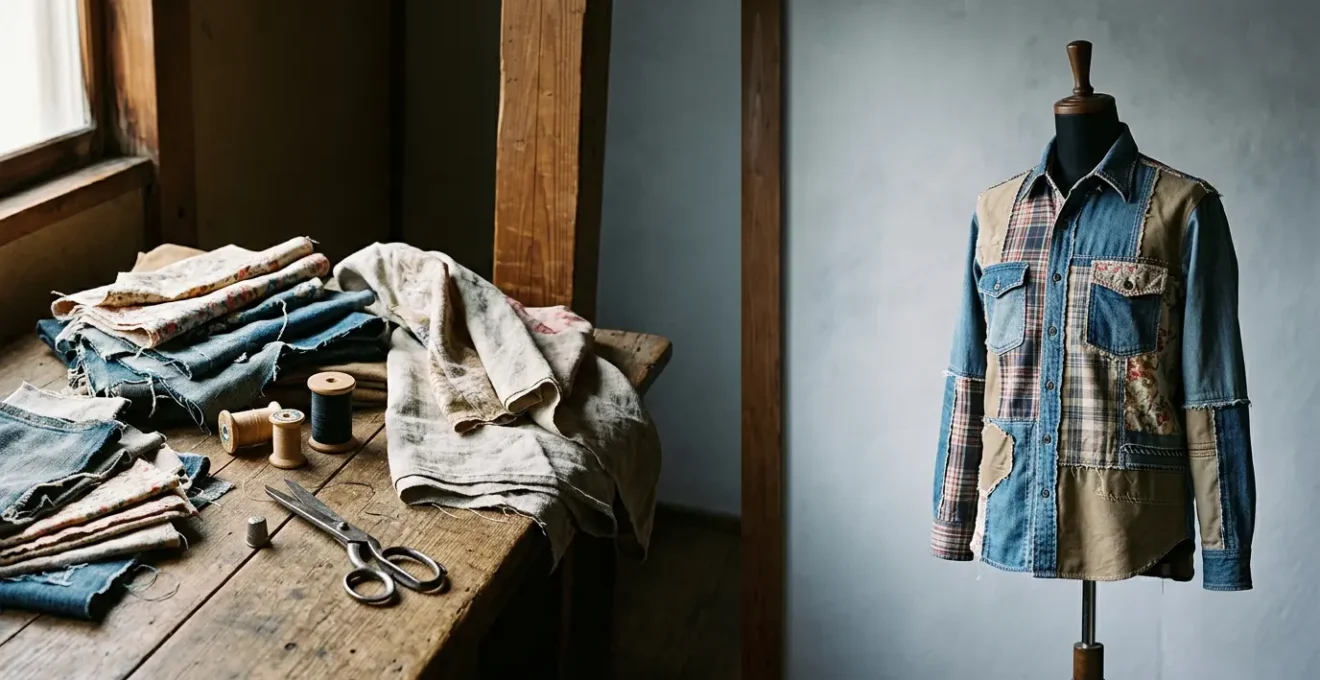
The $200 price tag on a reworked shirt isn’t about the original garment; it’s about the « transformation value » added through skill, time, and design vision.
- DIY saves money but costs you significant time in sourcing, skill acquisition, and labor.
- Designer upcycling buys you expertise, curated quality, and a finished, durable statement piece.
Recommendation: Choose DIY for the joy of the process and learning; choose a designer piece to invest in guaranteed quality and reclaim your most valuable asset—your time.
You see it on a mannequin or an online boutique: a one-of-a-kind reworked shirt, a patchwork masterpiece born from forgotten textiles. Then you see the price tag: $200. The immediate reaction for any crafty person is a mix of admiration and skepticism. « That’s beautiful, » you think, « but I could probably make that myself for a fraction of the cost. » This is the core dilemma for anyone who values both creativity and their wallet. We’re often told that DIY is the budget-friendly, sustainable choice, while designer upcycling is an indulgence.
But this simple binary of cheap vs. expensive misses the entire point. It ignores the invisible labor, the acquired skill, and the artistic foresight that turns textile « waste » into a wearable work of art. The real question isn’t about the cost of the original materials. It’s about what we call the transformation value—the sum of sourcing intelligence, technical skill, and design vision required to give a garment a second, more glorious life. Is it more valuable to invest your own hours, energy, and potential frustration, or to purchase the finished result of someone else’s dedicated craft?
This article moves beyond the surface-level cost analysis. We will deconstruct the entire upcycling process, from the hunt in a kilo shop to the final stitch, to reveal where the true value lies. By understanding the economics of labor, the science of fabrics, and the art of styling, you’ll be able to decide with confidence whether to roll up your sleeves and start a project or to invest in a piece that’s worth every penny.
To help you navigate this complex and creative world, we’ve broken down the key stages and considerations. This guide will walk you through everything from sourcing potential gems to understanding the ethics behind a price tag, empowering you to make an informed choice.
Table of Contents: Deconstructing the Value of a Reworked Garment
- Thrift Flip Sourcing: How to Spot Potential in Ugly oversized Garments?
- No-Sew Hacks: How to Crop a T-Shirt Without a Machine?
- One-of-a-Kind: Why Size Consistency is Impossible in Upcycled Collections?
- The Patchwork Jacket: How to Wear It Without Looking Like a Scarecrow?
- Seam Integrity: Why Re-stitched Vintage Fabric Might Tear Faster?
- Kilo Shop or High-End Vintage: Which Store Matches Your Budget?
- The $5 T-Shirt: Why It Is Mathematically Impossible to Be Ethical?
- Why Hand-Woven Textiles Have Imperfections That Machines Can’t Copy?
Thrift Flip Sourcing: How to Spot Potential in Ugly oversized Garments?
The journey of every upcycled piece begins with sourcing. This isn’t just a shopping trip; it’s a treasure hunt that requires a trained eye. The potential of a garment isn’t in its current state—the dated print, the unflattering cut—but in its raw material. The most successful makers possess a high degree of material intelligence. They look past the « ugly » to see the quality of the fabric, the yardage it offers, and the way it drapes. An oversized men’s blazer in a hideous 80s pattern might be a failure as a blazer, but its high-quality wool could become a structured corset top or a set of stylish pouches.
Your first step is to ignore the garment’s intended purpose and assess its components. Focus on the fabric’s feel, weight, and condition. Is it a natural fiber like cotton, linen, or wool that will be breathable and easy to work with? Or is it a cheap polyester that will pill and feel unpleasant? Look for signs of wear, but distinguish between terminal damage (brittle fabric, large stains in the center) and workable flaws (a torn seam, a missing button). The true potential lies in the quality of the canvas you’re about to work on.
As this close-up shows, high-quality fabric has a tangible structure. You can see the weave, the texture, and the life within the fibers. A designer who upcycles spends countless hours sifting through racks to find these gems. When you buy their work, you are paying for this expertise and the time they saved you from digging through piles of worthless synthetics. Your DIY journey starts by developing this same skill: learning to see a beautiful textile disguised as an ugly garment.
Your Action Plan: Assessing a Garment’s Upcycling Potential
- Material First: Ignore the shape and print. Touch the fabric. Is it a quality natural fiber (cotton, wool, silk, linen)? Check the tag. This is your primary indicator of potential.
- Yardage Scan: Unfold the garment. How much usable, continuous fabric is there? An oversized dress or a tablecloth offers more raw material than a small t-shirt.
- Damage Triage: Inspect for flaws under good light. Are the stains, holes, or sun-fading located on seams that you’ll cut away, or are they in the middle of the main panels, rendering the fabric useless?
- Hardware & Details: Look at the buttons, zippers, and embroidery. Are they unique features you can salvage and make a centerpiece of your new design, or are they cheap plastic that you’ll need to replace?
- The Vision Test: Hold it up. Can you mentally deconstruct it? Imagine it not as a shirt, but as a collection of fabric panels. Can you see a new form emerging from them? If you can’t, leave it for someone else.
No-Sew Hacks: How to Crop a T-Shirt Without a Machine?
The idea of reworking clothes can be intimidating if you don’t own or know how to use a sewing machine. But the maker movement is built on accessibility, and there are countless ways to alter garments without a single stitch. These no-sew hacks range from temporary stylistic choices to surprisingly permanent alterations, allowing anyone to dip their toes into the world of DIY fashion. The simplest method is the classic « tuck and tie, » using knots or hair elastics to create a cropped or fitted look that can be undone at the end of the day.
For a more permanent crop without sewing, a sharp pair of fabric scissors is your best friend. A raw, cut-off hem on a cotton jersey t-shirt can create a relaxed, slightly edgy look that’s popular and requires zero technical skill. The key is to measure carefully and cut with confidence. For fabrics that might fray, or for a cleaner finish, fabric glue or fusible bonding tape offer a revolutionary solution. These adhesives create a durable bond that can often withstand washing, bridging the gap between a temporary hack and a fully sewn garment.
This entry-level creativity is a powerful gateway into sustainable fashion. It empowers you to see your wardrobe not as a fixed collection, but as a set of modular pieces ready for transformation. The choice to alter a garment, even in a small way, is a step towards a more conscious relationship with your clothing.
Case in Point: Fusible Bonding Web for Permanent Hems
Professional upcyclers often need to create crisp, durable alterations without the bulk of a machine-sewn seam. A popular technique involves using fusible bonding web products (like Wundaweb or Stitch Witchery). As demonstrated by various DIY guides, placing this web between two layers of fabric and applying heat with an iron melts the adhesive, creating a strong, permanent bond. This method is perfect for creating clean hems on cropped shirts or trousers, offering a professional-looking finish that remains accessible to beginners without sewing equipment, as confirmed by guides for those new to upcycling.
One-of-a-Kind: Why Size Consistency is Impossible in Upcycled Collections?
One of the biggest mental hurdles when shopping for upcycled or vintage clothing is sizing. You might be a consistent « medium » in fast fashion, but in the world of reworked garments, that label is meaningless. This isn’t a flaw in the upcycling process; it’s an inherent feature of using pre-existing, diverse materials. A designer creating a collection of 20 reworked shirts might be starting with 20 different shirts from 20 different brands, spanning 20 different years. Each of those original garments was made with a different « fit model » and sizing chart.
This inconsistency is compounded by the history of « vanity sizing, » where brands have progressively inflated their sizes over the decades. A size 12 dress from the 1970s is significantly smaller than a size 12 dress today. Therefore, an upcycler isn’t just altering a garment; they are often deconstructing it and rebuilding it to fit a modern body, but the original tag’s information is completely unreliable. This is why reputable upcyclers and vintage sellers provide detailed measurements (bust, waist, hips, length) rather than just a size number. They are selling a specific, unique object, not a mass-produced template. The rise of this market reflects a broader shift in consumer values; the global upcycled fashion market is predicted to grow from $8.54 billion in 2024 to $20.65 billion by 2034, showing a growing acceptance of this unique, non-standardized approach.
As one expert on vintage clothing advises, the best approach is to know your own measurements and ignore the tag entirely.
As there is almost no consistency between brands when it comes to sizing today, your best bet, without a doubt, is to disregard the size number on a vintage tag and instead work off of measurements.
– Chronically Vintage, Vintage clothing sizing 101 guide
The Patchwork Jacket: How to Wear It Without Looking Like a Scarecrow?
The patchwork jacket is the quintessential upcycled statement piece. It’s a walking testament to creativity and resourcefulness, but it can also be intimidating to wear. The fear is of looking chaotic or, worse, like a scarecrow. The secret to pulling it off lies in one word: intentionality. A well-designed patchwork piece isn’t a random collection of scraps; it’s a carefully composed collage. A skilled designer uses principles of color theory and balance to ensure the final garment feels harmonious, not haphazard.
When styling a patchwork jacket, the most effective strategy is to make it the undisputed star of your outfit. Build the rest of your look with neutral, solid-colored basics. Think of your black jeans, your white t-shirt, or your beige trousers as the gallery wall, and the jacket as the painting. This creates a visual anchor and allows the complexity of the patchwork to shine without competition. Another pro tip is to identify an anchor color within the patchwork—a hue that appears in several different patches—and echo that color in a smaller part of your outfit, like your shoes or a bag. This creates a subtle thread of coherence that ties the whole look together.
Ultimately, wearing patchwork is an act of confidence. It’s about embracing bold expression and celebrating the story of the fabrics. It’s a trend that has moved from a niche craft to a mainstream sustainable fashion statement, transforming fabric scraps into desirable garments.
Case in Point: The Rise of Intentional Patchwork
Recent fashion trend analysis highlights patchwork as a dominant technique in the upcycling movement, extending far beyond traditional denim. As noted by industry watchers, the trend’s success lies in its execution. The most wearable pieces demonstrate a clear design vision, using deliberate color coordination and balanced silhouettes to turn potential chaos into an intentional statement. This transforms what could be a jumble of scraps into a cohesive design that aligns with modern sustainable values, a point underscored by analysis of current upcycled fashion trends.
Seam Integrity: Why Re-stitched Vintage Fabric Might Tear Faster?
When you buy a $200 reworked designer piece, you’re not just paying for the design; you’re paying for an expert’s understanding of structural integrity. Working with vintage or used fabric is fundamentally different from working with new material. Old textiles can suffer from fabric fatigue. Fibers can become brittle over time due to sun exposure, repeated washing, or simply age. A skilled upcycler knows how to assess this and will reinforce weak areas or avoid using compromised sections of fabric altogether.
A significant, often overlooked, issue is the stress of re-stitching. Every time a needle pierces a fabric, it creates a tiny hole. When you deconstruct a garment, you are left with lines of these holes along the original seams. Sewing a new seam right next to an old one can create a « perforated » effect, much like the edge of a postage stamp, making the fabric prone to tearing under stress. A professional will either incorporate the old seam lines into their design, use special stitches to distribute the tension, or cut away the compromised edges, even if it means losing some fabric.
This is a critical part of the « transformation value. » The durability of a reworked garment depends entirely on the maker’s knowledge of these material limitations. A DIY novice might be so excited about their design idea that they overlook the fragility of their 50-year-old fabric, resulting in a piece that falls apart after one wear. The higher price tag of a designer piece is an insurance policy against this kind of disappointment.
Fabric quality determines durability, drape, comfort, and resale value. A poorly made polyester blend might pill after one wash, while a well-constructed wool coat can last decades with care.
– Thrift Flipping Guide, Alibaba Product Insights – Thrift Flipping 101
Kilo Shop or High-End Vintage: Which Store Matches Your Budget?
The choice of where you source your materials directly reflects your primary investment: time or money. This decision is central to the DIY vs. designer debate. On one end of the spectrum, you have the kilo shop, the thrift store outlet, or the « dollar day » sale. Here, your financial outlay is minimal, but your time investment is enormous. You are the one doing the labor: digging through bins, assessing countless flawed items, and taking a gamble on quality. This path is perfect for the maker who enjoys the thrill of the hunt and is planning to deconstruct garments for raw material, like in a patchwork project.
On the other end is the high-end, curated vintage store. Here, the financial cost is significantly higher, but the time investment is almost zero. The shop owner has already done the hard work for you. They have sourced the best pieces, authenticated them, professionally cleaned them, and often made minor repairs. You are paying for their expertise and their time. This is the ideal source if your project involves a more respectful alteration of an already beautiful piece, where the original garment’s quality is paramount.
Choosing between these two isn’t about which is « better, » but which aligns with your project’s goals and your personal resources. One sells you raw potential that requires hours of your labor; the other sells you curated quality that saves you those hours. The following table breaks down this trade-off.
| Criteria | Kilo Shop / Thrift Store | High-End Vintage Store |
|---|---|---|
| Price Point | $1.99-$6.29 per item (curtains, blankets, large garments) | Premium pricing (curated quality) |
| Time Investment | High (hours of digging required) | Low (pre-curated selection) |
| Quality Assurance | Variable (requires expertise to assess) | High (professionally cleaned, authenticated) |
| Best Use Case | Raw material for deconstruction & patchwork projects | Foundational pieces for respectful alteration |
| Hidden Value | Budget-friendly fabric sourcing (e.g., Goodwill dollar days at $0.99) | Owner expertise, guarantee of authenticity, professional repairs |
| Skill Required | High (fabric assessment, envisioning transformation) | Moderate (styling and fit knowledge) |
The $5 T-Shirt: Why It Is Mathematically Impossible to Be Ethical?
To fully grasp the value of a $200 upcycled shirt, we must first understand the true cost of its antithesis: the $5 fast fashion t-shirt. The price seems like a bargain, but it’s only possible because the costs are externalized—pushed onto the environment and exploited workers. The math simply doesn’t add up for it to be made ethically or sustainably. Let’s start with the material. Cotton is a thirsty crop; research on fast fashion’s true cost reveals that it takes around 2,700 liters of water to produce the cotton needed for a single t-shirt.
Then comes the human cost. For a $5 shirt to be profitable, the cost of labor must be driven down to almost nothing. This involves paying garment workers wages that are far below a living standard, often in unsafe working conditions. The price tag on a piece of clothing is a direct reflection of the value assigned to the human hands that made it. In fast fashion, that value is negligible. In upcycling, especially with a designer piece, the labor cost is the most significant part of the price. You are paying for a skilled person’s time, expertise, and creativity—a fair wage for fair work.
When you choose to DIY or buy from an upcycling designer, you are actively opting out of this exploitative system. You are part of a movement that re-infuses the value of human labor and environmental respect back into our clothing. The $200 price tag isn’t just for a shirt; it’s for a piece of a better, more equitable fashion system. It represents the true, internalized cost of making something with care.
Key Takeaways
- Value Transformation, Not Material: The worth of an upcycled garment lies in the skill, time, and vision used to transform it, not the cost of the original item.
- Time vs. Money: The choice between DIY and designer is a personal calculation. DIY invests your time to save money; designer invests your money to save time and guarantee quality.
- Quality is Multilayered: A durable, beautiful upcycled piece depends on both high-quality source material and the technical skill to reconstruct it without compromising its structural integrity.
Why Hand-Woven Textiles Have Imperfections That Machines Can’t Copy?
In a world obsessed with machine-made perfection, the maker movement champions a different kind of value: the beauty of imperfection. This is most evident in hand-woven or handcrafted textiles. Unlike a factory loom that produces flawless, uniform bolts of fabric, a human weaver’s work tells a story. There may be a slight variation in the tension, a tiny knot where a new thread was joined, or a subtle shift in color. These aren’t defects; they are the signature of the human hand. They are marks of authenticity that a machine, in its quest for sterile uniformity, can never replicate.
A perfect example of a « valuable imperfection » is the ‘slub’ in fabrics like linen or raw silk. These are tiny, raised thickenings in the yarn that occur naturally. A machine-made polyester linen will be perfectly smooth, which is a sign of its artificiality. The presence of slubs is a mark of high-quality, authentic fabric.
You should also look for ‘slubs’, tiny raised imperfections throughout the weave. Slubs are naturally-occurring — part of linen’s organic appeal and are the mark of high quality, authentic fabric. Machine-made linen manufacture from polyester is identified through the absence of slubs.
– Lagom Magazine, How to thrift and all the fabrics you’ll want to avoid
This appreciation for imperfection is the philosophical heart of upcycling. When we rework a garment, we are not trying to erase its history. We are adding a new chapter to it. A slight fade, a mended patch, a seam that tells of a previous life—these are the elements that give an upcycled piece its soul. Whether you are the one lovingly stitching those patches or you are investing in a designer who has artfully composed them, you are participating in a culture that values story over sterility. This is the ultimate « transformation value »: turning not just waste into want, but turning history into a future.
Now that you understand the true value embedded in a reworked garment, the next step is to apply this knowledge. Begin your own project by seeking out materials with character, or consciously invest in a piece from a local rework artist, knowing you’re supporting skill, creativity, and a more sustainable fashion future.