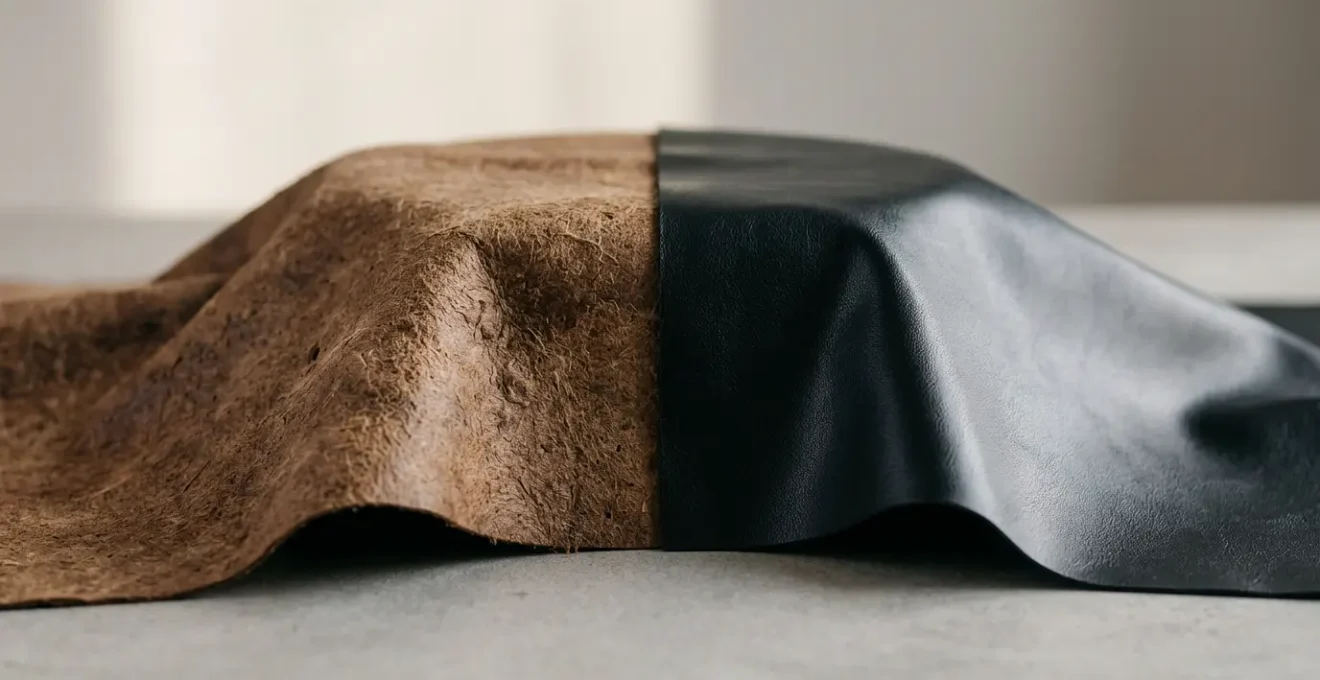
The « vegan » label alone guarantees neither durability nor sustainability; the material’s specific polymer chemistry is the only true indicator of quality.
- Cheap synthetics like PVC and PU are designed to fail, shedding microplastics and cracking as their chemical plasticizers leach out.
- Advanced bio-fabrics like mycelium (mushroom) leather offer a structurally superior alternative, but their environmental impact is complex and not universally low.
Recommendation: Shift your focus from the « vegan » marketing claim to a critical assessment of the material itself—its backing, flexibility, and end-of-life potential—to invest in products designed for longevity, not landfill.
You know the feeling. That pang of disappointment when your one-year-old “vegan” leather bag starts flaking at the straps, or the shoulders of a favorite pleather jacket begin to peel away like a bad sunburn. For the ethical consumer, this creates a frustrating paradox: in trying to avoid animal products, we often end up with disposable plastic goods that contribute to a different environmental crisis. We’re told to accept this poor quality as a trade-off for animal welfare, a compromise for a guilt-free purchase. But what if the problem isn’t the absence of leather, but the presence of inferior plastics?
The common conversation pits animal leather against a single entity called « vegan leather, » but this is a fundamental misunderstanding. From a materials science perspective, this category is a vast spectrum of different polymers, each with its own distinct chemistry, performance, and lifecycle. The real issue isn’t a simple binary choice, but a failure to differentiate between low-grade, petroleum-derived plastics and the next generation of high-performance biomaterials. The key to finding a durable and truly sustainable alternative lies not in the marketing label, but in understanding the science of what these materials actually are.
This guide moves beyond the simplistic ethical debate to empower you with the knowledge to deconstruct these materials. We will explore the material science behind why synthetics fail, how to identify quality before you buy, and what the true environmental cost of these alternatives is. By examining the polymer chemistry that governs everything from cracking to compostability, you can finally make an informed choice that aligns with both your ethics and your desire for products built to last.
This article provides a science-based framework for assessing leather alternatives. By understanding the fundamental differences in materials, from basic plastics to advanced bio-fabrics, you will gain the tools to look past greenwashing and identify true quality.
Summary: A Scientist’s Guide to Modern Leather Alternatives
- The Peel Test: How to Spot Cheap Pleather Before Buying?
- Oil or Water: How to Moisturize Plastic-Based Leather to Prevent Cracking?
- Is Vegan Leather Worse for the Planet than Real Leather?
- The Hairdryer Trick: Can You Stretch Vegan Leather Shoes?
- Liquid Vinyl: How to Fix Scratches on a Vegan Leather Bag?
- Mushroom Leather and Spider Silk: When Will Bio-Fabrics Hit the High Street?
- The Freezer Trick: Does It Really Stretch Tight Leather Shoes?
- Why « Made from Recycled Bottles » Is Not Always the Eco-Hero You Think?
The Peel Test: How to Spot Cheap Pleather Before Buying?
The peeling and flaking of a synthetic bag or jacket is not a random failure; it’s the predictable end-of-life for a poorly constructed material. Most low-cost « vegan leather » is one of two things: PVC (Polyvinyl Chloride) or PU (Polyurethane). Both are plastic coatings applied to a textile backing. The durability of the final product is determined entirely by the quality of these two components. Cheap pleather uses a thin, non-woven fabric base that offers no structural resistance to tearing, combined with an unstable plastic coating that is destined to break down.
High-quality synthetics, in contrast, use a robust woven or knit textile base (like a cotton or polyester canvas) that resists stress. The tell-tale signs are available to you before you ever make a purchase. You must become a material detective in the store. The smell is a key indicator: cheap PVC emits a sharp, chemical odor from the plasticizers used to make it flexible, whereas higher-grade PU is virtually odorless. The feel and weight also provide clues. PVC is often heavier, stiffer, and colder to the touch, while PU is lighter and more supple. The most definitive test, however, is how the material responds to pressure.
This table breaks down the key forensic indicators to look for when comparing common leather alternatives. Understanding these differences allows you to predict a material’s future performance and durability.
| Quality Indicator | PVC Leather | PU Leather | Mushroom/Bio Leather |
|---|---|---|---|
| Backing Fabric | Thin, non-woven or knitted base | Thicker woven or non-woven fabric | Often uses textile backing for reinforcement |
| Smell Test | Strong chemical odor (plasticizers) | Minimal to no odor | Faint earthy, natural scent |
| Weight & Feel | Heavier, stiffer, less breathable | Lighter, softer, more flexible | Variable; often lightweight and supple |
| Surface Response | Harsh creases, resists bunching | Fine wrinkles, leather-like drape | Natural texture, minimal creasing |
| Durability | More resistant to wear but brittle over time | Prone to cracking and flaking | Still being tested; less scratch-resistant |
Your Action Plan: The 5-Step Pre-Purchase Material Audit
- Points of contact: Examine all visible material edges where layers are exposed—seams, cuffs, the underside of straps. This is your first window into the material’s construction.
- Collecte: Inventory the item’s sensory signals. Note the smell (sharp chemical vs. neutral/earthy), the weight (heavy and dense vs. light), and the feel (stiff and cold vs. soft and supple).
- Cohérence: Confront the tactile feel with the visual evidence. Does the backing fabric at the edges look like a robust woven canvas or a flimsy, paper-like felt? A quality item’s structure is consistent.
- Mémorabilité/émotion: Perform the micro-wrinkle test by gently bunching the material. The memorable « tell » is the result: does it form fine, elegant, leather-like lines (quality) or resist bunching and form harsh, permanent creases (cheap plastic)?
- Plan d’intégration: Make your decision based on the complete audit. If the material fails multiple checks, reject it and avoid adding another future peeling item to your wardrobe.
Oil or Water: How to Moisturize Plastic-Based Leather to Prevent Cracking?
The question of how to « moisturize » plastic-based leather is based on a false premise. Unlike animal hide, which is a porous biological material that absorbs oils, PU and PVC are non-porous plastics. The cracking and brittleness that develop over time are not due to a loss of moisture, but a process called plasticizer migration. Plasticizers are small molecules added to the polymer matrix to make it soft and flexible. Over time, exposure to heat and UV radiation causes these molecules to migrate to the surface and evaporate, leaving the plastic rigid and prone to cracking.
Therefore, you cannot « moisturize » plastic; you can only try to seal the surface to slow the loss of its original chemical components. This is why traditional leather conditioners containing oils and lanolin are ineffective and can even damage the synthetic finish. The goal is preservation, not hydration. The lifespan of these materials is inherently limited, with industry data showing a typical durability of 2 to 5 years for standard PVC leather, though proper care can extend this.
The most effective strategy involves a two-pronged approach: correct storage and the use of specialized surface protectants. To slow plasticizer migration, you must minimize environmental stressors. This means storing items away from direct sunlight and avoiding temperature extremes, which accelerate chemical breakdown. Using a dedicated vegan leather conditioner—typically a water-based or silicone-based formula—creates a protective barrier on the surface, sealing in the existing plasticizers and adding a layer of flexibility. The type of product matters, as high-gloss « patent » finishes require a silicone spray, while matte finishes need a water-based protectant to avoid altering the sheen.
- Storage Strategy: Store items away from direct sunlight (UV rays accelerate degradation) and avoid extreme heat or cold cycles (which make plastic brittle).
- Avoid Sealed Plastic Bags: Do not store vegan leather in sealed plastic bags, which trap fumes and speed up chemical breakdown. Use breathable dust bags instead.
- Use Specialized Conditioners: Apply a vegan leather-specific conditioner that creates a protective barrier to slow plasticizer loss and restore surface flexibility. Avoid real leather products containing lanolin.
- Finish-Specific Application: High-gloss ‘patent’ finishes require silicone-based spray. Matte finishes need water-based protectants. Textured surfaces need soft brush application to avoid residue.
Is Vegan Leather Worse for the Planet than Real Leather?
There is no simple answer to this question, as it involves comparing two vastly different industrial systems, each with its own significant environmental drawbacks. Traditional leather production is intrinsically tied to animal agriculture, a leading source of methane emissions, deforestation, and massive water consumption. The tanning process itself uses a cocktail of toxic chemicals, including chromium, which can pollute waterways. However, the finished product is durable, repairable, and biodegradable over the very long term.
On the other hand, most « vegan leather » is simply plastic derived from fossil fuels. PVC is particularly harmful, releasing phthalates and dioxins during its lifecycle. Even PU, a less toxic alternative, is a non-biodegradable plastic that will persist in landfills for centuries and shed microplastics into the environment. The critical mistake is to view « vegan leather » as a monolith. Emerging bio-fabrics are changing the equation entirely. These materials, derived from sources like cacti, pineapples, or mushrooms, can have dramatically lower environmental footprints. For example, some lifecycle assessments show that certain plant-based leathers can have a fraction of the carbon impact of cowhide, with one study indicating a footprint of 1.4 kg CO2e/m² for cactus leather compared to over 60 kg for traditional leather.
However, even « bio-based » is not a synonym for « eco-friendly. » The production process matters immensely. As one case study reveals, the promise of sustainability can be complicated by industrial realities.
Case Study: The Hidden Energy Cost of Mycelium Leather
A 2024 lifecycle assessment of mycelium-based leather produced in Indonesia revealed a surprisingly high carbon footprint of 57.15 kg CO2e per square meter. The study found that 46.53 kg of this total was attributed solely to electricity consumption. While the raw material (mycelium) is renewable, the energy-intensive fermentation process, which requires precise temperature and humidity controls, significantly increased the material’s overall environmental impact. This highlights that a « bio » source does not guarantee a low footprint if the manufacturing process relies heavily on fossil fuel-based energy.
The Hairdryer Trick: Can You Stretch Vegan Leather Shoes?
The popular « hairdryer trick »—heating shoes and wearing them with thick socks to stretch them—is a technique borrowed from real leather and misapplied to synthetics. Whether it works, or whether it will destroy your shoes, depends entirely on the polymer chemistry of your specific « vegan leather. » Materials like PU and PVC are thermoplastics, meaning they become temporarily soft and malleable when heated. For these materials, the hairdryer trick can provide a minor, one-time stretch. However, the heat must be applied carefully on a low setting, as excessive heat can permanently melt or warp the plastic coating.
This method is completely unsuitable for the new generation of bio-fabrics. Materials derived from mycelium (mushroom), pineapple leaves (Piñatex), or cactus are not thermoplastics. Their structure is composed of natural fibers and binders. Applying direct heat will not make them pliable; instead, it is likely to cause irreversible damage, such as scorching, shrinking, or delamination of the layers. For these materials, the only safe way to achieve a gentle stretch is to use a professional shoe stretcher, which applies slow, even mechanical pressure without heat.
The effectiveness of stretching is also limited by the backing fabric. If the plastic coating is applied to a non-stretch textile base, you will not be able to achieve any significant expansion, regardless of the method used. The table below provides a material-specific guide to stretching.
| Material Type | Heat Response | Stretching Method | Important Limitations |
|---|---|---|---|
| PU/PVC (Thermoplastics) | Temporarily malleable with low heat | Use hairdryer on low setting + thick socks for minor adjustments | One-time permanent fix; minimal stretch achievable (not gradual like leather) |
| Mycelium/Pineapple/Cactus Leather | Heat can cause irreversible damage | Avoid heat entirely; use professional shoe stretcher for slow, even pressure | Not thermoplastic; does not conform over time like animal leather |
| Fabric-Backed Vegan Materials | Limited by non-stretch backing | Focus on specific pressure points only; minimal overall expansion possible | Stretching limited by the textile base fabric properties |
Liquid Vinyl: How to Fix Scratches on a Vegan Leather Bag?
Repairing scratches on plastic-based leather is fundamentally more challenging than repairing animal leather. Real leather has a natural, fibrous grain structure that can be buffed, conditioned, and re-dyed, allowing repairs to blend in. Synthetic leather, by contrast, is a uniform sheet of plastic. Any scratch or gouge is a physical removal of this material, and there is no underlying grain to work with. The goal of a repair is not to heal the material, but to patch the void with a compatible filler and camouflage it.
The process requires a multi-step, meticulous approach. First, the area must be thoroughly cleaned with an alcohol-based solution to remove any dirt or silicone residue. For deeper scratches, a flexible filler compound, often sold as a « liquid vinyl » or PU repair kit, is applied in thin layers to build the surface back up to level. This is the most critical step and requires patience to avoid overfilling. Once the filler is cured, the next challenge is recreating the texture. This can sometimes be achieved by dabbing the semi-cured filler with a textured material or using a grain-patterned paper from a specialized repair kit.
Finally, the patch must be color-matched and sealed. This usually involves mixing acrylic-based colorants to match the exact shade of the bag and applying it carefully with a fine brush or sponge. A clear top-coat or sealer is then applied to protect the repair and match the sheen of the surrounding material. As one expert notes, the uniformity of the material is both a challenge and a requirement for a successful repair.
Unlike traditional leather, vegan leather lacks natural grain, so repair compounds must be selected to maintain the uniform appearance. Proper sealing after repair is crucial to prevent further peeling or cracking.
– Marcus Liu, Leather Goods Restoration Specialist, Artisan Leatherworks
Mushroom Leather and Spider Silk: When Will Bio-Fabrics Hit the High Street?
For years, advanced bio-fabrics like mycelium (the root structure of mushrooms) leather and lab-grown spider silk have been heralded as the future of sustainable textiles. They promise the performance and aesthetic of traditional materials without the environmental or ethical baggage of animal agriculture or fossil fuels. These materials move beyond simple plastic coatings and instead use biomimicry to create complex, durable structures at a microscopic level. The question for consumers, however, is no longer « are they possible? » but « when can I actually buy them? »
The transition from laboratory pilot to high street reality is happening, but it is slow, expensive, and happening first at the highest end of the market. Companies are now overcoming the significant hurdles of producing these materials at an industrial scale while maintaining quality and consistency. This involves large-scale fermentation, automated processing, and sophisticated finishing techniques. The journey of MycoWorks, a leader in mycelium leather, provides a clear case study of both the progress and the remaining challenges.
Case Study: MycoWorks’ Path to Commercial Scale
With over $187 million in capital and a 136,000 square-foot automated factory, California-based MycoWorks represents the forefront of commercial mycelium production. Their material, « Reishi, » made its debut in high-profile collaborations, including an Hermès travel bag, interiors for a GM Cadillac concept car, and furniture from Ligne Roset. The company grows its mycelium sheets on sawdust and then ships them to tanneries in Spain for finishing, where the material meets or exceeds industry benchmarks for flexibility and abrasion resistance. Despite these successes and significant automation, analysts note that development timelines remain slow and expensive, indicating that widespread, affordable availability is still several years away.
While full-scale commercialization is not yet here, these materials are no longer science fiction. They are appearing in limited-edition luxury goods, concept cars, and high-end furniture. As production scales and costs decrease, expect to see these bio-fabrics filter down to more accessible brands within the next 5 to 10 years, finally offering a truly high-performance, next-generation alternative to both plastic and animal leather.
The Freezer Trick: Does It Really Stretch Tight Leather Shoes?
The « freezer trick »—placing a bag of water in a shoe and freezing it to let the expanding ice stretch the material—is another popular DIY method that poses a significant risk to most vegan leathers. The logic seems sound: water expands by about 9% when it turns to ice, creating a powerful, slow-acting stretching force. While this can sometimes work on durable, thick animal leather, applying it to synthetics is a dangerous gamble with their material integrity.
The primary danger lies in how synthetic polymers react to extreme cold. Unlike the fibrous, resilient structure of animal hide, plastics can become extremely brittle at low temperatures. This is especially true for PVC, which is notorious for its poor performance in the cold. Material science research confirms that PVC becomes brittle and prone to cracking when exposed to low temperatures. When you combine this temperature-induced brittleness with the immense, uncontrolled force of expanding ice, you create the perfect conditions for catastrophic failure. Instead of a gentle stretch, you are far more likely to cause micro-cracks in the plastic coating or even split the seams entirely.
Furthermore, any moisture that seeps into the seams or backing fabric during the process can cause delamination as it freezes and thaws, leading to the very peeling you want to avoid. The force is also non-uniform, putting immense pressure on specific points like the toe box and heel rather than creating an even stretch. For synthetic materials, this method is simply too high-risk. Gentle, controlled methods like using a professional shoe stretcher or the careful application of low heat (for thermoplastics only) are far safer and more effective approaches.
Key takeaways
- Most peeling « vegan leather » is cheap plastic (PVC/PU) failing as designed; true quality is identified by inspecting the backing fabric, smell, and flexibility before purchase.
- The environmental impact of a leather alternative is not determined by the « vegan » or « recycled » label, but by its entire material lifecycle, from fossil fuel or bio-based sourcing to its end-of-life microplastic shedding and (non)recyclability.
- Care for plastic leather is not « moisturizing »; it’s about sealing the surface with specialized, non-oil-based products to prevent the loss of chemical plasticizers and protect against UV degradation.
Why « Made from Recycled Bottles » Is Not Always the Eco-Hero You Think?
The « made from recycled bottles » claim has become a powerful marketing tool, making consumers feel they are making a virtuous choice. The material, known as rPET (recycled polyethylene terephthalate), takes plastic bottles and spins them into a soft, felt-like fabric. This fabric is then often used as the backing for a new « vegan leather. » While this diverts plastic from landfills, it is far from the perfect environmental solution it appears to be. This process is more accurately described as downcycling, not true recycling.
The primary issue is that the final product—a composite of rPET fabric, a virgin PU or PVC coating, glues, and dyes—is a complex material that cannot be recycled again. It is a one-way ticket to the landfill or incinerator. Furthermore, the very act of wearing these items contributes to plastic pollution. As a crucial study on synthetic materials highlights, these products shed microscopic plastic fibers through everyday abrasion. This process releases microplastics into the air, soil, and waterways, a problem that doesn’t exist with truly biodegradable materials.
Case Study: The Unseen Pollution of Recycled Synthetics
Synthetic and vegan leathers made from plastics, including those using recycled bottles (rPET), do not biodegrade. According to analysis from environmental groups, these materials shed microplastic fibers throughout their lifespan due to normal wear and tear. This constant, low-level pollution of ecosystems is a hidden environmental cost. Moreover, the composite nature of an rPET-based bag (fabric + PU coating + adhesives) makes it impossible to separate and recycle at its end of life. This means that despite its recycled origin, the product’s ultimate destination is the landfill, where it will persist for hundreds of years, unlike some genuinely biodegradable bio-fabrics.
To navigate this greenwashing, the conscious consumer must ask more critical questions. Is the entire product recycled, or just a small part like the lining? Is the recycled base coated with a layer of new, virgin plastic? Does the product have a reputable third-party certification like the Global Recycled Standard (GRS)? Looking past the marketing headline is essential to understanding the true lifecycle of the product you are buying.
Now that you are armed with the scientific principles to evaluate these materials, the next logical step is to apply this critical lens during your purchasing decisions. Demand transparency from brands not just about animal welfare, but about their material’s specific polymer chemistry, its full lifecycle assessment, and its potential for end-of-life recycling or composting.