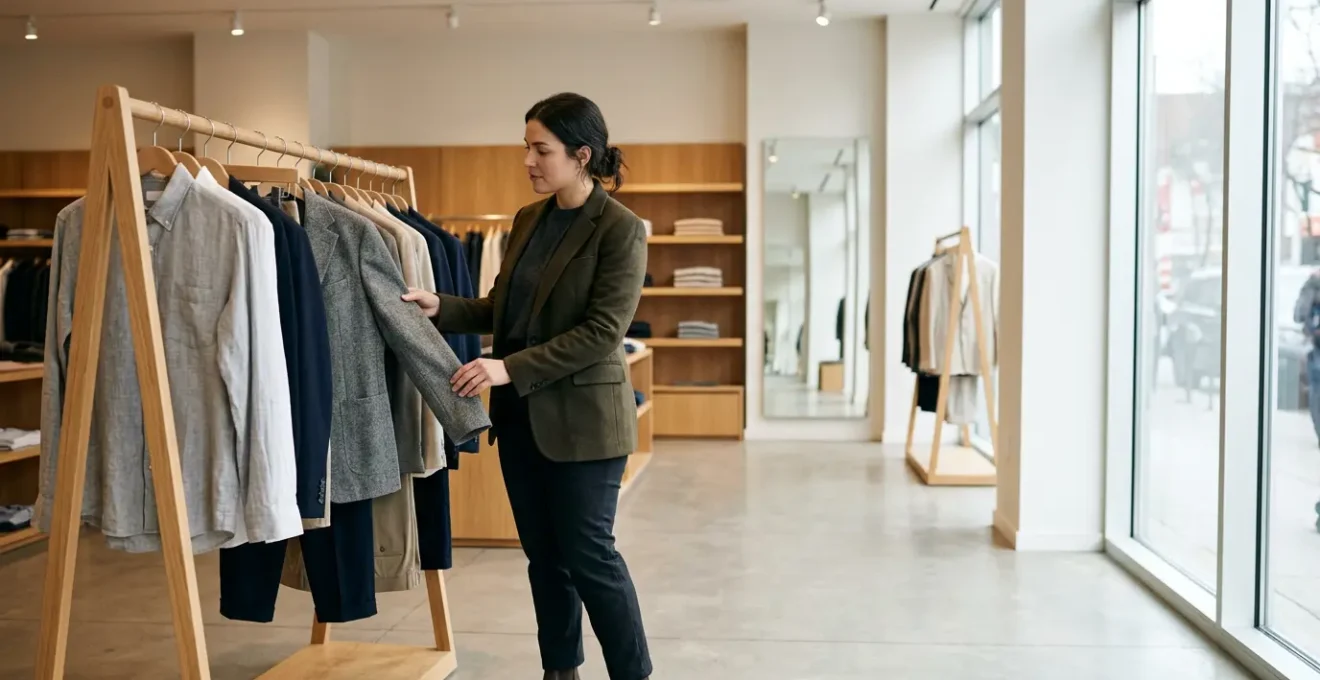
The secret to wearing menswear when you have hips isn’t finding a tailor; it’s mastering ‘structural hacking’—understanding and manipulating the garment’s cut to work for your body.
- Menswear is cut straight, prioritizing chest and waist. Your goal is to create shape where there is none by using strategic tucks, lapel styles, and fit-point prioritization.
- Start with the most difficult fit point first. For trousers, buy to fit your hips, then tailor the waist. For shirts, ensure the shoulders fit and use styling to manage the length.
Recommendation: Stop trying to fit into men’s clothes. Instead, learn the principles of their construction to make them fit you. It’s a shift from accommodation to empowerment.
There’s a quiet frustration familiar to many women who venture into the men’s department. You’re drawn in by the quality of the fabrics, the robust construction of a good blazer, the timeless appeal of a crisp Oxford shirt, or the clean lines of tailored trousers. Yet, the experience often ends in a fitting room disappointment. That perfect pair of pants won’t go past your hips, the shirt that fits your shoulders is a tent around your waist, and the blazer creates a boxy silhouette that erases your shape entirely. The core of the problem is the fundamental difference in fit philosophy: menswear is engineered for a straight silhouette, while your body has curves, most notably a distinct hip-to-waist ratio.
The common advice is generic and uninspired: « buy oversized, » « just take it to a tailor, » or « balance it with something tight. » These tips treat the symptom, not the cause. They force you to work around the clothes. But what if the approach was reversed? What if, instead of trying to contort your body to fit the clothes, you learned to deconstruct and manipulate the clothes to fit your body? This is the art of ‘structural hacking.’ It’s about understanding the « why » behind a garment’s cut—the straight torso lines, the longer hems, the different shoulder-to-hip measurements—and using that knowledge to your advantage.
This guide moves beyond the obvious. It’s a cross-gender fit specialist’s perspective on transforming menswear from a source of frustration into a powerful tool for self-expression. We will explore how to make a men’s shirt look intentionally styled, not just oversized. We’ll analyze how specific shoe styles can visually slim your entire leg line and which blazer lapel actually flatters a curvy torso. Ultimately, this is about mastering a new language of fit, one that allows you to confidently build a sharp, androgynous, and perfectly fitted wardrobe from any section of the store.
This article provides a structured approach to mastering menswear. The following sections break down each element, from sizing myths to tailoring strategies, to build your expertise step by step.
Summary: A Strategic Guide to Wearing Menswear
- Unisex Sizing: Does an XS Men’s really fit a Women’s M?
- The Half-Tuck: How to Make a Men’s Shirt Look Deliberately Styled?
- Derbies or Oxfords: Which Menswear Shoe Slims the Female Ankle?
- Red Lip or Statement Earring: How to Add a Feminine Touch to a Suit?
- Tie or No Tie: When Does Androgyny Cross the Line at Work?
- Unisex vs. Genderless: How Brands Are Rethinking Sizing for Modern Bodies?
- Peak vs. Notch Lapel: Which Style Actually Slims the Torso?
- How to Commute by Bike in a Suit Without Ruining Your Trousers?
Unisex Sizing: Does an XS Men’s really fit a Women’s M?
The promise of « unisex » sizing feels like the perfect solution, a simple bridge between men’s and women’s sections. However, the reality is that most unisex clothing isn’t a new, inclusive standard; it’s simply men’s sizing relabeled. An « XS » men’s or unisex T-shirt will not map cleanly onto a women’s « M » because they are built on entirely different foundations. As a general rule, women typically need to size down one or two sizes from their standard womenswear size when buying unisex, but this is a blunt instrument that fails to address the core issue of shape.
The difference lies in the fit philosophy. Menswear patterns are drafted with a focus on chest and waist measurements, assuming a relatively straight line from the shoulder to the hip. Womenswear, in contrast, is fundamentally built around the bust, waist, and hip ratio, designed to accommodate and contour to curves. A comprehensive analysis of fit highlights this divergence: men’s sizing prioritizes broader shoulders and longer torsos, while women’s sizing is a game of ratios. This is why a men’s shirt that fits your shoulders might be too tight at the hips, or a pair of trousers that accommodates your hips will have a gaping waistband. The trade-off with most unisex sizing is fit accuracy, especially for tailored pieces.
Case Study: The Fit Philosophy Difference
A comprehensive analysis reveals that men’s sizing emphasizes broader shoulders, longer torsos, and straighter hips with measurements focusing on chest, waist, and inseam length. Women’s sizing is designed with bust, waist, and hip ratios in mind, emphasizing contouring to curves. The trade-off with unisex sizing is fit accuracy: while it works for oversized garments, it struggles with tailored items like blazers or fitted trousers where the hip-to-waist ratio is critical.
Therefore, thinking of a men’s XS as a direct equivalent to a women’s M is a flawed starting point. It’s more effective to ignore the label and focus on the most critical fit point for that specific garment. For a blazer, it’s the shoulders. For trousers, it’s the hips. Buy the size that fits that one point perfectly, and then plan to tailor or style the rest. This is the first step in structural hacking: identifying the non-negotiable anchor point and treating the rest of the garment as malleable.
The Half-Tuck: How to Make a Men’s Shirt Look Deliberately Styled?
A men’s button-down shirt is a staple, but its length and straight cut can be problematic. Left untucked, its longer hem can shorten the leg line and create a shapeless look. A full tuck can result in excessive blousing at the waist due to the extra fabric. The solution is a strategic, deliberate tuck—a form of structural hacking that reshapes the garment’s silhouette on your body. The goal isn’t just to tuck your shirt in; it’s to create new lines that are both flattering and intentional.
The most effective technique is the asymmetrical half-tuck. Instead of tucking the front center of the shirt, which can cut the body in half, tuck just one side, slightly off-center. This creates a diagonal line that draws the eye upward, elongating the torso and visually breaking up the straight, boxy cut of the shirt. It subtly hints at the waist without constricting it and allows the fabric to drape naturally over the hips on the untucked side. This makes the oversized nature of the shirt look like a conscious styling choice rather than a poor fit.
Experimentation is key. Try tucking only the very front and letting the sides hang loose, or tucking the shirt into a high-waisted bottom to redefine your waistline entirely. The key is to ensure the shoulders of the shirt fit well. If the shoulder seam droops significantly down your arm, the shirt will always look ill-fitting, no matter how artfully you tuck it. The half-tuck is a powerful tool, but it works best when the garment’s foundational fit across the shoulders is correct.
Action Plan: Mastering the Men’s Shirt
- Assess Length and Shoulders: Before buying, check where the hem falls. Ensure the shoulder seams sit correctly at the edge of your shoulders. A tailor can shorten a shirt, but fixing shoulders is major surgery.
- Perform the Asymmetrical Tuck: Tuck in only one front panel of the shirt, about 2-3 inches to the side of the center button placket. This creates a flattering diagonal line.
- Manage Fabric Volume: Pull the tucked fabric gently to create a slight « blouson » effect, then smooth the back and untucked side so they drape cleanly over your hips.
- Create Proportional Balance: Pair the partially-tucked, voluminous shirt with fitted bottoms like slim-cut trousers or a pencil skirt to maintain a balanced and intentional silhouette.
- Consider Alterations: If you find a shirt with a fabric you love but it’s excessively long, a tailor can easily raise the hem for a few dollars, making it far more versatile.
By treating the tuck as a design tool, you transform a standard men’s shirt into a piece that is uniquely styled for your body, solving the hip-fit dilemma with a simple, elegant hack.
Derbies or Oxfords: Which Menswear Shoe Slims the Female Ankle?
Footwear is the foundation of any outfit, and in menswear, it can be a powerful tool for proportional engineering. When adapting men’s styles, especially trousers that can have a wider leg opening, the right shoe can dramatically alter the perception of your entire silhouette, right down to the ankle. While both are classic lace-up dress shoes, the subtle structural differences between Oxfords and Derbies have a significant impact on this.
The answer lies in the vamp and the lacing system. Oxfords are defined by their « closed lacing, » where the shoelace eyelets are stitched underneath the vamp (the front part of the shoe). This creates a clean, uninterrupted line along the top of the foot. Derbies, on the other hand, have « open lacing, » with the eyelet tabs sewn on top of the vamp, creating a more visible, slightly bulkier construction. For the purpose of creating a slim, elongated leg line, the Oxford is the superior choice. Its sleek, low-profile design minimizes visual clutter, allowing the eye to travel smoothly from the hem of the trouser to the tip of the shoe. This creates an elegant, continuous line that makes the ankle appear slimmer and the leg longer.
This effect is especially powerful when paired with well-tailored trousers that have a minimal « break » (the fold of fabric where the pant hem meets the shoe). The clean silhouette of the Oxford allows it to sit neatly under the trouser hem without adding bulk.
As the image highlights, the magic is in the intersection of fabric and leather. The unbroken line of an Oxford’s vamp, as it disappears under the trouser cuff, is a masterclass in subtle proportional hacking. It draws a sharp, clean finish to your leg line, providing a solid and elegant anchor that balances the potential volume of menswear trousers. A Derby, with its more robust construction, can sometimes appear clunky in contrast, visually « cutting off » the ankle. When aiming for a slim and streamlined androgynous look, the Oxford is your most strategic ally.
Red Lip or Statement Earring: How to Add a Feminine Touch to a Suit?
Once you’ve nailed the fit of your menswear-inspired suit, the conversation often shifts to « softening » it with feminine touches. However, this framing can be limiting. The goal shouldn’t be to compensate for the androgyny, but to embrace it as a canvas for deliberate self-expression. A red lip or a statement earring isn’t a corrective measure; it’s a punctuation mark, a conscious style choice that co-exists with the suit’s clean lines. In a world where recent market research confirms that binary wardrobes are becoming an outdated concept, these accessories are about personal identity, not gender performance.
The key is to think in terms of contrast and focus. A sharply tailored suit creates a strong, architectural frame. An accessory’s job is to introduce a different element—be it color, texture, or shape.
- A Classic Red Lip: This is the most direct and powerful contrast. It introduces a bold splash of color against the typically neutral palette of a suit (charcoal, navy, black). It draws focus to the face and adds an element of classic, confident glamour without altering the suit’s silhouette.
- A Statement Earring: This works differently. A single, sculptural, or glistening earring can play with asymmetry and light. It adds a point of visual interest near the face, breaking up the solid lines of the blazer’s collar and lapel. It’s less about color and more about adding a touch of modern artistry.
Ultimately, these choices are about celebrating the duality of your look. As style writer Adam Cheung notes, fashion is a primary form of creative expression.
What you choose to wear is one of the most creative forms of self-expression, and it’s quite surprising that so many labels out there still choose to conform with the traditional, and somewhat stereotypical, idea of male and female fashion.
– Adam Cheung, OPUMO Magazine
Choosing to wear a bold lip or a dramatic earring with a suit isn’t about making the suit « wearable for a woman. » It’s about demonstrating that strength and softness, structure and artistry, can and should coexist. It’s a statement of confidence in the androgynous look you’ve so carefully constructed.
Tie or No Tie: When Does Androgyny Cross the Line at Work?
Navigating androgynous style in a professional environment is less about a single item like a tie and more about understanding context and mastering the art of « polished intention. » The question isn’t whether a tie is « too much, » but whether the overall look communicates competence, confidence, and respect for the workplace culture. An ill-fitting suit with a poorly knotted tie looks unprofessional, regardless of gender. A perfectly tailored suit, worn with a crisp open-collar shirt, can be far more powerful.
The line is crossed not by androgyny itself, but by sloppiness. A successful androgynous business look hinges on impeccable fit and quality fabrics. The focus should be on creating a sharp, clean silhouette. For most corporate settings, especially in more conservative industries, the most effective approach is to build a strong foundation with a neutral-toned blazer and well-fitted trousers. This creates a look of authority and polish. A tie can be added, but it should be a deliberate choice: a slim-width tie in a subtle texture (like knit silk) can look incredibly chic. Conversely, going without a tie requires that your shirt collar is crisp and stands up properly within the blazer’s lapels.
As the Wildfang workplace style guide illustrates, versatility is key. What works in a creative agency or tech startup (e.g., a bold-patterned blazer, a more relaxed trouser fit) may not fly in a law firm or financial institution. The smartest strategy is to observe the « highest » level of formality in your office and build your androgynous look to meet that standard. A classic blazer paired with tailored trousers is a universally accepted uniform for success. Whether you add a tie, a silk scarf, or simply a pristine open collar is a secondary choice, a personal signature on an already professional canvas.
Unisex vs. Genderless: How Brands Are Rethinking Sizing for Modern Bodies?
The frustration with « unisex » sizing has pushed a new, more thoughtful movement to the forefront: « genderless » design. The two terms are often used interchangeably, but their philosophies are worlds apart. Unisex, as we’ve seen, typically means grading a standard men’s block pattern up or down. Genderless, in its truest form, means abandoning traditional gendered patterns altogether and designing garments based on a wider range of body shapes and proportions.
This new approach is about creating a more inclusive and accurate fit from the ground up. Forward-thinking brands are moving beyond simple measurements and embracing a more holistic view of the human form. This is made possible by innovative technologies like 3D body scanning and adaptive fitwear, which allow designers to gather data on a multitude of body types. This data informs new patterns that can better accommodate features like wider hips, shorter or longer torsos, and different shoulder-to-waist ratios, regardless of a person’s gender identity. It’s a shift from a two-pattern system (male/female) to a multi-pattern system based on shape.
Some brands are achieving this without high-tech solutions, instead focusing on deep customer engagement and extensive fit testing.
Case Study: Big Bud Press & True Genderless Sizing
The LA-based brand Big Bud Press exemplifies truly inclusive fashion. They offer one of the most comprehensive size ranges in the industry (XXS-6XL) and design their garments specifically to fit diverse body types. Unlike brands that just scale men’s patterns, Big Bud Press drafts each size to accommodate different shapes. They actively encourage customers to reach out for personalized fit guidance, closing the gap between the garment and the individual body and proving that a genderless fit is about intention, not just a marketing label.
The rise of genderless design is a direct response to the failings of the unisex model. It acknowledges that a person with wide hips and a narrow waist exists and deserves clothes that fit, just as much as a person with broad shoulders and a straight torso. For those shopping the men’s section out of a desire for a certain aesthetic or quality, the emergence of true genderless brands offers a powerful alternative: clothing designed for bodies, not binaries.
Peak vs. Notch Lapel: Which Style Actually Slims the Torso?
When hacking a men’s blazer to fit a body with hips, the lapel is one of the most powerful and overlooked tools for proportional engineering. It’s not just a decorative flap of fabric; its shape and direction can fundamentally alter the perceived silhouette of your upper body, helping to balance your overall proportions. The two most common styles are the notch lapel and the peak lapel, and one is far more effective for this purpose.
The notch lapel is the standard for single-breasted suits and blazers. It features a visible « notch » where the bottom of the collar meets the top of the lapel. It’s understated and classic, but its horizontal lines do little to shape the torso. The peak lapel, traditionally found on double-breasted jackets but now common on single-breasted styles, is defined by its sharp edges that point upwards towards the shoulders. This upward-pointing ‘V’ shape is the key to our structural hack. It creates a powerful visual illusion: it draws the eye outwards and upwards, making the shoulders appear broader and the waist relatively narrower. This creates a more defined V-shaped torso, which provides a beautiful counterbalance to wider hips. It’s a classic tailoring trick used to add authority and shape, and it’s incredibly effective for a curvy body.
A perfectly tailored suit is a statement of confidence, but that confidence comes from the details working in harmony with your body. A stylist once noted that a suit makes you look « together, capable, and successful. » The peak lapel is a crucial ingredient in achieving that effect. By visually broadening the shoulders, it balances the hips and sculpts the waist, transforming a potentially boxy men’s blazer into a garment that enhances, rather than hides, your shape. When faced with the choice, always opt for the peak lapel. It is the single most effective built-in feature for slimming and shaping the torso.
Key Takeaways
- Stop thinking in equivalents; unisex sizing is typically relabeled men’s sizing and won’t fit a curvy body properly without strategic selection.
- Master the « structural hack »: use intentional tucks, lapel styles, and shoe choices to manipulate a garment’s silhouette to create shape.
- Prioritize the most difficult fit point (shoulders for blazers, hips for trousers) and tailor or style the rest.
How to Commute by Bike in a Suit Without Ruining Your Trousers?
Wearing tailored trousers, especially those from the men’s section, while commuting by bike presents a unique challenge. The friction from the saddle can quickly wear out the fabric in the inner thigh and seat, and the fit around the hips and thighs is critical for both comfort and durability. The solution lies in a two-pronged approach: smart tailoring from the outset and selecting the right fabric.
The most important rule when buying men’s trousers for a body with hips is to buy to fit your hips and thighs first. Ignore the waist size on the label. Find a pair that comfortably accommodates the widest part of your lower body without pulling or straining. The waist will almost certainly be too large, but this is the easiest and most common alteration for a tailor to perform. Taking in the waist is a simple procedure that ensures the trousers drape correctly from the hips down. This is far more effective than trying to let out the seams of trousers that are too tight in the hips, which is often impossible.
When you take your trousers to the tailor, you can also ask for preventative reinforcements. A good tailor can add a discreet extra layer of fabric or a saddle patch to the inside of the trousers at high-friction points. Furthermore, discuss fabric options. While traditional wool is excellent, a stretch-wool blend can be a game-changer for an active commute. These performance fabrics offer greater mobility and durability without sacrificing the sharp look of a tailored suit. They provide the necessary give when pedaling, reducing stress on the seams and prolonging the life of your trousers.
Your Tailoring Strategy for Menswear Trousers
- Prioritize the Hip Fit: Always buy trousers that fit your hips and seat perfectly. The waist can and should be tailored down.
- Consult a Tailor Immediately: Take your new trousers to a tailor to have the waist taken in for a flawless fit. This is a standard and essential alteration.
- Request Reinforcement: Ask your tailor to add reinforcing panels to high-friction areas like the inner thighs and seat, especially if you are an active commuter.
- Discuss Performance Fabrics: Inquire about stretch-wool or other performance blends that offer mobility and durability for daily wear and tear.
- Dial in the Hem: Ensure the trousers are hemmed to the correct length for the shoes you’ll be wearing most often, aiming for a slight or no break for a clean, modern line.
By investing in smart tailoring and choosing the right materials, you can easily adapt menswear trousers for a perfect fit that stands up to the rigors of a daily bike commute, ensuring you arrive at your destination looking polished and professional.