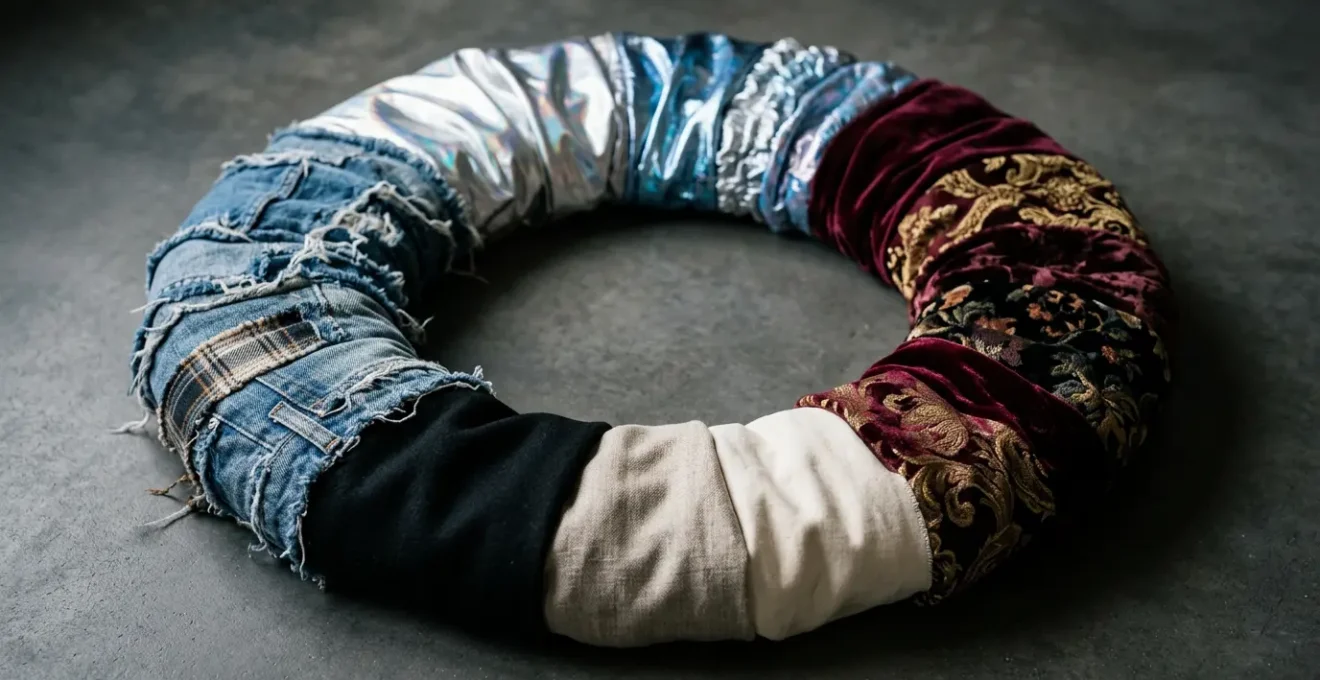
Contrary to popular belief, the return of Y2K fashion isn’t just a nostalgic repeat. This article reveals it’s a ‘remix culture’ where Gen Z uses past aesthetics as a costume for stability in an unstable world. We’ll decode the 20-year cycle, the ‘Old Money’ illusion, and how social media is changing the game, giving you the tools to distinguish lasting style from fleeting micro-trends.
If the sight of a low-rise jean, a visible thong, or a trucker hat in the wild has sent a cold shiver down your spine, you’re not alone. For any millennial who survived the early 2000s fashion scene, its current resurgence feels less like a charming revival and more like a cultural haunting. We lived through the era of questionable denim washes and velour tracksuits, and we have the slightly embarrassing photos to prove it. The common wisdom tells us that « fashion is cyclical » or that it’s all just nostalgia, but that doesn’t quite explain the visceral whiplash of seeing trends we deemed « bad » resurrected and celebrated by a new generation.
The easy answer points to a mystical « 20-year rule, » but that feels too simple. The real story is far more complex and fascinating. This isn’t a carbon copy of the past; it’s a distorted reflection. Gen Z isn’t experiencing Y2K fashion the way we did. They are sampling it, filtering it through a modern lens of economic anxiety, digital identity, and a yearning for a pre-algorithmic world they never knew. This phenomenon is less about simple nostalgia and more about a « nostalgia distortion field, » where the aesthetic of an era is detached from its reality.
But what if the key to understanding this perplexing return isn’t just looking at the past, but analyzing the very machinery that brings it back? The truth is that the return of Y2K’s “worst” trends is a powerful case study in how style is now manufactured, consumed, and discarded at an unprecedented speed. It reveals a cultural conversation between generations, the power of social media to create « aesthetic cosplay, » and the difference between a fleeting moment and a style with true staying power.
This analysis will guide you through the mechanics of the modern trend cycle. We will explore the data behind the 20-year rule, decipher the meaning behind viral aesthetics like « Old Money, » and differentiate between a lasting « core » and a disposable micro-trend, ultimately empowering you to reclaim your personal style from the chaos.
Summary: Why the 2000s Won’t Die
- The 20-Year Cycle: Which Decade is Next on the Revival List?
- Cottagecore vs. Sustainability: Which Movement Will Shape the Next 5 Years?
- TikTok Aesthetics: How « Old Money » Became a Costume for Gen Z?
- Pantone Color of the Year: Does It Actually Influence What Is in Stores?
- Normcore to Gorpcore: Why Are We Obsessed with Dressing « Normal »?
- The 90s Bag Revival: Which Forgotten Models Are Back in Style?
- Core vs. Trend: How to Identify Styles That Will Last More Than 3 Months?
- How Social Media Micro-Trends Are Destroying Personal Style?
The 20-Year Cycle: Which Decade is Next on the Revival List?
The « 20-Year Rule » is the most common explanation for fashion’s cyclical nature. The theory posits that it takes about two decades for a trend to feel fresh again. The generation that was too young to wear it the first time around discovers it, finding it novel and exciting, while the generation that originated it is now old enough to feel a pang of nostalgia. This predictable rhythm has held for decades, explaining the 70s revival in the 90s, the 80s comeback in the 2000s, and, yes, the Y2K obsession of the 2020s. Following this logic, we should be bracing for the imminent return of mid-2010s indie sleaze and twee aesthetics.
However, recent analysis suggests this cycle is no longer a simple pendulum swing. A groundbreaking study from Northwestern University confirms the cycle’s existence but reveals a crucial shift. After analyzing nearly 37,000 images spanning from 1869 to today, researchers found that the modern trend cycle is becoming increasingly fragmented. Instead of one dominant look defining a decade, we now see multiple, often contradictory, trends co-existing.
This fragmentation is a direct result of the internet and social media, which allow niche communities to form and flourish. As lead researcher Dr. Emma Zajdela explains, this change has profound implications for how we understand trends:
Starting in the 1980s, the data show a wider range of skirt lengths appearing at the same time, suggesting that fashion trends are becoming more fragmented. Rather than one dominant trend, niches emerge, reflecting more diversity in fashion.
– Dr. Emma Zajdela, Northwestern University Fashion Cycle Study
So, while the 20-year cycle provides a blueprint, the next revival won’t be a singular look. It will be a buffet of aesthetics from the mid-2010s, picked apart and remixed by various online subcultures. The question is no longer « what’s next? » but « which parts of what’s next will stick? »
Cottagecore vs. Sustainability: Which Movement Will Shape the Next 5 Years?
As the trend cycle fragments, we see a fascinating clash between aesthetics and ethics. On one hand, you have movements like Cottagecore, an aesthetic built on an idealized, romantic vision of rural life, complete with flowy dresses, handcrafted items, and pastoral tranquility. On the other hand, you have the growing, values-driven movement of sustainability, which prioritizes conscious consumption, ethical production, and environmental impact. For the next five years, the dominant force in fashion will be the push and pull between these two ideas: the desire for an aesthetic escape and the demand for real-world responsibility.
The Y2K revival sits squarely in the middle of this tension. As noted by The Fashion Globe, the comeback is a challenge. Daniel Harper, in his analysis of the trend, highlights how the resurgence forces us to confront this conflict:
The resurgence of Y2K fashion represents the challenge of combining nostalgia with modern values such as sustainability, inclusivity and individuality in contemporary fashion trends.
– Daniel Harper, The Fashion Globe Y2K Fashion Comeback Analysis
This is where the « remix culture » truly comes alive. The most successful modern brands are not those that simply replicate old styles, but those that infuse them with current values. They understand that today’s consumer wants the look, but not the guilt. A perfect illustration of this is the rise of brands that manage to blend a nostalgic aesthetic with a modern, conscious ethos.
Case Study: Mauv Studio: Y2K Aesthetic Meets Conscious Consumption
Mauv Studio has become a quintessential Gen Z destination for Y2K fashion, exploding on TikTok with its unique mix of early 2000s and grunge aesthetics. Their ‘Digital Daydream’ collection of colored contact lenses sold out in 48 hours after a video went viral. What sets them apart is their community-driven approach; they regularly poll their 3.8 million Instagram followers on upcoming designs. This strategy creates a space where the experimental, anything-goes spirit of Y2K meets the conscious, community-focused sensibility of today’s young consumers, proving that aesthetic and ethics can, in fact, coexist.
Ultimately, neither Cottagecore nor sustainability alone will define the future. The most influential force will be their synthesis: the brands and movements that successfully weave the threads of aesthetic escapism with the fabric of genuine responsibility.
TikTok Aesthetics: How « Old Money » Became a Costume for Gen Z?
One of the most curious phenomena to emerge from TikTok is the « Old Money » aesthetic. Characterized by neutral palettes, classic silhouettes (think linen shirts, cashmere sweaters, and tailored trousers), and an air of effortless wealth, it’s a fantasy of generational privilege. With the hashtag #OldMoney amassing nearly 1 million posts on Instagram, it’s a certified mega-trend. But for a generation facing economic precarity and a volatile job market, the obsession with an aesthetic defined by inherited, unearned wealth seems deeply ironic. What’s really going on here?
This is not about social climbing in the traditional sense. It’s about « aesthetic cosplay. » In a world where traditional markers of success feel increasingly unattainable, adopting the visual signifiers of wealth becomes a form of escapism and performance. It’s a costume worn not to fool the upper class, but to provide a psychological shield against economic anxiety. By dressing the part, one can momentarily inhabit a fantasy of stability and security.
The « Old Money » trend is less about the clothes themselves and more about the feeling of control they represent. It’s a quiet, understated rebellion against the loud, chaotic, and algorithm-driven world of micro-trends. As one cultural analysis puts it, this fantasy is a direct response to a loss of agency.
In a job market shaped more by algorithms than ambition, the aesthetic of inherited wealth becomes less about social climbing and more about survival cosplay. The more unattainable wealth becomes, the more we fetishise its signifiers.
– Curation Edit cultural analysis, The Old Money Illusion
This explains why the aesthetic is so specific and rule-based: no logos, muted colors, « quality » fabrics. The strictness of the code itself provides a sense of order in a disordered world. It’s a carefully constructed performance of a life that, for most, will only ever exist on a social media feed.
Pantone Color of the Year: Does It Actually Influence What Is in Stores?
Every December, the design world holds its breath for the announcement of the Pantone Color of the Year. This single hue is presented as a « color snapshot » of the global cultural moment, destined to influence everything from runway collections to home decor. But does this announcement truly predict a trend, or does it create one? The reality is a bit of both, functioning as a masterfully executed « self-fulfilling prophecy. » It’s a top-down trend-setting mechanism that stands in stark contrast to the bottom-up, user-generated trends of TikTok.
The process is far from a spontaneous discovery. As industry insiders know, brands and designers don’t wait for the December announcement. They pay for color-forecasting intelligence from services like the Pantone Color Institute months or even years in advance. After approximately 9 months of research and selection by a secretive committee, the chosen color is revealed. By then, the brands that have paid for this insight have already designed and produced their collections in the « it » color. The public announcement then serves as a massive, global marketing campaign that drives consumer demand for the very products already waiting in warehouses.
This manufactured consensus creates a powerful illusion of organic popularity. As an analysis from WhatTheyThink points out, the system is designed to work this way.
Pantone’s Color of the Year typically acts like a global forecast that sets the tone for what people will buy, wear, or gravitate towards in the near future. It’s a self-fulfilling prophecy, as brands pay for color-forecasting intelligence months or years in advance, thus creating the very trend Pantone ‘announces’.
– WhatTheyThink Industry Analysis, Reflecting on Pantone’s 2026 Color of the Year
So, when you see « Peach Fuzz » or « Viva Magenta » suddenly appear everywhere, it’s not a coincidence or a reflection of a collective mood. It’s the result of a highly coordinated, commercial strategy. It proves that while social media can create trends from the ground up, the old guard of top-down industry influence remains incredibly powerful, shaping our tastes in ways we rarely perceive.
Normcore to Gorpcore: Why Are We Obsessed with Dressing « Normal »?
In a world saturated with hyper-visible, ever-changing TikTok aesthetics, a powerful counter-movement has emerged: the desire to look « normal. » This isn’t about a lack of style; it’s a highly intentional style choice. First came Normcore in the 2010s, an aesthetic of radical un-specialness—think Steve Jobs’s turtleneck and dad jeans. Today, its successor is Gorpcore, a style built around functional, utilitarian outdoor gear like Patagonia fleeces, Arc’teryx shells, and Salomon sneakers. The name itself is an acronym for « Good Ol’ Raisins and Peanuts, » the classic trail mix, highlighting its connection to function over form.
But why the obsession with dressing in a way that seems deliberately anti-fashion? It’s a sophisticated form of social signaling. In an era where anyone can follow a viral trend, the most exclusive statement you can make is to opt out of the trend chase entirely. Choosing to wear a practical, weather-proof jacket instead of the latest « It » item signals that you are above the fray. It communicates an « insider » status that is not about wealth (like Old Money) but about a certain cultural and intellectual detachment.
These aesthetics are a quiet rebellion against the attention economy. They reject the performative nature of social media fashion, where outfits are assembled for the camera. Gorpcore, in particular, values durability, function, and a sense of preparedness—qualities that feel grounding in an unstable world. It’s a uniform that says, « I am not participating in your fleeting digital game; I am prepared for the real world. »
In a world of hyper-visible, algorithm-driven micro-trends, choosing to look ‘normal’ or utilitarian (Gorpcore) is a statement of opting out. It’s about signaling insider status by rejecting the trend chase itself.
– Fashion Cultural Analysis, Contemporary Anti-Fashion Signaling Study
This embrace of the « normal » is the ultimate paradox of modern fashion. It is a highly curated and conscious effort to appear un-curated. By choosing the mundane, followers of Normcore and Gorpcore are making one of the most potent style statements of our time.
The 90s Bag Revival: Which Forgotten Models Are Back in Style?
While some trends bubble up from the streets and social media, others are strategically excavated from a brand’s own archives. The revival of iconic 90s and Y2K handbags is a prime example of this top-down trend mechanism. It’s not just nostalgia; it’s a calculated business strategy where luxury houses monetize their own history, turning their back catalogs into an « IP Goldmine. » These are not forgotten models; they are sleeping assets, waiting for the right cultural moment to be re-awakened.
Unlike a fleeting TikTok trend, the revival of an iconic bag is about reinforcing brand equity. It leverages decades of cultural capital. When a brand brings back a beloved silhouette, they are tapping into a pre-existing reservoir of desire and recognition. Consumers who coveted the bag in their youth can now finally afford it, while a new generation discovers it as a « vintage » classic, validated by its historical significance.
This strategy allows brands to participate in the revivalist trend cycle on their own terms, maintaining control over their image and pricing power. It’s a far safer bet than launching a completely new design.
Case Study: Fendi Baguette and Dior Saddle Bag: The IP Goldmine Strategy
The Fendi Baguette and the Dior Saddle bag are the archetypes of the ‘IP Goldmine’ revival. Both bags, immensely popular in the late 90s and early 2000s, were strategically re-introduced to the market in recent years. Fendi re-launched the Baguette with a massive celebrity-driven campaign, while Dior brought back the Saddle bag to its runways. This wasn’t a response to consumer demand; it was a deliberate move to capitalize on the 20-year nostalgia cycle. By reviving these recognizable, heritage designs, the brands successfully leveraged their past to generate new excitement and sales, proving that sometimes the most valuable new product is an old one.
The return of these bags demonstrates a different facet of the trend cycle. It shows how established players can actively shape and profit from nostalgia, reminding us that not all trends are born equal. Some are discovered, while others are deliberately deployed.
Core vs. Trend: How to Identify Styles That Will Last More Than 3 Months?
In the whirlwind of modern fashion, the most valuable skill is learning to distinguish a lasting style movement from a disposable micro-trend. The vocabulary itself gives us a clue: a « trend » is a direction of travel, often fleeting, while a « core » is a foundational aesthetic, a center of gravity around which a personal style can be built. As social media has accelerated the cycle, this distinction has become critical. The lifespan of a trend has shrunk dramatically; the fashion trend cycle has accelerated from 20 years to mere months or weeks.
A « core » aesthetic has depth. It’s connected to a broader lifestyle, philosophy, or subculture. Cottagecore isn’t just about a dress; it’s about a yearning for simplicity and nature. Dark Academia isn’t just a blazer; it’s about a love for literature and classic learning. These cores have a clear philosophical anchor and allow for wide personal interpretation. You can participate in them at different price points, with different body types, and by adapting them to your own taste.
A micro-trend, by contrast, is shallow. It’s often centered on a single, hyper-specific item (like the viral strawberry dress or a particular style of sunglasses). It emerges from an algorithm, has no historical precedent, and has highly rigid « rules » that make it inaccessible and quickly obsolete. It’s designed for novelty and rapid replacement. So, how can you diagnose the difference in the wild?
- Philosophical Anchor Test: Does it have a clear lifestyle or philosophical foundation? A ‘Core’ like Gorpcore is about utility and the outdoors. A micro-trend is often just an item without deeper meaning.
- Aesthetic Range Evaluation: Can it be interpreted broadly? ‘Cores’ allow for personalization across budgets and body types. Micro-trends often have very specific, narrow requirements (e.g., a certain color of a certain shoe).
- Historical Root Verification: Does it connect to a historical art movement or subculture? Lasting ‘Cores’ often have roots in the past. Micro-trends often appear out of nowhere, driven solely by algorithms.
- Platform Diversity Check: Does it exist beyond TikTok? Styles that appear on Pinterest, in blogs, and in real life have a better chance of longevity. A trend that lives only on TikTok is likely designed for algorithmic churn.
By applying this mental checklist, you can begin to see through the noise. You can identify the aesthetics with real substance and invest your time, energy, and money in building a style that feels authentic, rather than chasing an endless parade of fleeting moments.
Key Takeaways
- The 20-year trend cycle is real but is fragmenting; instead of one dominant look, multiple niche revivals now coexist.
- Viral aesthetics like ‘Old Money’ are often a form of ‘aesthetic cosplay,’ used by younger generations to perform stability in an economically anxious world.
- You can build a lasting personal style by learning to distinguish deep-rooted ‘Cores’ (based on lifestyle or philosophy) from shallow, algorithm-driven ‘micro-trends’.
How Social Media Micro-Trends Are Destroying Personal Style?
If you feel like you’re in a state of constant trend whiplash, you’re not imagining it. Social media, particularly TikTok, has fundamentally broken the fashion cycle. The platform’s algorithm is optimized for one thing: novelty. It rewards what is new and different, creating an endless churn of micro-trends that rise and fall in a matter of weeks. This « algorithmic acceleration » is having a devastating effect on the development of genuine personal style, replacing individual expression with a pressure to conform to the latest viral item.
The speed is dizzying. One week it’s the « coastal grandmother » aesthetic, the next it’s « balletcore, » followed by « weird girl. » Each comes with a new shopping list of must-have items, fueling a cycle of hyper-consumption. The data shows this influence is very real; according to one survey, 39% of Gen Zers are directly influenced to buy a product after seeing it on TikTok. This creates a feedback loop where fast fashion brands rush to produce knockoffs of viral items, further flooding the market.
This environment makes it nearly impossible to cultivate a style that is truly your own. Personal style requires time for reflection, experimentation, and discovery. It’s about learning what makes you feel confident and comfortable. The micro-trend cycle replaces this internal process with an external one, urging you to constantly look outward for the next set of instructions. As one analysis notes, the business model of fast fashion is now inextricably linked to this cycle.
Fast fashion brands release up to 52 micro-collections annually, flooding the market with excessive choices and encouraging consumers to chase the latest TikTok-promoted trend continuously.
– Kylteri Fashion Analysis, TikTok, Ultra-Fast Fashion, and its Consequences
The only way to win this game is to stop playing. Escaping the micro-trend trap requires a conscious shift from reactive consumption to proactive self-definition. It means building a wardrobe based on your own internal « cores » rather than the algorithm’s whims. The following checklist provides a framework for doing just that.
Action Plan: Build Your Anti-Trend Wardrobe
- Define Your Core Themes: Identify 3-4 personal style ‘cores’ or aesthetic themes that resonate with your true identity (e.g., ’70s academic scholar,’ ‘minimalist techwear,’ ‘vintage romantic’). Write them down.
- Establish Theme Boundaries: For each theme, create a private Pinterest board or a physical mood board with color palettes, key silhouettes, and textures that define its foundation. This becomes your style guide.
- Practice Selective Integration: Before buying a trendy item, ask: « Does this authentically fit within one of my pre-established themes? » If the answer is no, it’s algorithmic noise. Filter it out.
- Prioritize Investment Over Impulse: Shift your mindset to acquiring versatile, high-quality pieces that can serve multiple themes in your wardrobe, rather than disposable items tied to a single viral moment.
- Conduct Regular Theme Audits: Every quarter, review your wardrobe against your defined themes. Identify what you actually wear and what was an impulse buy. Sell or donate items that no longer serve your aesthetic direction.
Take back control by using these strategies to build a wardrobe that reflects who you are, not what an algorithm thinks you should be. Start today by defining your core themes and begin the journey toward a more personal, sustainable, and satisfying style.