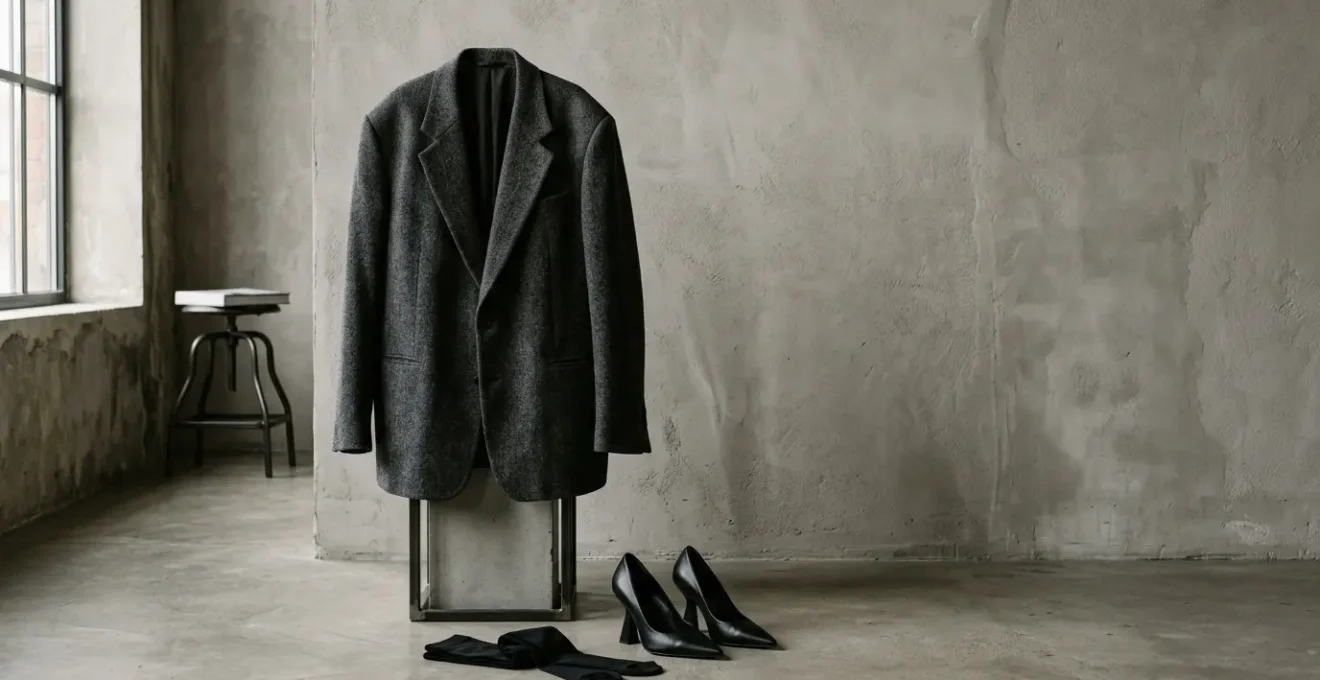
In summary:
- Extreme runway trends are not meant to be copied literally, but translated using a core formula of proportion, structure, and context.
- Mastering a bold look like the « no-pants » trend depends on its « structural integrity »—the right underpinnings, fabric weight, and layering.
- Every « unwearable » item, from extreme shoulder pads to sheer skirts, can be made wearable by balancing its silhouette with classic, neutral pieces.
- The purpose of outrageous runway fashion is to act as a creative thesis that inspires the more commercial, wearable collections that arrive in stores.
You see it on the runway or splashed across your social media feed: a model strides confidently in a look that feels more like a piece of installation art than an outfit. The « no-pants » trend, with its oversized blazers and high-fashion briefs, is a perfect example. The immediate reaction is a mix of awe and disbelief, followed by a crucial question for any daring fashionista: « Could I ever actually wear that in the real world? » The common advice is often simplistic and unhelpful, boiling down to « just wear it with a big sweater » or « it’s all about confidence. »
While confidence is key, it’s a result, not a starting point. True confidence in a bold outfit comes from knowing it is structurally sound and contextually appropriate. These dramatic trends, from extreme shoulder pads and transparent skirts to 15cm platform heels, are not just random provocations. They are exercises in proportion, texture, and silhouette. The secret to translating catwalk drama into wearable reality isn’t about blindly copying a look; it’s about understanding the architectural principles behind it.
But if the true key isn’t just bravery, but a strategic formula? This guide moves beyond generic tips to provide a practical framework for deconstructing these « unwearable » trends. We will break down the engineering of a bold look, focusing on the concepts of structural integrity, proportion play, and contextual adaptation. By the end, you won’t just know *how* to wear the no-pants trend; you’ll have a repeatable method for making any audacious fashion statement feel intentional, powerful, and uniquely yours.
This article explores the core principles behind making the unwearable wearable. We’ll dissect several of this season’s most challenging trends and provide a clear formula for integrating them into your wardrobe.
Table of Contents: A Practical Guide to Unwearable Fashion
- Runway to Sidewalk: How to Tame the Extreme Shoulder Pad Trend?
- Transparent Skirts: What to Wear Underneath for Modesty?
- Platform Heels: How to Walk in 15cm Heels Without Twisting an Ankle?
- Color Blocking: How to Pair Neons Without Looking Like a Traffic Cone?
- The Belt Hack: How Runway Stylists Cinched Every Blazer This Season?
- Oversized and Distorted: Why Designers Are Hiding the Human Body?
- Polka Dots and Stripes: The Secret Rule to Mixing Prints Successfully
- Why Do Runway Models Wear Clothes That Look « Unwearable »?
Runway to Sidewalk: How to Tame the Extreme Shoulder Pad Trend?
The return of the extreme shoulder pad is a masterclass in silhouette manipulation. On the runway, it’s a powerful, almost aggressive statement. In real life, the key to taming this trend is not to diminish it, but to balance its architectural volume. Think of your outfit as a sculpture; if the top half is broad and commanding, the bottom half must be sleek and defined to create a harmonious form. Avoid pairing a power-shoulder blazer with wide-leg trousers or a full skirt, which can create a boxy, overwhelming effect.
Instead, opt for sharp contrast. A blazer with formidable shoulder pads works best with slim-fit trousers, a simple pencil skirt, or even over a slip dress. This contrast ensures the shoulder remains the undisputed focal point of the outfit without consuming your entire frame. The goal is to command attention with the silhouette, not to be lost within it. The choice of fabric also plays a vital role in its real-world application.
A heavily structured shoulder pad requires a certain level of textile engineering to sit correctly and maintain its shape. The illustration below shows the intricate layering and construction that go into creating this powerful design element.
As you can see, the pad is not just a piece of foam; it’s a carefully built component. When shopping for this trend, look for jackets where the shoulder construction feels deliberate and integrated, not like a flimsy afterthought. A well-made shoulder pad will feel like an extension of the garment’s tailoring, providing a clean, sharp line from the collar to the arm. This structural integrity is what separates a high-fashion statement from a dated costume piece.
Transparent Skirts: What to Wear Underneath for Modesty?
The sheer skirt trend presents a direct challenge: how to embrace transparency without sacrificing modesty or sophistication. The solution lies in a concept we can call « intentional layering. » This isn’t about hiding; it’s about making a deliberate choice about what is seen and how it is framed. The underpinnings are not an afterthought but a central component of the look itself. A poorly chosen undergarment can make the outfit feel accidental or unfinished, while the right one transforms it into a confident, fashion-forward statement.
The most common and safest option is a pair of high-waisted briefs in a neutral or matching tone. This creates a clean, retro-inspired silhouette that feels both modern and secure. For more coverage, a tonal bodysuit offers a seamless line from top to bottom. However, for the truly bold, playing with contrast is where the trend gets interesting. Pairing a delicate black lace skirt with crisp, opaque white boy-shorts or cycling shorts creates a graphic, high-impact look. As stylist Neelo Noory advises, the options are broader than you think.
I think Miu Miu has opened the door to not just do skimpy underwear or black lingerie under a sheer skirt. Go for white. Go for old school high rise à la Jockey. Or a bikini hipster vibe circa ’90s.
– Neelo Noory, Stylist interview on sheer skirt styling for The Zoe Report
The choice of undergarment ultimately depends on the skirt’s material and the occasion. A delicate organza requires a different approach than a sporty mesh fabric. The following matrix breaks down the ideal pairings to ensure your look is always intentional.
| Skirt Type | Ideal Undergarment | Best Occasion | Coverage Level |
|---|---|---|---|
| Sheer Organza Maxi | Nude seamless slip or high-waist briefs | Evening events, red carpet | Medium to Full |
| Lace Pencil Skirt | Tonal bodysuit or matching slip | Business meetings, formal dinners | Full coverage |
| Chiffon Midi | Bike shorts or slip dress underneath | Daytime casual, brunch | Medium |
| Mesh Mini | High-waisted briefs or cycling shorts | Night out, fashion-forward events | Strategic coverage |
| Tulle Maxi | Contrast bodysuit or white high-rise brief | Weddings, garden parties | Intentional reveal |
Platform Heels: How to Walk in 15cm Heels Without Twisting an Ankle?
Platform heels, with their towering height, are a testament to fashion’s love affair with drama. With a reported 75% increase in searches for platform heels in recent years, their popularity is undeniable. However, wearing them requires more than just courage; it demands a specific technique and preparation. The physics are simple: the reduced angle between your foot and the ground (thanks to the platform at the front) makes them surprisingly more comfortable than a traditional stiletto of the same height. But walking in them is a different skill altogether.
The key is to adjust your gait. Instead of walking toe-first, you must walk with a more pronounced heel-to-toe motion. Place your heel down first, then roll through your foot to the toe. This creates a more stable base and prevents the « clomping » sound often associated with heavy footwear. Take shorter steps than you normally would, and engage your core to maintain balance. Think of it as a controlled, deliberate strut rather than a hurried walk. Practicing on a safe, even surface at home is essential before venturing out.
Beyond technique, physical preparation is crucial for avoiding pain and injury. Podiatrists recommend a pre-wear routine to increase flexibility and reduce pressure on the ball of the foot. Here are some expert-approved steps:
- Calf Stretch: Stand facing a wall, place one foot against it with your heel down, and gently move your knee toward the wall. Hold for 30 seconds and repeat.
- Toe Flexibility: Consciously straighten and wiggle your toes to prepare the muscles for the confined space of the shoe.
- Strategic Taping: Tape your third and fourth toes together with medical tape. This alleviates pressure on a key nerve that often causes a burning sensation.
- Metatarsal Pad Insertion: Place gel insoles or cushioning pads at the ball of your foot to provide shock absorption.
- Post-Wear Recovery: Soak your feet in warm water with Epsom salts and perform stretches to relieve soreness.
Finally, be mindful of your environment. Navigating different surfaces, from smooth concrete to treacherous cobblestones, requires constant awareness. As the image below suggests, the interaction between the shoe and the ground is a critical part of the experience.
Color Blocking: How to Pair Neons Without Looking Like a Traffic Cone?
Neon is an inherently joyful and attention-grabbing color family, but its intensity can be intimidating. The fear of looking like a highlighter is real, yet neon color blocking continues to be a major force in fashion, with a strong presence at events like New York Fashion Week. The secret to wearing it successfully lies in a simple but powerful formula: the 80/20 rule. This principle dictates that your outfit should be composed of 80% neutral tones, with only 20% dedicated to a powerful neon accent.
This « anchor and pop » strategy grounds the look and makes the neon feel intentional rather than overwhelming. The neutrals—black, white, gray, navy, beige—act as a sophisticated canvas that allows the single neon piece to shine. You could pair a neon green sweater with classic black trousers, or wear a head-to-toe white outfit with a shocking pink handbag and matching shoes. The key is to choose one single neon focus. Mixing multiple neons is an advanced technique best left for the runway; for daily wear, one is more than enough to make a statement.
Texture also plays a significant role in moderating neon’s impact. A neon knit sweater feels more approachable and soft when paired with denim, while a neon satin blouse paired with leather creates a high-fashion, edgier vibe. For those hesitant to commit to a full garment, starting with accessories is the perfect entry point. A neon belt, a pair of earrings, or bold shoes can provide that 20% pop of color against an all-neutral base, allowing you to test your comfort level.
The Belt Hack: How Runway Stylists Cinched Every Blazer This Season?
The oversized blazer has been a wardrobe staple for years, but this season, stylists have given it a crucial update with one simple tool: the belt. This « belt hack » is more than just an accessory choice; it’s a strategic move to reclaim the waist and introduce sculptural definition to an otherwise boxy silhouette. It masterfully bridges the gap between masculine-inspired tailoring and feminine form, creating a look that is both powerful and polished. The magic of this technique lies in its ability to completely transform the garment’s shape without any permanent alteration.
The placement of the belt is critical. For the most flattering effect, it should be cinched at your natural waist—the narrowest part of your torso—rather than at the blazer’s button stance or low on your hips. This placement creates an hourglass shape, even with the most oversized of blazers, and highlights your body’s proportions underneath the voluminous fabric. The type of belt matters, too. A thick leather belt creates a bold, structural statement, while a thinner, more delicate belt offers a subtler sense of definition. You can even use a contrasting color or texture to make the belt a focal point.
This technique works on single-breasted, double-breasted, and even unbuttoned blazers. For an unbuttoned style, simply cinch the belt over the open jacket to pull the fabric in at the waist, creating elegant draping at the front. This hack is the ultimate proof that an outfit’s entire message can be changed with a single, well-placed line. The Vivienne Westwood Spring 2024 collection provides a perfect real-world example of this principle in action.
Case Study: Vivienne Westwood Spring 2024
An analysis of Vivienne Westwood’s Spring 2024 collection shows the perfect application of belt cinching on oversized shoulder blazers. The collection featured two-piece suit sets where jackets were paired with skirts and secured with coordinating belts at the natural waist. According to a review in Glam magazine, this created an office-approved silhouette with high-fashion impact, proving that the belt transforms the blazer from boxy to sculptural while maintaining the power shoulder statement. The technique was consistently applied at the natural waist, reinforcing its importance in creating a defined shape.
Oversized and Distorted: Why Designers Are Hiding the Human Body?
The trend of oversized, distorted, and body-obscuring silhouettes can seem counterintuitive in a world often focused on form-fitting styles. From massive, floor-sweeping coats to voluminous trousers that pool at the ankle, these designs challenge traditional notions of flattery. However, to see this trend as simply « hiding » the body is to miss its deeper philosophical point. Rather than concealing, these garments are about creating a new kind of space—a personal architecture that prioritizes comfort, power, and a rejection of the male gaze.
By moving away from clothes that cling to and define every curve, designers are proposing a different relationship between the body and what covers it. This approach gives the wearer control over what they reveal. The body isn’t erased; it’s given a private domain. The focus shifts from the body *as* the silhouette to the body *inhabiting* a silhouette. This can be incredibly empowering, offering a sense of protection and freedom. It’s a statement of self-possession, where the wearer’s comfort and confidence take precedence over conforming to external expectations of shape.
This movement is closely linked to a broader cultural shift towards individualism and authenticity. It’s a form of power dressing for the modern era, where power is defined not by accentuating a feminine form for others, but by creating a strong, self-determined presence. As British Vogue’s fashion features director Julia Hobbs notes, this is about owning one’s space and identity.
people wanting to be themselves in how they dress… I think it does lean into this attitude of ‘take me as I am’ and feeling great in their own skin and owning it.
– Julia Hobbs, discussing body-positive trends on BBC’s Woman’s Hour
Ultimately, these oversized garments are not about hiding. They are about creating a new canvas. The wearer, their personality, and their attitude become the focal point, framed by the dramatic lines of the clothing. It is a quiet rebellion that reclaims the body as a private entity, choosing when and how it is seen. The clothes become a protective shell, allowing the person inside to move through the world with a unique blend of comfort and authority.
Polka Dots and Stripes: The Secret Rule to Mixing Prints Successfully
Mixing prints, especially classic patterns like polka dots and stripes, can feel like a high-wire act in fashion. Done right, it looks effortlessly chic and intentional. Done wrong, it can feel chaotic and jarring. The secret to success isn’t random luck; it’s a set of underlying principles that create visual harmony. The most important rule is to establish a common color anchor. No matter how different the patterns are, if they share at least one or two of the same colors, your brain will automatically register them as belonging together. For example, classic navy-and-white Breton stripes pair beautifully with navy-and-white polka dots.
The second crucial principle is to vary the scale of the prints. Combining two prints of the same size will often cause them to compete for attention, creating a dizzying effect. The most successful pairings involve one dominant, large-scale print and one smaller, more subtle print. For instance, you could pair a blouse with wide, bold stripes with a skirt featuring tiny, delicate polka dots. The larger print becomes the statement, while the smaller one acts as a texture. This creates a clear visual hierarchy and allows the eye to rest.
Finally, consider the 60/30/10 rule, a concept borrowed from interior design. In your outfit, 60% should be your dominant print (e.g., a striped dress), 30% should be your secondary print (e.g., a polka-dot scarf), and 10% should be an accent color or a solid piece that ties it all together (e.g., a solid-colored belt or shoes). This formula provides a structured approach to ensure your mixed-print look feels balanced and deliberate, rather than accidental. By following these rules, you can move from a place of uncertainty to one of creative confidence, turning what seems like a clash into a sophisticated combination.
Key takeaways
- Translate, Don’t Copy: The purpose of runway fashion is to provide a creative concept. Your job is to translate that concept using a formula of proportion, structure, and context.
- Prioritize Structural Integrity: A bold look’s success depends on its foundation. The right underpinnings, fabric weight, and tailoring are what provide the confidence to wear it.
- Master Proportion Play: Every extreme garment can be balanced. Pair voluminous pieces with sleek ones, anchor bright neons with neutrals, and use belts to create shape.
Why Do Runway Models Wear Clothes That Look « Unwearable »?
Runway fashion often operates in the realm of the fantastical. Garments can seem absurdly impractical, wildly oversized, or shockingly revealing, leaving many to wonder about their purpose. The truth is, these « unwearable » clothes are not meant for the weekly grocery run. They function as the creative thesis statement for a designer’s entire collection. They are pure, undiluted artistic expression, designed to communicate a mood, a concept, or a new silhouette in its most extreme form. This spectacle generates buzz, defines the brand’s creative direction for the season, and sets the stage for the more commercial pieces that will follow.
This is the « trickle-down » effect in action. The most provocative runway look serves as the inspiration for the wearable, profitable versions that eventually land in stores. A designer might show a completely sheer dress on the runway, which then inspires a collection of blouses with sheer sleeves, or dresses with sheer paneling. The extreme idea is the genesis, and the commercial collection is its practical evolution. The Miu Miu Fall 2023 collection is a perfect case study of this journey from runway shock to street-style staple.
Case Study: Miu Miu’s « No-Pants » Trickle-Down
Miu Miu’s Fall 2023 collection featured models in high-fashion briefs paired with layered cardigans and peacoats. As documented by Fashion Times, this extreme « no-pants » look quickly translated from the runway to reality. Celebrities adopted the look for red carpets, and by 2024, the brand’s nearly $6,000 bedazzled underwear became a coveted item, solidifying the no-pants aesthetic as a mainstream trend. This demonstrates how a provocative runway concept can serve as the « thesis statement » that informs a commercially successful, wearable trend.
So, how does a daring fashionista translate a concept like the « no-pants » trend? By focusing on its structural integrity. It’s not about being literally pantless; it’s a game of extreme proportion. As culture journalist Christina Binkley notes, the reveal is often no more than swimwear. The key is in the execution, ensuring the look feels secure and intentional.
Your Action Plan: The ‘No-Pants’ Pre-Wear Security Checklist
- The ‘Sit, Bend & Wind’ Test: Before leaving home, perform all three movements in front of a full-length mirror to ensure nothing unexpected is revealed from any angle.
- Choose Secure Underpinnings: Opt for high-waisted briefs, bike shorts, or bodysuits in substantial fabrics that provide full coverage and stay firmly in place.
- Master the Posture: Own the look by standing tall with your shoulders back and core engaged. Good posture is a critical component of the outfit’s structural integrity.
- Select Structured Materials: Pair your minimal bottoms with heavy wool blazers, leather jackets, or thick cotton shirts that provide definitive coverage and a strong silhouette.
- Follow the Graduation System: Start with Level 1 (a long shirt or short dress over micro-shorts) before progressing to more daring interpretations of the trend.
Now that you have the formula for deconstructing any runway trend, the next logical step is to choose one—whether it’s power shoulders, sheer fabrics, or the infamous « no-pants » look—and begin applying these principles to make it your own.