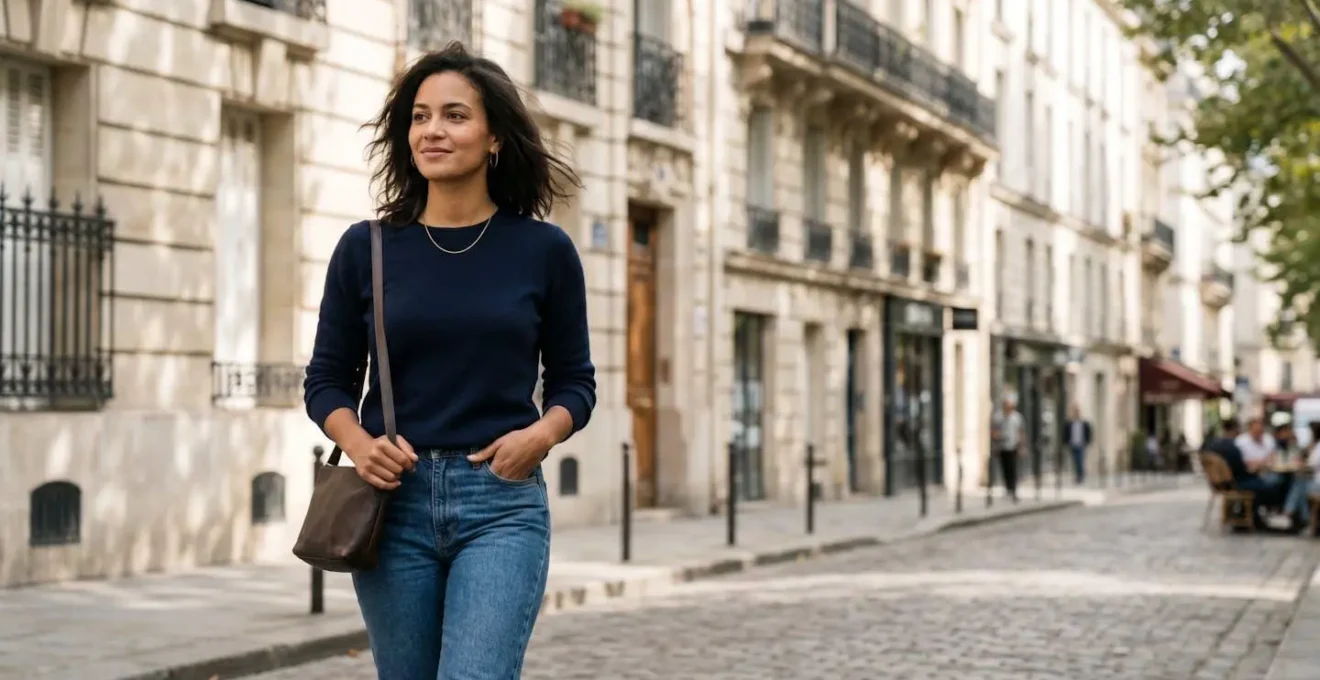
The secret to French style isn’t in buying the right clothes; it’s in adopting an attitude of « intentional imperfection » that values confidence over conformity.
- True Parisian chic comes from mastering how to look slightly « undone, » not perfectly polished.
- It’s a philosophy of mixing high with low, investing in quality over logos, and telling a story with your style.
Recommendation: Stop trying to copy outfits and start cultivating a mindset where your confidence—not a brand—is your most valuable accessory.
You’ve followed all the rules. You bought the trench coat, the striped marinière, the perfect-fit jeans. You even have the red lipstick. Yet, when you look in the mirror, you don’t see a chic Parisienne; you see someone in a costume. This feeling of « trying too hard » is the most common frustration for women aiming for that elusive French « je ne sais quoi. » It’s a sign that you’ve been focusing on the « what » instead of the « how » and, more importantly, the « why. »
Most style guides will give you a shopping list. They’ll tell you to invest in timeless basics and luxury accessories, creating a uniform that, while classic, can feel rigid and soulless. They miss the fundamental point. French style is not a formula to be replicated; it’s an attitude to be embodied. It’s less about having a Chanel bag and more about having the confidence to pair Zara jeans with Chanel heels, or better yet, with a pair of well-loved loafers.
But what if the key wasn’t in adding more to your wardrobe, but in subtracting the need for perfection? This guide is your personal French style coach, here to debunk the myths. We will explore the philosophy behind the choices, from achieving perfectly imperfect « bedhead » hair to understanding why visible logos are the antithesis of chic. Forget the shopping list. We are going to decode the mindset that makes French style truly effortless, focusing on the art of intentional imperfection, personal narrative, and unwavering self-assurance. It’s time to stop dressing like a French woman and start thinking like one.
To help you master this new approach, this article is structured around the core elements of the Parisian look, breaking down not just the item, but the philosophy behind it. From hair and outerwear to accessories, you will learn the secrets that truly make a difference.
Summary: The real codes behind the French « je ne sais quoi »
- Bedhead Hair: How to Achieve That « Undone » Look Without Looking Unkempt?
- The Trench Coat: How to Style It Without Looking Like Inspector Gadget?
- Zara Jeans with Chanel Heels: How to Mix Price Points Like a Parisian?
- Why True Parisian Style Avoids Visible Logos at All Costs?
- Sneakers or Loafers: Which Flat Shoe is Acceptable for a Business Meeting?
- Chunky Necklaces or Chandelier Earrings: Which One Suits a Turtleneck?
- The Silk Turban: How to Cover Bad Hair Days Chicly?
- 5 Ways to Tie a Silk Scarf That Upgrade a White T-Shirt Instantly
Bedhead Hair: How to Achieve That « Undone » Look Without Looking Unkempt?
The first myth to debunk is that « effortless » French hair requires no effort. The perfectly undone, day-two texture that looks like you just rolled out of bed is, in fact, the result of a deliberate, calculated routine. The goal is not messiness but intentional imperfection. It’s about creating a look that whispers « I have better things to do than spend an hour on my hair, » even if you’ve spent time preparing it the night before. This aesthetic is rooted in a deep-seated preference for health over styling, a foundation of the entire French beauty philosophy.
This focus on fundamentals is not just a feeling; it’s a market reality. Research shows that over 70% of French consumers prioritize hair care products that promote scalp health and hair vitality over temporary styling fixes. The shine and movement of French hair come from a healthy foundation, not from layers of product. Heat styling is used sparingly. Instead, the focus is on quality shampoos, regular treatments, and techniques that work *with* the hair’s natural texture, not against it. This is the real secret: the « undone » look only works if the hair itself is fundamentally healthy and cared for.
As you can see, the result is hair that has movement, texture, and a natural shine. It doesn’t look overly styled or « done. » It’s achieved by encouraging natural waves and texture, often through overnight methods like braiding damp hair. The morning routine is minimal: a shake of the head, some finger-combing, and perhaps a touch of dry shampoo for volume. It is the mastery of this controlled nonchalance that separates chic « bedhead » from a genuinely unkempt look. It is a style that is lived-in, not manufactured.
Ultimately, achieving this look is less about the specific products you use and more about embracing a routine that creates a natural, touchable texture that looks and feels healthy.
The Trench Coat: How to Style It Without Looking Like Inspector Gadget?
The trench coat is a Parisian cliché for a reason: it’s practical, timeless, and endlessly versatile. However, owning one is not enough. The difference between looking like a chic Parisienne and a cartoon detective lies entirely in the *how*. The French approach treats the trench not as a formal piece of outerwear but as a casual, almost-unthinking layer. It’s about removing the stiffness and formality, making it part of your personal style narrative rather than a uniform.
A key part of this is understanding proportion. A trench that is too long or too short can overwhelm your frame. It’s about finding a length that complements your body and your other clothes, not just blindly following a trend. While rules are made to be broken, understanding the fundamentals of proportion gives you the confidence to do so effectively, as detailed in a guide to trench coat proportions.
| Trench Length | Proportion (% of Height) | Best For | Styling Principle |
|---|---|---|---|
| Short (Hip-length) | 25-30% | Petite frames, casual styling | Pair with high-waisted bottoms to elongate legs; avoid heavy hems |
| Mid-length (Knee) | 45-55% | Most versatile; average height, curvy figures | Define waist with belt; creates balance between upper and lower body |
| Cropped (Above knee) | 35-40% | Modern proportions, highlighting curves | Simplifies hem-matching with skirts/dresses; creates focal point at waist |
| Long (Mid-calf) | 60-70% | Tall frames, dramatic looks | Pair with heels or platform shoes; works well with wide-leg pants for volume balance |
Case Study: The Rise of Second-Hand Luxury Trenches
The preference for a « lived-in » look is confirmed by market trends. A comprehensive study on the second-hand luxury market highlights that vintage trench coats are highly sought-after investment pieces. The research, which notes the pre-loved clothing trade provides livelihoods for over 100,000 people, emphasizes that the appeal lies in their soft, worn-in texture and patina. These qualities, found in a vintage piece, contribute more to the « je ne sais quoi » than a brand new designer model, creating an authentic visual story that new garments cannot replicate. This validates the idea that style is about narrative and character, not newness.
Your Action Plan: The Nonchalant Trench Belt Knot
- Assess your approach: Stop using the buckle. It’s the number one sign of a formal, non-Parisian style.
- Collect your materials: Simply take the two ends of the belt.
- Check for coherence: Cross the belt loosely at your natural waist, ensuring it doesn’t pull the fabric tightly or sit too low.
- Evaluate the aesthetic: Tie a single, simple knot. The ends should hang asymmetrically. The goal is nonchalance, not perfect symmetry.
- Integrate the look: If wearing the coat open, tie the belt in a loose knot at the back to keep it neat without cinching the waist.
By treating your trench less like a precious item and more like a trusted old friend, you transform it from a stiff uniform into an extension of your personal style.
Zara Jeans with Chanel Heels: How to Mix Price Points Like a Parisian?
The concept of « high-low » dressing is fundamental to modern French style, yet it is widely misunderstood. It is not about randomly throwing expensive and cheap items together. It is a deliberate and strategic act of high-low dissonance. It’s a statement that says, « My style is not defined by price tags. I appreciate quality where it matters, but I am not a slave to brands. » Pairing accessible Zara jeans with iconic Chanel heels is the ultimate power move in this regard.
Why does this combination work so well? First, it grounds the luxury item. The Chanel heels, when worn with a couture gown, can look formal and distant. When paired with simple, well-fitting denim, they become instantly cooler, more modern, and more approachable. The jeans act as a canvas that makes the luxury shoe the focal point without the outfit feeling ostentatious. It’s a sartorial wink that communicates confidence and a playful disregard for outdated style rules.
Second, this mix demonstrates a sophisticated understanding of value. The Parisian philosophy is to invest in items that hold their value and have a long lifespan: a great coat, a timeless handbag, and beautifully crafted shoes. These are the « high » elements. For trendier or basic items like a simple t-shirt or a pair of jeans, a « low » option from a high-street brand is perfectly acceptable, provided the fit and quality are decent. This pragmatic approach frees up your budget for the pieces that truly elevate your wardrobe for years to come.
Ultimately, mastering the high-low mix is about asserting your own taste. It shows that you are the one in control, choosing pieces for their intrinsic style and quality, not because of the logo or price attached to them.
Why True Parisian Style Avoids Visible Logos at All Costs?
Walk the streets of Le Marais or Saint-Germain-des-Prés in Paris, and you will notice something striking: a near-total absence of visible brand logos. This is not an accident; it is a core tenet of the French style philosophy. In a culture that values discretion and individuality, overt branding is often seen as « nouveau riche » or, worse, a sign of insecurity. The underlying message of a logo-heavy outfit is, « I need this brand to validate my status. » The message of a logo-free outfit is, « I validate myself. »
The « je ne sais quoi » is built on an foundation of quiet confidence. It’s the idea that your presence, your personality, and your attitude are what make the outfit, not the other way around. Your confidence is the main accessory. A garment should highlight you, not the brand that made it. This is why Parisians gravitate towards pieces known for their cut, fabric, and silhouette rather than their branding. They are buying the design, not the marketing.
This aversion to logos also ties back to the appreciation for a personal style narrative. A vintage, unbranded leather bag that has developed a beautiful patina over years of use tells a far more interesting story than a brand-new « it-bag » covered in monograms. The former speaks of a life lived, of personal history and taste. The latter speaks only of a recent purchase. True chic is about curating a collection of pieces that feel uniquely yours, creating a style that couldn’t be bought off a mannequin.
By choosing anonymity over advertisement, you shift the focus back to where it belongs: on your own personal style and the confident way you carry yourself.
Sneakers or Loafers: Which Flat Shoe is Acceptable for a Business Meeting?
The old rules of office attire are fading, but the question of appropriate footwear in a professional setting remains tricky. For the Parisian woman, the choice between sneakers and loafers for a business meeting isn’t about a rigid « yes » or « no » to a shoe category. It’s entirely about context, quality, and execution. The « anti-try-hard » aesthetic applies here: the goal is to look polished and serious without appearing stuffy or uncomfortable.
A sleek, minimalist leather sneaker can absolutely be appropriate. Think of a clean, white or black sneaker from a brand like Veja or Common Projects. When paired with tailored trousers and a sharp blazer, the look is modern, dynamic, and confident. The key is that the sneakers must be immaculate—no scuffs, no dirt. They are not your gym shoes; they are a deliberate style choice. This look signals that you are forward-thinking and value both style and comfort.
On the other hand, a classic leather loafer is almost always a safe and chic bet. A well-made loafer, perhaps with a subtle horse-bit detail, instantly conveys a sense of timeless elegance and intellectualism. It pairs beautifully with everything from wide-leg trousers to a simple dress. The loafer projects an aura of quiet competence. The choice between the two often comes down to the specific industry and office culture. A creative agency will be more welcoming of a sneaker, while a traditional law firm might be better suited to a loafer.
Ultimately, whether you choose sneakers or loafers, the deciding factor is the quality of the shoe and the confidence with which you integrate it into a polished, professional outfit. Both can be right; the secret is in the thoughtful execution.
Chunky Necklaces or Chandelier Earrings: Which One Suits a Turtleneck?
The turtleneck is a quintessential piece of the Parisian wardrobe, offering a sleek, sophisticated canvas. However, accessorizing it can be a challenge. The question of whether to pair it with a chunky necklace or chandelier earrings gets to the very heart of a key French style principle: the power of a single focal point. The « less is more » philosophy dictates that an outfit should have one hero piece, one element that draws the eye. Trying to have two creates visual noise and undermines the effortless aesthetic.
When you wear a turtleneck, the high neckline already frames your face. Adding large, dramatic chandelier earrings works beautifully with this. The earrings have space to shine, drawing attention upward and elongating the neck. They become the singular statement of the outfit. The combination is elegant, bold, and balanced. There is no competition for attention; the earrings are the undisputed star.
Conversely, wearing a chunky necklace over a turtleneck is often a mistake. The necklace fights with the neckline of the sweater, creating a cluttered, constricted look. It visually shortens the neck and disrupts the clean lines of the turtleneck. Instead of creating a focal point, it creates confusion. If you wish to wear a statement necklace, it is best paired with an open neckline, such as a crewneck sweater, a V-neck, or an unbuttoned silk shirt, where it has the space to become the intended focal point.
So, for a turtleneck, the answer is clear: choose the chandelier earrings. Let them be your statement and keep the rest of your accessories minimal to maintain that chic, edited, and confident Parisian look.
The Silk Turban: How to Cover Bad Hair Days Chicly?
Every woman has bad hair days, but the French approach is not to hide under a generic baseball cap. Instead, it’s an opportunity to turn a problem into a style statement. This is where an accessory like a silk turban or a beautifully tied headscarf comes into play. It’s the perfect embodiment of the Parisian mindset: using elegance and a touch of drama to solve a practical problem. It’s not about hiding; it’s about transforming with confidence.
The silk turban is not just a hair covering; it’s a powerful accessory that instantly elevates a simple outfit. Paired with a plain white t-shirt, a trench coat, and a pair of sunglasses, it creates a look that is mysterious, glamorous, and utterly chic. It signals a woman who is in control of her image and has a flair for the dramatic. It says, « This wasn’t an accident; this was a choice. » This is a far more powerful message than one of simply trying to conceal messy hair.
The key to pulling it off is to keep the rest of the look simple. The turban is the focal point. Your makeup should be clean—perhaps a bold lip to balance the look—and your jewelry should be minimal. The fabric of the turban is also important. A pure silk or a rich velvet will look luxurious and intentional, whereas a simple cotton might look more like a last resort. The art is in choosing a turban or scarf that looks like a precious accessory in its own right.
Instead of letting a bad hair day defeat you, see it as a chance to channel your inner 1960s film star. It’s a chic, elegant solution that is the very definition of making a virtue out of a necessity.
Key Takeaways
- True « je ne sais quoi » is an attitude of self-confidence, not a collection of expensive items.
- Master the art of « intentional imperfection »—looking chicly undone is a deliberate skill.
- Your confidence is your most important accessory; wear it daily and avoid anything that screams « I need validation, » like visible logos.
5 Ways to Tie a Silk Scarf That Upgrade a White T-Shirt Instantly
We’ve discussed philosophy and mindset, but the final step is putting it into practice. The silk scarf is perhaps the most quintessentially French accessory because it perfectly encapsulates the entire philosophy: it’s a simple, versatile piece that can completely transform a basic outfit through personal, creative styling. A plain white t-shirt and jeans can go from simple to exceptionally chic with the right knot. It is the ultimate tool for injecting your personality and a touch of color into a neutral wardrobe. Here are five classic ways to tie it.
- The Classic Neck Knot: Fold the scarf into a triangle, then roll it into a thin band. Wrap it once around your neck and tie a small, neat double knot to the side. Let the short ends peek out. This look is timeless, polished, and adds a small, sharp point of interest right at the collarbone.
- The Bandit: Fold the scarf into a triangle and place the point facing down on your chest. Wrap the ends around the back of your neck and bring them forward, tying a small knot just under your chin or leaving them to hang. It’s a slightly more casual, bohemian take.
- The Wrist Tie: Roll the scarf into a thin band and wrap it snugly around your wrist several times, tying a neat knot. It acts as a soft, colorful bracelet and is an unexpected way to add flair, especially when your sleeves are rolled up.
- The Hair Tie: Use a rolled scarf to tie back a low ponytail or bun. Let the ends hang long down your back. This adds a touch of romance and movement to your hairstyle and is a chic alternative to a plain elastic band.
- The Handbag Adornment: Simply tie the scarf around the handle of your handbag. This is the easiest way to add a pop of color and personality to your look without wearing it on your body. It instantly customizes your bag and ties your whole color palette together.
Start today by choosing one of these ties and practice it. See how a single, thoughtful accessory can change the entire feel of your simplest outfit. This is the first practical step to moving beyond the « costume » and into the realm of truly personal, effortless style.